
Customise
Your art print
Annunciation OF Leonardo da Vinci
Annunciation
Leonardo da Vinci's *The Annunciation*: the dawn of the Renaissance
The Annunciation, carefully preserved at the Uffizi Gallery in Florence, is an iconic work that captures the essence of the burgeoning genius of Leonardo da Vinci. This oil and tempera painting on a large poplar wood panel, measuring 98 centimetres high by 217 centimetres wide, is far more than a simple biblical depiction; it is a window onto the intellectual and artistic effervescence of the Italian Renaissance.
The Annunciation by Leonardo da Vinci: between tradition and innovation
Painted between 1472 and 1475, The Annunciation is one of the first major works attributed to the young Leonardo da Vinci, whilst he was completing his training in the bustling workshop of Andrea del Verrocchio in Florence. At that time, Florence was the cradle of the Renaissance, a hub where artists, thinkers and patrons were redefining aesthetic and intellectual standards, drawing inspiration from classical antiquity whilst paving the way for new explorations. The painting was originally commissioned for the church of San Bartolomeo at the territorial abbey of Santa Maria di Monte Oliveto Maggiore, near Florence, reflecting the importance of religious commissions in the careers of artists of the time. Although Leonardo was still under the influence of his master, one can already perceive in this work the beginnings of his scientific approach to painting, his keen sense of observation and his quest for realism. The theological context is also significant, as the theme of the Annunciation was a subject of popular devotion, widely commented upon, notably in the homilies of Saint Bernard of Clairvaux, which may have influenced the way in which Leonardo sought to visually convey the mystery of the Incarnation. It is in this fertile ground of artistic renewal and religious fervour that The Annunciation takes root, marking a crucial stage in the young artist’s journey towards creative autonomy.
Harmony and perspective in The Annunciation by Leonardo da Vinci
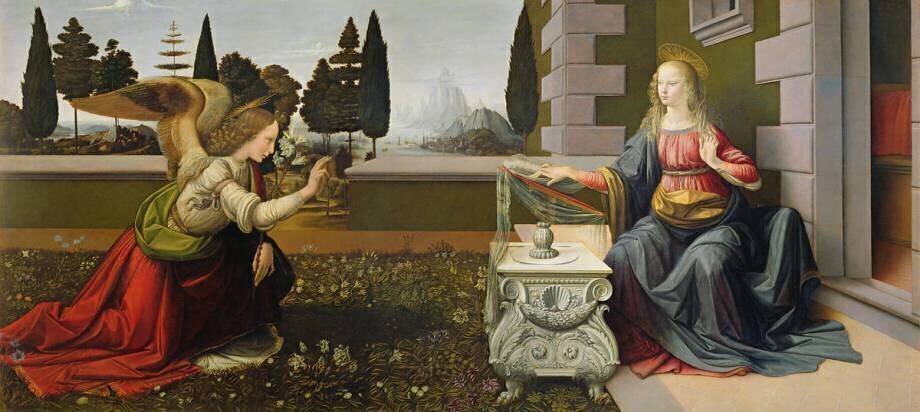
At first glance, The Annunciation captivates with its balanced composition and the serenity it exudes. The scene unfolds within a hortus conclusus, a lush enclosed garden that opens onto a distant landscape bathed in soft, atmospheric light. Leonardo structures the space with a nascent yet already impressive mastery of linear perspective, guiding the viewer’s gaze from the foreground, where the sacred interaction takes place, towards the mountains that merge with the sky on the horizon. This technique is characteristic of da Vinci’s style and demonstrates his early interest in rendering atmospheric effects and the way in which light and air alter the perception of colours and forms with distance. The architecture of the portico, the slender cypress trees and the variety of meticulously depicted floral species bear witness to the artist’s scrupulous attention to natural detail. Light plays a pivotal role, delicately shaping forms and drapery, creating a subtle interplay of light and shadow that already foreshadows Leonardo’s famous sfumato technique. The whole exudes a peaceful harmony, inviting contemplation and immersion in this moment suspended between the divine and the human.
The sacred dialogue at the heart of The Annunciation by Leonardo da Vinci
At the heart of the composition lies the encounter between the Archangel Gabriel and the Virgin Mary. The angel, kneeling on a bed of flowers, is depicted in profile, his majestic wings still spread as if he had just landed. His right hand offers a blessing whilst his left holds a white lily, the traditional symbol of Mary’s purity. His face expresses a respectful gentleness as he delivers the divine message. Facing him, the Virgin, seated before a richly carved lectern, is caught in the act of reading. Her demeanour is imbued with a pensive grace; her left hand traces a complex gesture, which may express at once astonishment, acceptance and a form of inner questioning in the face of the extraordinary announcement. Leonardo excels at conveying the subtlety of emotions and the psychology of the characters. Mary’s gaze, directed towards the angel yet seemingly turned inwards as well, suggests the depth of her reflection. The drapery of the garments, ample and with skilfully studied folds, lends the figures a sculptural presence and emphasises their volume. The interaction between the two protagonists is at the heart of the narrative, capturing with remarkable finesse this precise, meaning-laden moment when Mary’s destiny—and by extension that of humanity—is turned on its head.
The secret language of symbols in The Annunciation by Leonardo da Vinci
The Annunciation is replete with symbolic elements that enrich the interpretation of the work and anchor the scene in a centuries-old Christian iconographic tradition, whilst bearing the mark of Leonardo’s personal interpretation. The enclosed garden, or hortus conclusus, in which the scene takes place, is a well-established medieval metaphor for the virginity of Mary. The lily held by the archangel Gabriel reinforces this idea of immaculate purity. The open book on the lectern before Mary symbolises her piety and her knowledge of the Scriptures, particularly Isaiah’s prophecy concerning the virgin birth. The lectern itself, inspired by the sarcophagus of Pietro and Giovanni de’ Medici sculpted by Verrocchio, is a tribute to the art of its time but has also been interpreted by some as an ambivalent object, “half cradle, half sarcophagus”, foreshadowing both the birth and the Passion of Christ. The cypress trees, often associated with death and eternity, could also allude to the coming sacrifice. Even the landscape in the background, with its harbour and mountains fading into a bluish mist, is not merely an exercise in atmospheric perspective; it may evoke a journey, a passage to a new world or a new era inaugurated by the Incarnation. Every detail, from the flowers in the foreground to the distant mountains, is laden with meaning, inviting the viewer to a profound meditation on the divine mystery at work.
The Annunciation: a seminal work for Leonardo da Vinci
Although The Annunciation is an early work, it occupies a pivotal place in the career of Leonardo da Vinci and in the history of Renaissance art. It bears witness to the artist’s rapid assimilation of the teachings of his master Verrocchio, but also to his early desire to transcend them through a more naturalistic and scientific approach. Technical innovations, such as the subtle use of chiaroscuro and the early signs of the sfumato that would become his signature, are already evident, lending the figures and the landscape a new softness and realism. The work likely helped to establish the young Leonardo’s reputation, enabling him to receive his first independent commissions and to assert his unique style. Beyond its impact on the artist’s personal development, The Annunciation forms part of a broader movement of renewal in religious painting, in which the search for psychological depth in the figures and the faithful representation of nature became central concerns. The attention paid to perspective, harmonious composition and symbolic richness has influenced many contemporary and later artists. This Annunciation remains a striking demonstration of Leonardo’s emerging genius, a cornerstone heralding the masterpieces of his mature years and one that continues to inspire and fascinate centuries later through its timeless beauty and profound spirituality.
This artwork is a painting from the renaissance period. It belongs to the italian renaissance style.
« Annunciation » is kept at Galleria degli Uffizi, Florence, Tuscany, Italy.
Find the full description of Annunciation by Leonardo da Vinci on Wikipedia.
Other artworks by Leonardo da Vinci
-
From74.73 €£63.5262.28 €£52.93
-
From74.4 €£63.2462 €£52.7
-
From44.13 €£37.5136.77 €£31.26
-
From67.87 €£57.6956.56 €£48.08
-
From58.46 €£49.6948.71 €£41.41
-
From69.99 €£59.4958.32 €£49.57
-
From73.72 €£62.6661.43 €£52.22
-
From63.94 €£54.3553.28 €£45.29
-
From67.42 €£57.3156.19 €£47.76
-
From70.25 €£59.7158.54 €£49.76


Other artworks in the same colors
-
From80.71 €£68.667.26 €£57.17
-
From54.47 €£46.345.39 €£38.58
-
From70.91 €£60.2859.09 €£50.23
-
From65.76 €£55.954.8 €£46.58
-
From64.93 €£55.1954.11 €£45.99
-
From78.05 €£66.3565.04 €£55.29


Other similar artworks
-
From89.01 €£75.6674.18 €£63.05
-
From84.86 €£72.1370.72 €£60.11
-
From79.05 €£67.1965.87 €£55.99
-
From84.86 €£72.1370.72 €£60.11
-
From58.02 €£49.3248.35 €£41.1
-
From43.15 €£36.6835.96 €£30.56
-
From76.23 €£64.7963.52 €£53.99
-
From44.86 €£38.1337.38 €£31.77