


Customise
Your art print
Garden at Sainte-Adresse OF Claude Monet
Garden at Sainte-Adresse
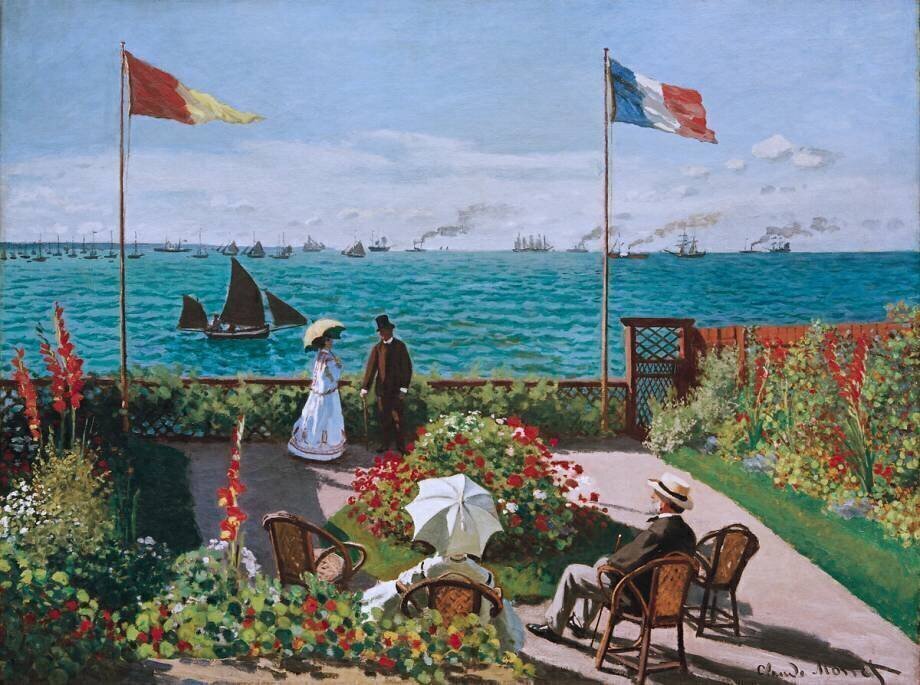
The painting Garden at Sainte-Adresse, painted by Claude Monet in 1867, is much more than a simple depiction of a summer scene; it is a pivotal painting that captures the vibrancy of an era and the stylistic evolution of a master in the making. Carefully preserved at the Metropolitan Museum of Art in New York, this oil on canvas, measuring a substantial 98.1 cm by 129.9 cm, invites us to contemplate a frozen moment, rich in colour and meaning.
Garden at Sainte-Adresse by Claude Monet: between family intimacy and new aspirations
The summer of 1867 was a period of contrasts for Claude Monet. It was in Sainte-Adresse, a popular seaside resort in Normandy near Le Havre, that he found refuge with his family, notably in the villa of his aunt, Madame Lecadre. This retreat was a welcome respite as the artist was facing financial difficulties and his partner, Camille Doncieux, was expecting their first child, Jean, who was born in August of that same year. This personal context coincided with a period of artistic ferment. The Second Empire saw the hegemony of the official Salon challenged by a new generation of painters, of whom Monet became a leading figure. Garden at Sainte-Adresse bears witness to this transition: whilst certain aspects of the composition may still appear rooted in a particular tradition, the boldness of the palette, the fragmentation of the brushstrokes in places and the choice of a contemporary subject clearly herald the beginnings of Impressionism. The emerging influence of Japanese prints, with their bold framing and blocks of colour, is also evident, signalling a desire to break with academic conventions and explore new pictorial avenues.
Garden at Sainte-Adresse by Claude Monet: flashes of light on the Normandy coast
At first glance, Garden at Sainte-Adresse strikes the viewer with its brightness and the richness of its colour palette. Here, Monet adopts a bird’s-eye view, as if the viewer were standing at a window or on a balcony overlooking the scene. This perspective offers a sweeping view of the flower-filled garden, the bustling terrace and, beyond, the ever-changing expanse of the sea. The composition is skilfully orchestrated by an interplay of horizontal lines—created by the sea and the balustrade—and vertical lines, formed by the flagpoles and the silhouettes of the figures. The flowerbeds, notably the bright red gladioli and geraniums, inject touches of pure and vibrant colours that contrast with the lush greens of the garden and the duller blues of the English Channel and the sky, which is sometimes tinged with grey. Monet is already experimenting with the juxtaposition of colours to capture the effect of natural light, a quest that would become central to his work. The brushstrokes vary, ranging from a smoother rendering for certain elements to more visible, fragmented impasto for the flowers and reflections, foreshadowing the Impressionist technique.
GARDEN AT Sainte-Adresse by Claude Monet: a bourgeois moment captured on the spot
At the heart of this light-drenched scene are four figures, witnessing a moment of relaxation and bourgeois sociability. In the foreground, seated on bentwood chairs, we can probably recognise Adolphe Monet, the artist’s father, wearing a straw hat, slightly apart from the others. Beside him, sheltered under a white parasol, stands an elegant female figure, identified as Jeanne-Marguerite Lecadre, generally recognised as Monet’s aunt. Further back, a couple is strolling: a man, perhaps Monet’s cousin, Paul-Eugène Lecadre, is conversing with a young woman. The faces of these figures are sketched rather than detailed, as Monet prioritised the overall atmosphere and the interplay of shapes and colours over an in-depth psychological study. Their presence anchors the scene in a contemporary reality, that of seaside leisure which the bourgeoisie was beginning to enjoy with the rise of the railways and seaside resorts. They embody a certain good life, enjoying the coolness of the garden and the breathtaking view.
Garden at Sainte-Adresse by Claude Monet: Symbols and Contrasts of a Changing Era
Garden at Sainte-Adresse is not merely a charming genre scene; it also carries deeper meanings, reflecting the dynamics of its time. The two flags fluttering in the wind at either end of the terrace are powerful visual elements. Their presence—possibly a French flag and another whose identity is open to interpretation—could evoke the flourishing international trade of the port of Le Havre, visible in the background with its numerous ships and steamboats. These vessels, symbols of the industrial era and technical progress, contrast with the tranquillity of the leisure scene in the foreground. This juxtaposition between idle bourgeois life and the world of work and maritime trade creates a subtle tension. The composition itself, with its clear demarcation between the enclosed garden and the open sea, may also suggest a meditation on the relationship between man and nature, or between private space and the outside world. The Japanese influence, evident in the composition and use of colour, indicates an openness to new aesthetics and a desire for modernity.
Garden at Sainte-Adresse: a seminal painting for Claude Monet
Garden at Sainte-Adresse marks a significant milestone in the career of Claude Monet and, more broadly, in the emergence of Impressionism. Painted at a time when the artist was refining his technique and his vision, the work bears witness to his growing commitment to plein air painting and the capture of atmospheric and luminous effects. The bold use of colour, the freedom of brushwork in places, and the choice of a contemporary subject are all characteristics that would become emblematic of his style. The painting was, moreover, exhibited at the fourth Impressionist exhibition in 1879, a sign of its importance in the artist’s own eyes. It foreshadows Monet’s future series, in which the study of variations in light on a single motif becomes a creative obsession. More broadly, this work, through its freshness and modernity, helped to redefine the landscape in painting, moving away from academic conventions to embrace a more subjective and sensory perception of the world. It remains today a striking illustration of Monet’s precocious talent and a key milestone in the history of modern art.
This artwork is a painting from the classical period. It belongs to the impressionism style.
« Garden at Sainte-Adresse » is kept at Metropolitan Museum of Art, New York, USA.
Find the full description of Garden at Sainte-Adresse by Claude Monet on Wikipedia.
Other artworks by Claude Monet
-
From48.37 €£41.1140.31 €£34.26
-
From42.17 €£35.8535.15 €£29.87
-
From40.71 €£34.6133.93 €£28.84
-
From41.44 €£35.2334.54 €£29.36
-
From36.4 €£30.9430.33 €£25.78
-
From32.67 €£27.7727.22 €£23.14
-
From59.59 €£50.6549.66 €£42.21
-
From40.89 €£34.7634.07 €£28.96
-
From32.67 €£27.7727.22 €£23.14
-
From39.25 €£33.3632.71 €£27.8


Other artworks in the same colors
-
From46.08 €£39.1638.4 €£32.64
-
From52.66 €£44.7643.88 €£37.3
-
From74.73 €£63.5262.28 €£52.93
-
From73.23 €£62.2561.03 €£51.87
-
From41.44 €£35.2334.54 €£29.36
-
From37.79 €£32.1231.49 €£26.77
-
From44.13 €£37.5136.77 €£31.26
-
From51.56 €£43.8342.97 €£36.52
-
From54.85 €£46.6245.71 €£38.85
-
From39.01 €£33.1532.5 €£27.63


Other similar artworks
-
From38.76 €£32.9532.3 €£27.46
-
From39.49 €£33.5732.91 €£27.97
-
From62.52 €£53.1452.1 €£44.28
-
From47.24 €£40.1539.36 €£33.46
-
From39.74 €£33.7833.11 €£28.15
-
From39.25 €£33.3632.71 €£27.8
-
From30.32 €£25.7725.27 €£21.48
-
From42.91 €£36.4735.76 €£30.39