
Customise
Your art print
Judith beheading Holofernes OF Artemisia Gentileschi
Judith beheading Holofernes
Judith Beheading Holofernes: the genesis of a pictorial revenge by Artemisia Gentileschi
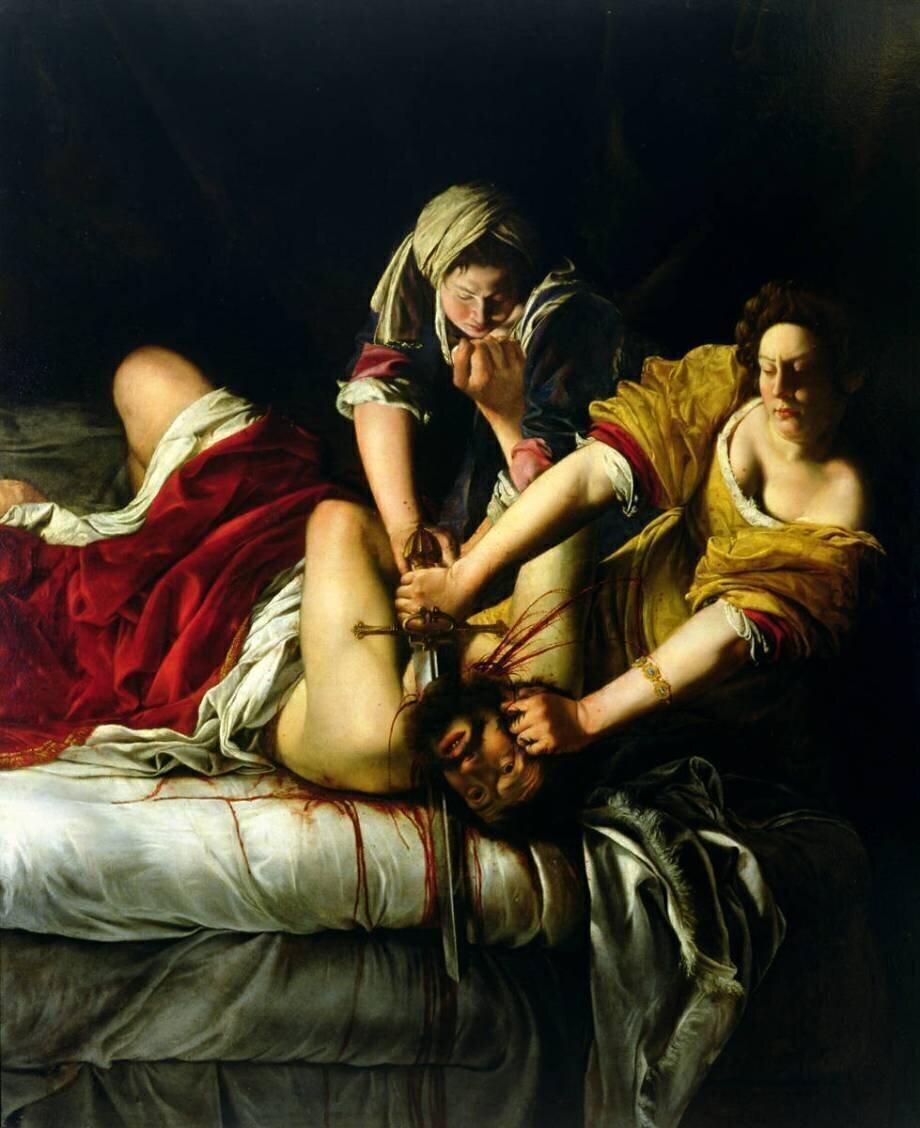
The striking work Judith Beheading Holofernes, painted by Artemisia Gentileschi between 1612 and 1614, is now one of the masterpieces of the Museo di Capodimonte in Naples. Its imposing dimensions, 158.8 cm high and 125.5 cm wide, contribute to the visceral impact of the scene. This painting is part of the artistic context of the early 17th century, strongly marked by dramatic realism and the powerful use of chiaroscuro initiated by Caravaggio, an influence that is palpable in Gentileschi's treatment of light and the raw violence of the representation. The work illustrates a biblical episode from the Book of Judith, in which the Jewish heroine saves her people by seducing and then murdering the Assyrian general Holofernes. However, the artist's personal context imbues this canvas with a particular resonance. Painted shortly after Artemisia's sensational rape trial against her tutor Agostino Tassi in 1612, the work is often interpreted as a catharsis, an artistic transposition of her own struggle and quest for justice. The violence she suffered and the humiliation of the trial seem to be echoed in Judith's fierce determination, transforming a biblical scene into a personal and artistic statement of rare power for the time.
Judith Beheading Holofernes: an immersive scene of Baroque violence
The overall composition of Judith Beheading Holofernes immediately plunges the viewer into the heart of brutal and intense action. Artemisia Gentileschi chooses to depict the precise and bloody moment of the beheading, breaking with more distant representations that often show Judith after the act. The pictorial space is tightened around the three characters, occupying almost the entire canvas and accentuating the claustrophobia and urgency of the scene. The background is plunged into deep darkness, typical of Caravaggio's tenebrism, highlighting the main figures with dramatic side lighting. This harsh light sculpts the volumes, accentuating the tense musculature of the arms, the texture of the fabrics and, above all, the horror of the blood spurting profusely from Holofernes' slit throat. The colour palette is dominated by dark tones, but enhanced by the bright red of the blood and drapery, as well as the colours of the women's clothing, creating powerful contrasts that reinforce the theatricality and violence of the moment. The absence of superfluous details focuses all attention on the act itself and the physical effort involved.
The tragic trio: Judith, Holofernes and Abra in action
At the centre of this pictorial drama is Judith, a determined and active figure. Far from being an ethereal beauty, she is depicted as a robust woman, focused on her macabre task. Her sleeves are rolled up, her powerful arms firmly hold Holofernes' head while her other hand thrusts the sword into the general's neck. Her face, often interpreted as a self-portrait of the artist, expresses a cold, almost detached resolve, contrasting with the obvious physical effort. Holophernes, meanwhile, is captured in his final moments of struggle. His massive body thrashes about on the bed, his face contorted in agony and surprise, his hand desperately clutching the maid's collar. Artemisia is said to have given her the features of her rapist, Agostino Tassi, adding a dimension of personal vengeance to the biblical scene. The third figure, the servant Abra, plays a crucial and unusual role here. Unlike many other depictions where she waits passively, she actively participates in the action, immobilising Holofernes' legs or body. Depicted younger than in the traditional version, her face contorted with effort and revulsion testifies to the physical and psychological intensity of the scene, emphasising a form of female solidarity in this terrible act.
Judith beheading Holofernes, beyond the blood
This work goes far beyond a simple illustration of a biblical story; it is laden with symbolism and open to multiple interpretations. The graphic violence and the blood spurting with raw realism symbolise not only physical death but can also represent purification or liberation from oppression, both for the people of Bethulia and for the artist herself. The intense light that illuminates the scene, emerging from the darkness, may symbolise truth, justice or divine revelation guiding Judith's act, while at the same time mercilessly emphasising the horror. The sword, the focal point of the composition towards which the arms and gazes converge, is the instrument of justice and feminine power overthrowing male tyranny. Judith's unwavering determination and Abra's active participation are often interpreted as an affirmation of strength, agency and female sisterhood, a theme dear to Artemisia, who often painted strong, independent heroines. The work can thus be read as a metaphor for the struggle against oppression, a symbolic revenge for the violence suffered by the artist, but also as a bold exploration of female power and psychology in a male-dominated world.
Impact of Judith Beheading Holofernes on Artemisia Gentileschi and history
Judith Beheading Holofernes had a considerable impact, both on the career of Artemisia Gentileschi and on the history of Baroque art. This work, along with its later version preserved in Florence, helped establish her reputation as an artist capable of rivalling the male masters of her time in her treatment of historical and dramatic subjects. Her technical mastery and her ability to render psychological intensity and physical violence with such expressive force made a lasting impression on her contemporaries. Although the brutality of the subject matter may have shocked some, it also affirmed her unique style and boldness. For Artemisia, creating such a powerful work was a key step in establishing herself in the very male-dominated art world of the time, challenging the conventions that often relegated women painters to genres considered less noble, such as portraiture or still life. She became the first woman to be admitted to the Academy of Drawing in Florence shortly afterwards. Long neglected or studied mainly through the prism of her tragic biography, the work and the artist are now widely recognised. Judith Beheading Holofernes is rightly considered a Baroque masterpiece and a powerful testament to the resilience and artistic genius of Artemisia Gentileschi, an inspiring figure whose work continues to fascinate with its strength and modernity.
This artwork is a painting from the classical period. It belongs to the baroque style.
« Judith beheading Holofernes » is kept at Galleria degli Uffizi, Florence, Tuscany, Italy.
Find the full description of Judith beheading Holofernes by Artemisia Gentileschi on Wikipedia.
Other artworks by Artemisia Gentileschi
-
From63.65 €£54.1153.04 €£45.09
-
From64.14 €£54.5253.45 €£45.43
-
From61.38 €£52.1751.15 €£43.48
-
From66.74 €£56.7355.62 €£47.27
-
From68.85 €£58.5257.37 €£48.77
-
From34.86 €£29.6329.05 €£24.69
-
From63.98 €£54.3853.31 €£45.32
-
From64.63 €£54.9353.86 €£45.78


Other artworks in the same colors
-
From39.01 €£33.1532.5 €£27.63
-
From63.98 €£54.3853.31 €£45.32
-
From66.09 €£56.1855.07 €£46.81
-
From53.59 €£45.5544.65 €£37.96
-
From38.52 €£32.7432.1 €£27.28
-
From58.79 €£49.9748.99 €£41.64


Other similar artworks
-
From74.69 €£63.4962.25 €£52.91
-
From67.59 €£57.4556.33 €£47.88
-
From67.76 €£57.5956.46 €£47.99
-
From60.89 €£51.7650.74 €£43.13
-
From63.98 €£54.3853.31 €£45.32
-
From66.41 €£56.4555.34 €£47.04
-
From73.72 €£62.6661.43 €£52.22
-
From62.84 €£53.4152.37 €£44.51