

Customise
Your art print
Luxury, Serenity and Pleasure OF Henri Matisse
Luxury, Serenity and Pleasure
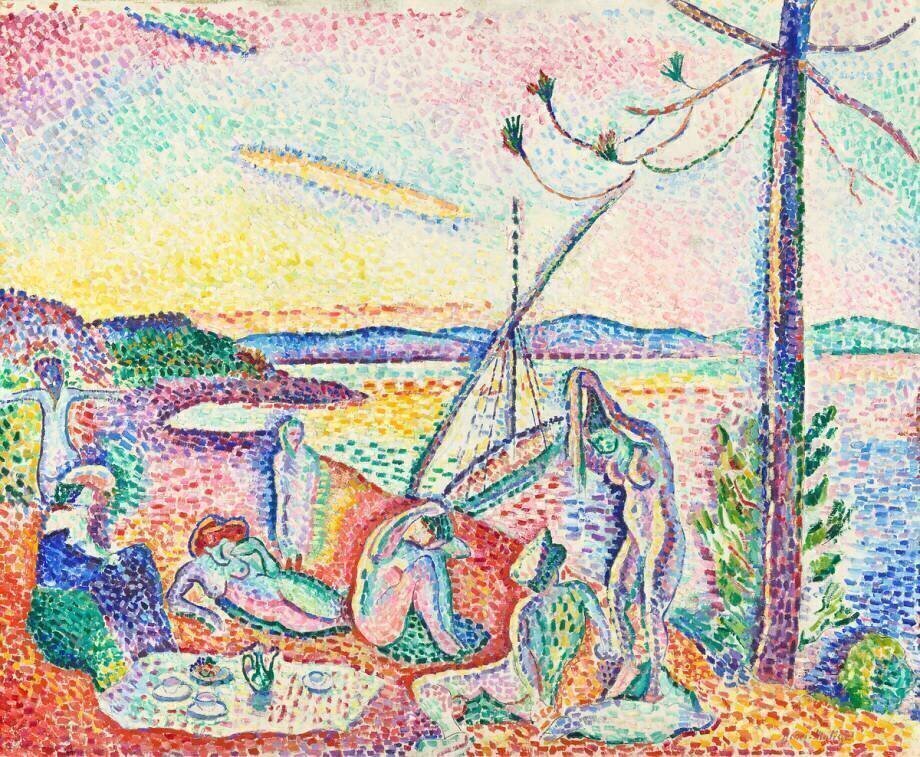
The oil on canvas Luxury, Calm and Voluptuousness, painted by Henri Matisse in 1904, now housed at the Musée d'Orsay in Paris, is far more than a mere pictorial representation. This 98.5 × 118.5 cm painting is a cornerstone in the artist’s career and a harbinger of the chromatic revolutions to come in early 20th-century art.
Luxe, Calme et Volupté by Henri Matisse: the origins of a chromatic paradise
In 1904, Henri Matisse was staying in Saint-Tropez with Paul Signac. It was under the influence of the latter, a theorist of Neo-Impressionism, that Matisse was introduced to the Divisionist technique. Luxe, Calme et Volupté is the direct result of this learning process and his experiments. The title itself, borrowed from the famous poem L'Invitation au voyage by Charles Baudelaire (“There, all is order and beauty, / Luxury, calm and voluptuousness.”), immediately places the work within a quest for the ideal, an evocation of a golden age, a theme dear to the artist, who drew upon a rich heritage ranging from Ovid to the works of Manet and Cézanne. Produced between the autumn of 1904 and the winter of the same year, this painting was preceded by numerous studies and sketches, bearing witness to careful consideration. Exhibited at the Salon des Indépendants in 1905, it certainly provoked a reaction, making a lasting impression and attracting the attention of critics such as Louis Vauxcelles, although Matisse himself would later express a certain dissatisfaction with the strict application of Divisionism, considering it limiting for the expressiveness he sought. The work was acquired by Paul Signac himself, who installed it in his villa ‘La Hune’ in Saint-Tropez, where it remained for several decades.
Luxe, Calme et Volupté by Henri Matisse: a symphony of brushstrokes and light
The first impression conveyed by Luxe, Calme et Volupté is one of intense luminosity and a bold harmony of colour. Matisse employs the divisionist technique, juxtaposing small squares or rectangles of pure colour, which blend optically in the viewer’s eye to create nuances and a distinctive vibrancy. The Mediterranean landscape, bathed in sunlight, is thus broken down into a multitude of colourful fragments. The warm hues – ochres, pinks, oranges – of the shoreline contrast with the blues and greens of the figures, the sea and the vegetation, creating a powerful visual dynamic. Far from a mimetic representation of reality, Matisse seeks to convey a sensation, an atmosphere. The forms are simplified, suggested rather than described with precision. The composition is carefully balanced: the beach stretches to the left, whilst a bay opens up to the right, framed by trees with slender silhouettes. A tree trunk in the foreground on the right interacts with the mast of a beached boat, structuring the space. The whole scene is bathed in a light that seems to emanate from the canvas itself, a light that is not natural but reconstructed through the science of colour inherited from Neo-Impressionism.
Luxe, Calme et Volupté by Henri Matisse: serene figures by the water’s edge
The central subject of Luxe, Calme et Volupté is an idyllic scene in which a group of female figures, some nude, others dressed in light dresses, lounge by the water’s edge. In poses imbued with relaxation and languor, they evoke a reimagined Arcadia, a place of pure pleasure and tranquillity. In the foreground, on a spread-out tablecloth, the remains of a picnic – a plate, some fruit, perhaps a tea set – anchor the scene in a moment of leisure and sharing. The figures are integrated into the landscape, their forms rendered using the same divisionist technique as their surroundings, their outlines sometimes blurred by the vibrancy of the brushstrokes. These figures are reclining, standing or bathing, contributing to this overall harmony. The scene does not tell a specific story but rather seeks to capture the essence of a moment of simple happiness, of a peaceful communion with nature, far from the turmoil of modern life.
Luxe, Calme et Volupté: Matisse’s dream Eden
The significance of Luxe, Calme et Volupté goes beyond a mere description of a seaside scene. The Baudelairean title immediately lends it a poetic and symbolic dimension, evoking a dreamlike otherworld, a refuge from the contingencies of reality. This work can be interpreted as a quest for universal harmony, a desire to rediscover a paradisiacal state, a sort of golden age where man lives in harmony with nature. The nudity of the figures, far from being provocative, refers to an original innocence, to an Edenic purity. The dazzling light and the pure colours contribute to this idealisation, transforming the Mediterranean landscape into a utopian setting. For Matisse, this painting is also a meditation on art itself, on its capacity to create worlds, to offer an escape. It is an “invitation to travel” not only geographically but also inwardly, towards a space of serenity and aesthetic pleasure. The work also symbolises a break with academic conventions, affirming the primacy of sensation and emotion over the mere imitation of reality.
Luxe, Calme et Volupté by Henri Matisse: a Fauvist milestone
Although Matisse quickly moved away from strict divisionist orthodoxy, Luxe, Calme et Volupté represents a crucial stage in his artistic evolution and in the history of modern art. This work is often regarded as one of the first major milestones leading to Fauvism, a movement that would burst onto the scene at the Salon d’Automne of 1905, with Matisse as one of its leading figures. By taking the use of pure colour to the extreme and breaking away from naturalistic representation, Matisse paved the way for a new conception of painting, in which colour became an autonomous means of expression, capable of conveying the painter’s emotions and sensations. The boldness of the canvas, its chromatic intensity and its innovative composition made a lasting impression on his contemporaries and foreshadowed the artist’s future explorations into the expressiveness of colour and the simplification of forms. Luxe, Calme et Volupté thus bears witness to a period of transition and intense experimentation, in which Matisse assimilated the lessons of Neo-Impressionism in order to move beyond them and forge his own pictorial language—the very language that would make him one of the major artists of the 20th century, a true liberator of colour.
This artwork is a painting from the modern period. It belongs to the fauvism style.
« Luxury, Serenity and Pleasure » is kept at Musee d'Orsay, Paris, France.
Find the full description of Luxury, Serenity and Pleasure by Henri Matisse on Wikipedia.
Other artworks by Henri Matisse
-
From57.16 €£48.5947.63 €£40.49
-
From39.01 €£33.1532.5 €£27.63
-
From49.66 €£42.2141.38 €£35.17
-
From40.89 €£34.7634.07 €£28.96
-
From46.81 €£39.7939.01 €£33.15
-
From47.54 €£40.4139.62 €£33.67
-
From60.34 €£51.2950.28 €£42.74
-
From56.01 €£47.6146.67 €£39.67
-
From52.97 €£45.0344.14 €£37.52
-
From58.03 €£49.3248.36 €£41.1


Other artworks in the same colors
-
From51.19 €£43.5242.66 €£36.26
-
From41.47 €£35.2534.56 €£29.38
-
From39.74 €£33.7833.11 €£28.15
-
From47.87 €£40.6939.89 €£33.91
-
From40.47 €£34.433.72 €£28.67
-
From45.39 €£38.5837.83 €£32.15
-
From41.2 €£35.0234.33 €£29.18
-
From45.59 €£38.7537.99 €£32.29
-
From40.47 €£34.433.72 €£28.67
-
From42.42 €£36.0635.35 €£30.05


Other similar artworks
-
From46.08 €£39.1638.4 €£32.64
-
From38.03 €£32.3331.69 €£26.94
-
From39.74 €£33.7833.11 €£28.15
-
From39.01 €£33.1532.5 €£27.63
-
From37.79 €£32.1231.49 €£26.77
-
From41.44 €£35.2334.54 €£29.36
-
From41.2 €£35.0234.33 €£29.18
-
From38.52 €£32.7432.1 €£27.28
-
From39.98 €£33.9833.32 €£28.32