
Customise
Your art print
The Hay Wain OF John Constable
The Hay Wain
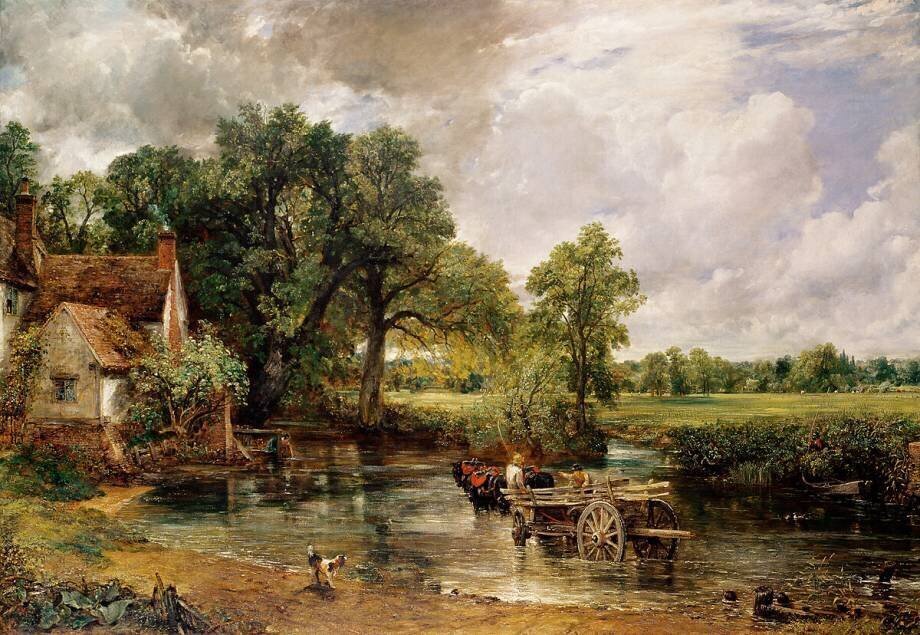
The Hay Wain (The Hay Wain), completed in 1821 by the English landscape painter John Constable, is an iconic work that left its mark on its era and continues to fascinate with its vivid and sensitive depiction of the English countryside. Carefully preserved at the National Gallery in London, this oil on canvas, measuring an imposing 130 × 185 cm, is much more than a simple rural scene; it reflects an era, an artistic vision and a deep love for the artist’s native land.
John Constable’s The Hay Wain: at the heart of the land
Born in Suffolk, the son of a miller, John Constable developed from a very young age a visceral attachment to the landscapes of his childhood, particularly the Stour Valley. Unlike many of his contemporaries who sought inspiration in distant lands and ancient ruins, Constable found grandeur in the everyday life of his region. The Hay Wain is part of a series of large-scale canvases intended to establish the landscape genre as a major one within the Royal Academy. Painted in his London studio, the work is the result of numerous sketches and studies made en plein air over the years, notably near the Flatford Mill, which belonged to his father. This period in the early 19th century was marked by the beginnings of the Industrial Revolution, which was beginning to radically transform landscapes and rural life. Constable’s work can thus be seen as an attempt to capture and preserve the beauty of an idealised pastoral world, perhaps already threatened with disappearance. He paints a familiar England, with a sincerity that contrasts sharply with the academic conventions of the time, favouring a direct and sensitive observation of nature.
John Constable’s The Hay Wain: a visual immersion in the English countryside
The painting offers a spacious and balanced composition, bathed in natural and shifting light, typical of Constable’s talent for capturing atmospheric effects. The scene unfolds beneath a vast and dynamic sky, where the clouds play a prominent role, reflecting the artist’s constant interest in the ‘science of clouds’. In the foreground, the River Stour, peaceful and glistening, flows across the canvas, guiding the eye towards the various elements of the landscape. On the left stands Willy Lott’s cottage, a modest red-brick building that appears in several of Constable’s works, symbolising permanence and a deep connection to the land. The lush right bank depicts the fields and trees of Essex. The colour palette is dominated by rich and varied greens, earthy browns and luminous touches of white and blue for the sky and water. Constable’s technique, with its small, juxtaposed touches of colour—particularly evident in the rendering of the foliage and the reflections on the water—lends the canvas a remarkable liveliness and freshness, already foreshadowing a sensibility that would later be explored by the Impressionists. The whole exudes an atmosphere of serenity and harmony, an idyllic vision of rural life.
John Constable’s The Hay Wain: at the heart of labour
The central element that gives the painting its title is a large hay cart, drawn by two powerful black horses, fording the river. Two figures, probably farmers, accompany the team; one is leading the animals, the other appears to be standing at the rear of the cart. This is not a full cart, ready for the harvest, but an empty cart, perhaps on its way to the fields or returning after a delivery. This detail, often highlighted, anchors the scene in a specific time within the agricultural cycle. The cart itself is depicted with great realism, its weathered wood and massive wheels bearing witness to daily toil. The horses, sturdy and calm, contribute to this image of a hard-working yet peaceful rural life. A small dog, a frequent feature in Constable’s works, adds a touch of life and dynamism to the prevailing tranquillity. This scene of farm work, though central, is perfectly integrated into the surrounding landscape, emphasising the symbiosis between man and nature so dear to the artist. Constable does not seek to glorify peasant labour, but to show it as an essential and harmonious component of this corner of the countryside.
John Constable’s The Hay Wain: beyond the visible
Whilst The Hay Wain is first and foremost a celebration of natural beauty and rural life, it is also imbued with deeper symbolic connotations, rooted in the nascent Romantic movement. For Constable, nature is not merely a backdrop, but a living force, a source of emotion and spirituality. The changing sky, the vibrant light and the rustling of the leaves are all manifestations of this powerful and inspiring nature. The water of the river, a vital element, can symbolise the flow of time and the continuity of life. The Willy Lott Cottage, unchanged through the seasons and the years, represents stability, rootedness and the persistence of traditions in the face of the upheavals of the modern world. The scene itself, depicting a moment of simple and authentic labour, can be interpreted as a nostalgia for a pastoral golden age, an idealised vision of harmony between man and his environment, at a time when industrialisation was beginning to erode that bond. The work expresses a profound sense of belonging to a place, a ‘sentimental geography’ where every element of the landscape carries memory and emotion.
Echoes of The Hay Wain by John Constable
When it was first exhibited at the Royal Academy in 1821, The Hay Wain did not immediately find a buyer in England and received a mixed reception from critics, who were not yet ready for this naturalistic approach and the absence of any grandiose historical or mythological narrative. However, the work’s fortunes changed when it was exhibited at the Salon de Paris in 1824, alongside other paintings by Constable. There it won a gold medal and drew the enthusiastic admiration of leading French artists such as Théodore Géricault and Eugène Delacroix. The latter is even said to have retouched the backgrounds of his painting Scenes from the Massacres at Chios after seeing Constable’s works, impressed by his technique and his mastery of light. This success in Paris helped to establish Constable’s reputation in France and, by extension, to enhance his standing in his own country. The Hay Wain played a decisive role in the evolution of landscape painting, paving the way for a more direct and sincere representation of nature. It had a considerable influence on the painters of the Barbizon School and is regarded as a precursor to Impressionism due to its focus on the effects of light, atmosphere and its vibrant brushwork. Today, The Hay Wain is universally recognised as a masterpiece of British art and a symbol of Romantic landscape painting.
This artwork is a painting from the classical period. It belongs to the naturalism styles and romanticism styles.
« The Hay Wain » is kept at National Gallery, London, United Kingdom.
Find the full description of The Hay Wain by John Constable on Wikipedia.
Other artworks by John Constable
-
From88.35 €£75.173.62 €£62.58
-
From66.74 €£56.7355.62 €£47.27
-
From59.43 €£50.5249.53 €£42.1
-
From61.38 €£52.1751.15 €£43.48
-
From60.08 €£51.0750.07 €£42.56
-
From69.66 €£59.2158.05 €£49.34
-
From63.94 €£54.3553.28 €£45.29
-
From67.87 €£57.6956.56 €£48.08
-
From60.41 €£51.3450.34 €£42.79
-
From78.05 €£66.3565.04 €£55.29


Other artworks in the same colors
-
From38.71 €£32.9132.26 €£27.42
-
From63.94 €£54.3553.28 €£45.29
-
From80.88 €£68.7467.4 €£57.29
-
From79.55 €£67.6266.29 €£56.35
-
From73.57 €£62.5361.31 €£52.11
-
From83.04 €£70.5869.2 €£58.82
-
From41.2 €£35.0234.33 €£29.18


Other similar artworks
-
From61.22 €£52.0351.01 €£43.36
-
From65.76 €£55.954.8 €£46.58
-
From63.33 €£53.8352.77 €£44.86
-
From57.16 €£48.5847.63 €£40.49
-
From81.35 €£69.1567.79 €£57.62
-
From42.42 €£36.0635.35 €£30.05
-
From71.61 €£60.8759.67 €£50.72