
Customise
Your art print
The Little Street OF Johannes Vermeer
The Little Street
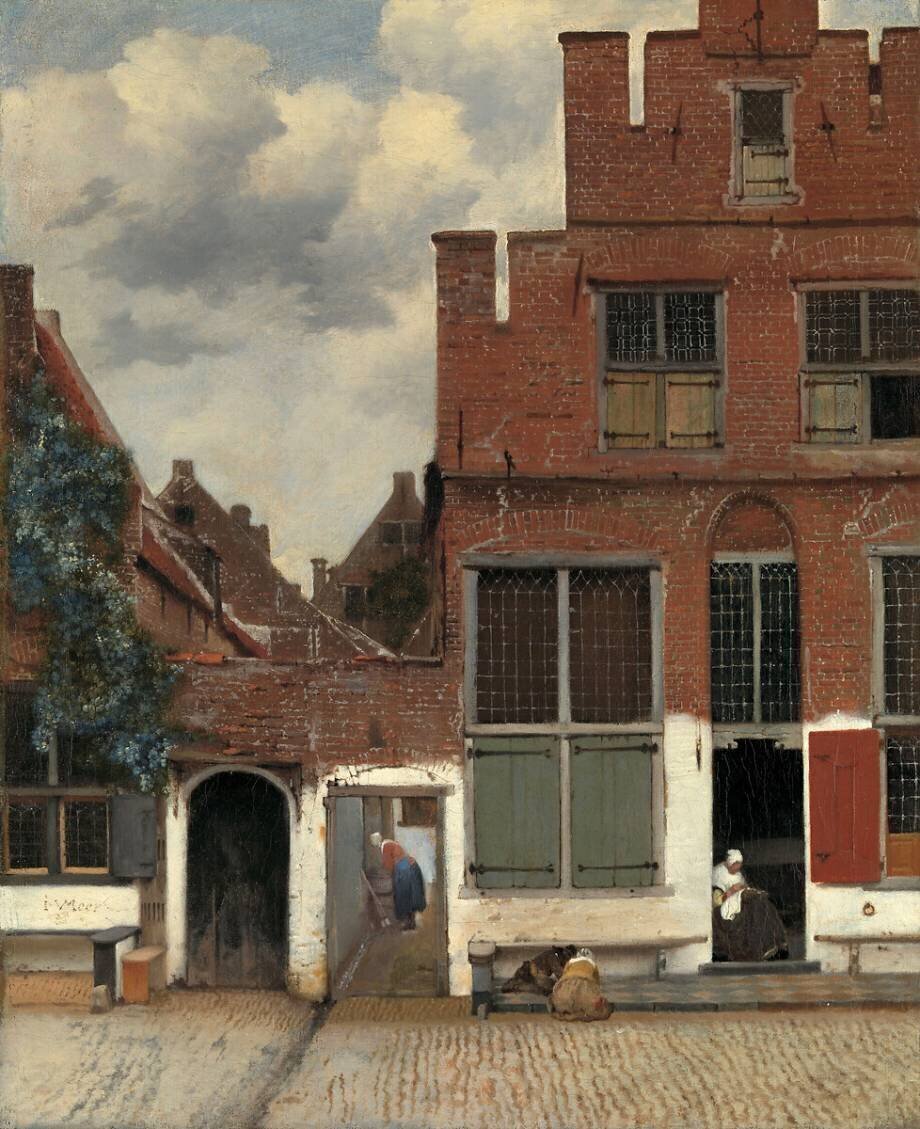
The Little Street (Het Straatje), painted by Johannes Vermeer around 1658, is an iconic work that stands out within the artist’s oeuvre, which is predominantly focused on interior scenes. This oil on canvas, measuring 54.3 cm in height and 44 cm in width, is carefully preserved at the Rijksmuseum in Amsterdam. It offers an intimate and tranquil glimpse of a corner of Delft in the 17th century, capturing the essence of everyday life with a mastery and sensitivity that continue to fascinate.
Vermeer’s The Little Street: a poetic escape in the heart of Delft
In the mid-17th century, Delft was a prosperous city in the United Provinces, the beating heart of the Dutch Golden Age. It was against this backdrop of economic and cultural effervescence that Johannes Vermeer developed his art. In contrast to the more ostentatious art of other European regions, Dutch painting of this era, supported by a merchant bourgeoisie enamoured of realism, turned towards the celebration of everyday life, landscapes and genre scenes. The Little Street fits perfectly into this movement, whilst bearing the inimitable mark of its creator. The work depicts a modest yet significant section of the city, identified in 2015 by Professor Frans Grijzenhout as the Vlamingstraat, where one of Vermeer’s aunts, Ariaentgen Claes van der Minne, lived. This biographical detail further anchors the painting in the reality experienced by the artist, suggesting a choice of subject driven by familiarity and perhaps a particular affection for this specific place. The peaceful atmosphere that emanates from it bears witness to a quest for beauty in the ordinary, far removed from grand historical or mythological scenes, favouring the authenticity of a moment frozen in time. Vermeer, the father of a large family, captures here a fragment of urban life, paying meticulous attention to the architecture and atmosphere, transforming a simple street scene into a poetic meditation.
Vermeer’s The Little Street: a composition of everyday life elevated to art
The composition of The Little Street is remarkably subtle, orchestrating a perfect balance between architectural masses and empty spaces. The eye is immediately drawn to the red-brick façade of the house on the right, which occupies a large part of the canvas. Vermeer renders the texture of the materials with astonishing virtuosity: the wear and tear of the bricks, the irregularity of the mortar, and the wooden shutters—sometimes open, sometimes closed, in shades of green and red—give rhythm to the surface. The light, so characteristic of Vermeer’s work, plays a vital role, caressing the surfaces, shaping the volumes and creating an atmosphere of almost palpable tranquillity. The sky, visible through a triangle formed by the gables of the houses, brings a touch of clarity and openness. In the foreground, the paving of the alley, with its central gutter, subtly guides the eye towards the background, creating an illusion of depth despite the narrowness of the scene. The perspective is frontal, giving the viewer the impression of being a privileged observer, almost a discreet intruder in this intimate scene. The artist’s signature, “I·VMeer”, is discreetly affixed to the white wall of the house on the left, like a humble mark of his presence.
Vermeer’s The Little Street: the silent theatre of the alley
At the heart of this meticulously depicted architecture, a few human figures discreetly animate the scene, going about their daily occupations without ever seeking to attract attention. Their faces are barely sketched, their identities undisclosed, which reinforces the universal nature of the scene. Behind the open door of the house on the right, a woman sits, absorbed in a household chore, probably sewing. Her presence embodies domestic life, the sheltered home. In front of the house, two children play crouched on the pavement, their childlike silhouettes adding a touch of liveliness and innocence. These children are, incidentally, a rarity in the known works of Vermeer. Further on, in the alleyway running between the houses, another woman, perhaps a servant, is bent over a barrel, busy with a chore. These figures, though central in their presence, are so integrated into their surroundings that they blend into the background. They are not posing; they are living. It is this authenticity, this capture of a moment of ordinary life, that constitutes the true subject of the painting: the simple beauty and dignity of everyday life.
Vermeer’s The Little Street : beyond the bricks
Whilst The Little Street captivates with its apparent realism, it also carries a discreet symbolic meaning, typical of 17th-century Dutch painting which, whilst celebrating reality, often imbues it with deeper significance. The house, with its doors and windows, can be seen as a metaphor for domestic life, a space of refuge and intimacy, a core value in Dutch society at the time. The visible wear and tear of the bricks, the small imperfections in the render, and the ivy climbing up the wall may symbolise the passage of time, the patina of life, but also permanence and resilience. The cleanliness of the alley and the sense of order emanating from the scene evoke the virtues of diligence and good housekeeping. The characters’ activities – sewing, playing, housework – emphasise the importance of hard work and family life. Even the choice of a modest alleyway rather than a prestigious building can be interpreted as a celebration of the humble and the authentic. The general atmosphere of calm and serenity invites contemplation and an appreciation of simple beauty, a subtle message about finding happiness in ordinary things, far from the hustle and bustle of the world.
Vermeer’s The Little Street: the resonance of a singular work
The Little Street, along with the View of Delft, is one of only two known outdoor scenes by Vermeer, which gives it a special place in his body of work. Whilst the artist is best known for his luminous and intimate interiors, this work demonstrates his ability to apply his poetic vision and meticulous technique to an urban subject. It bears witness to his attachment to his hometown and his keen observation of the world around him. Although Vermeer did not enjoy immense fame during his lifetime, his rediscovery in the 19th century established his genius. The Little Street helped to forge the image of a painter of silence and light, capable of transcending the everyday to reach a universal dimension. His influence has been felt by generations of artists, notably the Impressionists, who were drawn to his way of capturing light and atmosphere, and the Realists, attracted by his depiction of ordinary life. Today, The Alley is regarded as a masterpiece of Dutch genre painting, admired for its rigorous composition, subtle palette and the peaceful emotion it conveys. It invites the modern viewer to take a contemplative pause, to appreciate the discreet poetry nestled at the heart of the mundane.
This artwork is a painting from the classical period. It belongs to the baroque style.
« The Little Street » is kept at Rijksmuseum, Amsterdam, The Netherlands.
Find the full description of The Little Street by Johannes Vermeer on Wikipedia.
Other artworks by Johannes Vermeer
-
From57.64 €£4948.04 €£40.83
-
From58.46 €£49.6948.71 €£41.41
-
From56.96 €£48.4247.47 €£40.35
-
From54.72 €£46.5145.6 €£38.76
-
From55.37 €£47.0746.14 €£39.22
-
From57.48 €£48.8647.9 €£40.72
-
From58.13 €£49.4148.44 €£41.18
-
From65.44 €£55.6254.53 €£46.35
-
From55.21 €£46.9346.01 €£39.11
-
From58.62 €£49.8348.85 €£41.52


Other artworks in the same colors
-
From50.46 €£42.8942.05 €£35.74
-
From89.51 €£76.0974.59 €£63.4
-
From67.26 €£57.1756.05 €£47.64
-
From60.95 €£51.8150.79 €£43.17
-
From62.61 €£53.2252.17 €£44.35
-
From80.7 €£68.667.25 €£57.16


Other similar artworks
-
From38.52 €£32.7432.1 €£27.28
-
From32.91 €£27.9727.43 €£23.31
-
From50.46 €£42.8942.05 €£35.74
-
From38.76 €£32.9532.3 €£27.46
-
From32.88 €£27.9427.4 €£23.29
-
From46.81 €£39.7939.01 €£33.15
-
From43.62 €£37.0836.35 €£30.9
-
From33.66 €£28.6128.05 €£23.84