
Customise
Your art print
The Romans of the Decadence OF Thomas Couture
The Romans of the Decadence
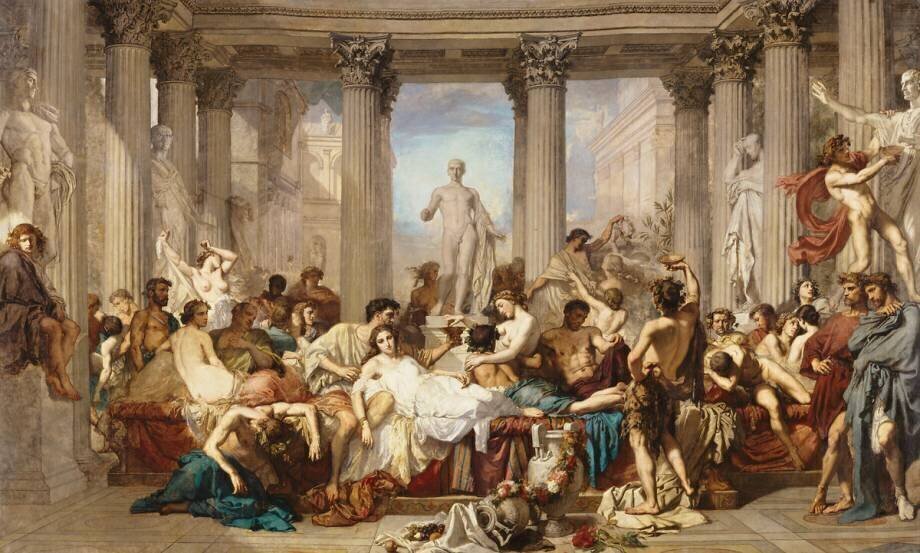
The monumental work by Thomas Couture, The Romans in Decline, is far more than a mere history painting; it proves to be a powerful allegorical fresco, a scathing commentary on his own era disguised as a depiction of a fading antiquity. Now housed at the Musée d'Orsay in Paris, this oil on canvas, measuring an impressive 472 centimetres in height by 772 centimetres in width, left its mark on its era and continues to fascinate with its visual richness and symbolic depth.
Roman decadence and its echo in 1847 as seen by Thomas Couture
Completed in 1847, The Romans in their Decadence is the result of a commission from the State awarded to Thomas Couture in 1846. To fuel his inspiration, the artist drew on the verses of the Roman satirical poet Juvenal, notably his sixth Satire, which castigates the corruption of morals: “Crueller than war, vice has descended upon Rome and takes vengeance on the vanquished world.” This quote, explicitly mentioned by Couture in the catalogue for the 1847 Salon where the work was exhibited, anchors the painting in a critique of moral corruption. However, Couture’s ambition goes beyond the mere illustration of an ancient text. Painted just one year before the Revolution of 1848 that brought an end to the July Monarchy, the work is steeped in the socio-political climate of France at the time. Many people at that time perceived the regime of Louis-Philippe as morally decadent and corrupt. Couture thus uses the ancient scene as a mirror held up to his contemporaries, denouncing the loss of values and the excesses of French society. By choosing such a subject, he also aims to challenge, or even shock, a predominantly Catholic and prudish society, whilst offering it a moral lesson under the guise of a grandiose historical scene. The painting thus forms part of a tradition of moralising history painting, in which the past illuminates and judges the present.
Thomas Couture’s The Romans of the Decadence: a visual plunge into the heart of debauchery
From the very first glance, The Romans during Decadence captivates with its monumental scale and the complexity of its composition. The scene unfolds within a vast architectural space, a majestic colonnaded portico that evokes the grandeur of Imperial Rome, whilst suggesting an influence from Raphael’s compositions or the opulent interiors of Venetian palaces, or even the frescoes discovered at Pompeii. Within this marble setting, a multitude of figures, men and women, abandon themselves to the pleasures of an orgy that seems to be drawing to a close. The richness of the colours, the finesse of the drapery and the realistic rendering of the flesh bear witness to Couture’s technical mastery. The light, skilfully orchestrated, sculpts the bodies and accentuates the contrast between the areas of full light where excess revels and the darker corners where melancholy or judgement seems to loom. The viewer’s gaze is first drawn to the central commotion, but then becomes lost in an exploration of the various groups and figures, each recounting a facet of this decline. Imposing and impassive, statues of deities and ancient heroes, such as Germanicus, observe the scene from their pedestals, acting as silent witnesses and reminders of lost grandeur and virtue.
The Romans of the Decadence by Thomas Couture: the faces of excess
At the heart of the composition, the central group embodies the very essence of debauchery. The bodies are intertwined, abandoned in lascivious or exhausted poses. Some figures, still driven by a drunken frenzy, raise their cups or attempt dance steps, whilst others, visibly overwhelmed by the excesses of the night, lie in a semi-conscious state, their gaze vacant or their expression marked by disillusionment. Couture does not merely depict a simple scene of debauchery; he explores the psychology of his characters, capturing a range of emotions ranging from the most boisterous euphoria to the deepest despondency. The poses of the figures, often twisted or off-balance, contrast sharply with the uprightness and marble-like serenity of the statues towering above them, thus highlighting the moral and physical degradation of the living. The plastic beauty of the bodies, rendered according to academic canons, stands in tension with the moral ugliness of their behaviour, creating a sense of unease and prompting the viewer to question the nature of pleasure and the consequences of losing one’s sense of proportion.
Thomas Couture’s E Les Romains de la décadenceE : symbol of a civilisation in decline
Every element of the canvas carries meaning and contributes to theoverall allegory of decadence. The ancient statues, notably that of Germanicus, which idealise the civic and military virtues of Republican Rome or the early Empire, stand as silent reproaches in the face of the moral decline of their descendants. Their impassivity and their formal perfection emphasise, by contrast, the disorderly turmoil and the corruption of the bodies and minds of those taking part in the orgy. On the right-hand side of the painting, a group of three figures stands apart from the feast. Among them, two figures often interpreted as poets or philosophers (one of whom may be a depiction of Juvenal himself, or even a self-portrait of Couture as a critical observer) contemplate the scene with an expression of disgust and sadness, embodying moral conscience and disapproving judgement in the face of this moral decay. The omnipresent wine symbolises intoxication, loss of control and the fleeting pleasures that lead to the neglect of duties and responsibilities. The abundance of food and wealth on display suggests the luxury and decadence that have eroded the foundations of the Empire. Thus, the architectural grandeur of the setting only serves to accentuate the moral decay of the scene, evoking a past splendour set against a degraded present.
The Romans during the Decadence: a notable success for Thomas Couture
The exhibition of The Romans of the Decadence at the 1847 Salon was a resounding triumph for Thomas Couture. The work was acclaimed by a large section of the critics, who saw in it a masterful synthesis between the classical tradition—through the rigour of the drawing and the nobility of the composition—and a more romantic sensibility, through the choice of subject, the dramatic intensity and the chromatic richness. Influential critics such as Étienne-Jean Delécluze and Théophile Thoré-Bürger praised this approach of the ‘golden mean’. This success propelled Couture to the forefront of the French art scene and made him one of the leading figures of academic painting. However, the implicit criticism of contemporary society did not go unnoticed and also sparked controversy. It is reported that Prince Napoleon strongly condemned the painting, seeing it as an attack on his era. Bolstered by this recognition, Couture opened a studio which became one of the most renowned in Paris, attracting numerous pupils, including future great names in painting such as Édouard Manet, Puvis de Chavannes and the American William Morris Hunt. Despite his status as an academic painter, Couture encouraged a certain freedom and careful observation of nature. However, despite this dazzling initial success, Couture’s career subsequently faced difficulties, notably with major unfinished public commissions. Disillusioned, he decided not to exhibit at the Salon after 1855. The Romans in their Decadence nevertheless remains his most famous work, a key milestone in 19th-century art, symbolising both the apogee of a certain pictorial tradition and a work capable of conveying a powerful social and moral message, the echoes of which still resonate today.
This artwork is a painting from the classical period. It belongs to the academism style.
« The Romans of the Decadence » is kept at Musee d'Orsay, Paris, France.
Find the full description of The Romans of the Decadence by Thomas Couture on Wikipedia.
Other artworks by Thomas Couture
-
From61.94 €£52.6551.62 €£43.88
-
From70.58 €£59.9958.82 €£49.99
-
From51.65 €£43.943.04 €£36.58
-
From63.6 €£54.0653 €£45.05
-
From59.29 €£50.3949.41 €£42
-
From71.08 €£60.4259.23 €£50.35
-
From61.78 €£52.5151.48 €£43.76
-
From63.44 €£53.9252.87 €£44.94
-
From63.27 €£53.7852.73 €£44.82
-
From61.45 €£52.2351.21 €£43.52


Other artworks in the same colors
-
From49.64 €£42.1941.37 €£35.16
-
From76.23 €£64.7963.52 €£53.99
-
From56.83 €£48.3147.36 €£40.26
-
From46.62 €£39.6338.85 €£33.03
-
From40.96 €£34.8134.13 €£29.01
-
From39.01 €£33.1532.5 €£27.63


Other similar artworks
-
From82.04 €£69.7368.37 €£58.11
-
From90.61 €£77.0275.51 €£64.18
-
From50.22 €£42.6941.85 €£35.57
-
From82.54 €£70.1668.78 €£58.46
-
From79.55 €£67.6266.29 €£56.35
-
From106.45 €£90.4888.71 €£75.4