

Customise
Your art print
The School of Athens OF Raffaello
The School of Athens
The School of Athens by Raphael: a papal masterpiece
At the height of the Italian High Renaissance, a period of unprecedented artistic and intellectual effervescence, Pope Julius II undertook an ambitious project: the renovation and decoration of his private apartments in the Vatican. It was in this context, towards the end of 1508, that he called upon a young painter from Urbino whose reputation was growing steadily: Raffaello Sanzio, known as Raphael.
Upon his arrival in Rome, Raphael was entrusted with the decoration of several rooms, which would become famous as the ‘Stanze di Raffaello’. The first of these rooms to be decorated, and undoubtedly the most emblematic, was the Stanza della Segnatura (Room of the Signature), intended to be the private library and office of the sovereign pontiff. For this place of knowledge and power, Julius II and his advisers devised a complex iconographic programme aimed at celebrating the highest faculties of the human mind: Theology, Philosophy, Poetry and Jurisprudence. It was within this framework that Raphael designed and executed, between 1509 and 1511, the monumental fresco that would embody Philosophy: The School of Athens. This work was not an isolated commission, but part of an overall decorative project designed to exalt the synthesis between ancient wisdom and Christian faith, an ideal dear to Renaissance humanism and to the Pope himself. The execution of this fresco marked a decisive turning point, propelling Raphael to the top of the Roman art scene, rivalling Michelangelo, who was then working on the ceiling of the nearby Sistine Chapel.
Raphael's The School of Athens, an ancient scene beneath the vaults of the Vatican
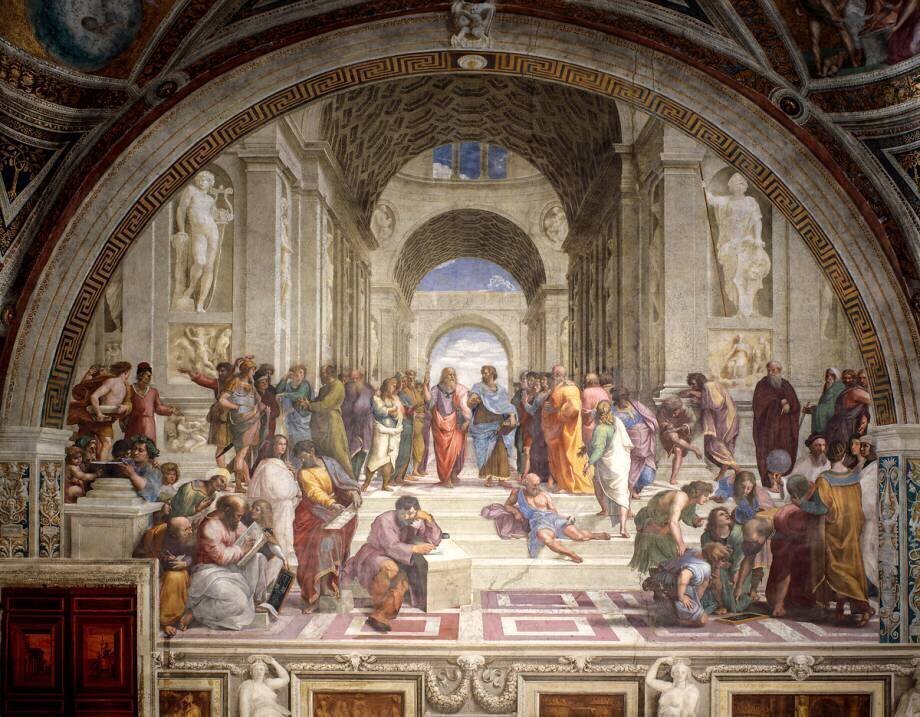
The School of Athens is presented in the form of a fresco, a technique of mural painting applied to fresh plaster, which allows it to blend perfectly with the architecture and gives it remarkable durability. The work occupies an entire wall of the Stanza della Segnatura in the Vatican Palace and is impressive for its considerable size, with a base measuring approximately 770 cm and a height of 440 cm. Visually, the fresco plunges us into the heart of a grandiose and idealised classical architecture. Raphael displays an astonishing mastery of linear perspective, creating a striking illusion of depth. Immense vaults open onto a clear sky, while niches housing monumental sculptures punctuate the space. In the background, a series of arches guides the eye towards the central vanishing point, strategically placed between the two main figures. Clear, diffused light bathes the scene, highlighting the rich colours of the clothing and the plasticity of the bodies. The composition is exemplary in its harmony and balance: the numerous figures are divided into dynamic but orderly groups, occupying the space without overloading it. The whole exudes an atmosphere of majestic serenity, intense intellectual concentration and lively dialogue, capturing the effervescence of ancient philosophical thought in an architectural setting that evokes the rediscovered grandeur of Rome.
The immortal dialogue at the heart of Raphael's The School of Athens
At the nerve centre of this assembly of sages, two figures stand out and immediately capture the attention: Plato and Aristotle. Raphael depicts them in full discussion, embodying the two fundamental pillars of Western philosophy. Plato, the older of the two, depicted with the supposed features of Leonardo da Vinci, raises his index finger towards the sky, holding his work, the Timaeus, under his arm. This gesture symbolises his quest for perfect and intelligible forms, which, according to his theory, lie beyond the sensible world, in a higher and transcendent reality. At his side, Aristotle, his younger and more pragmatic disciple, extends his palm towards the ground, while holding his Ethics. His gesture points to the tangible world, the importance of empirical observation, logic and morality rooted in earthly reality. This dialectical opposition between teacher and student, between idealism and realism, structures the entire composition. Their central position, their relative isolation from the surrounding groups and the convergence of the lines of perspective towards them emphasise their paramount importance. These are not merely portraits of philosophers, but the living embodiment of two major paths of human knowledge, engaged in an eternal dialogue at the very heart of Raphael's imagined temple of knowledge.
Raphael's The School of Athens: an allegory of knowledge
Beyond the central duo, The School of Athens is a vast allegory of the quest for rational truth, bringing together some fifty figures representing the greatest thinkers of antiquity. Although not all identifications are certain and are still the subject of debate, several figures are recognisable or traditionally identified. In the foreground on the left, Pythagoras is absorbed in his mathematical calculations. Further away, Socrates, recognisable by his distinctive profile, is conversing with a group. In the foreground on the right, Euclid (or Archimedes), leaning forward, draws a geometric figure with a compass, under the supposed features of the architect Bramante, a friend of Raphael's and designer of the new St. Peter's Basilica. A pensive, isolated figure leaning on a block of marble in the foreground is often interpreted as Heraclitus, to whom Raphael is said to have given the features of Michelangelo, adding this figure a little later as a tribute to his rival. Diogenes the Cynic lies nonchalantly on the steps. The monumental statues in the niches reinforce the symbolism: Apollo, god of light, music and reason (on Plato's side), and Minerva (Athena), goddess of wisdom and the arts (on Aristotle's side). All of these figures, their interactions and the objects they are holding (books, globes, instruments) symbolise the diversity and richness of intellectual disciplines – mathematics, geometry, astronomy, rhetoric, logic – unified under the aegis of Philosophy, in a synthetic vision typical of Renaissance humanism.
The eternal legacy of Raphael's The School of Athens
The completion of The School of Athens and the Stanza della Segnatura was a triumph for Raphael. This spectacular work definitively established his reputation in Rome, placing him on a par with the already established giants, Leonardo da Vinci and Michelangelo. His work in the Pope's apartments demonstrated his ability to handle complex, large-scale compositions, his mastery of drawing, colour and perspective, and his profound humanist culture. This papal commission opened the doors to the most prestigious Roman patrons and ensured his dominant position in the artistic sphere of the papal city until his untimely death in 1520. Aware of his own role in this intellectual and artistic lineage, Raphael discreetly included himself in the fresco: on the far right, a young man wearing a black beret looks directly at the viewer, asserting his presence as an artist-thinker. Beyond its impact on Raphael's career, The School of Athens became one of the most emblematic works of the High Renaissance. It perfectly embodies the ideals of this period: harmony, clarity, balance, human dignity, admiration for classical antiquity and the attempt to reconcile it with Christian thought. Its influence on Western art was immense and lasting, serving as a model and inspiration for countless artists throughout the centuries, and remaining today an unrivalled testimony to the power of painting in the service of ideas.
This artwork is a painting from the renaissance period. It belongs to the italian renaissance style.
« The School of Athens » is kept at Vatican Museums, Rome, Italy.
Find the full description of The School of Athens by Raffaello on Wikipedia.
Other artworks by Raffaello
-
From73.94 €£62.8561.61 €£52.37
-
From50.54 €£42.9642.12 €£35.8
-
From57.47 €£48.8547.89 €£40.71
-
From53.66 €£45.6144.71 €£38.01
-
From54.22 €£46.0945.18 €£38.41
-
From49.53 €£42.141.28 €£35.09
-
From40.54 €£34.4633.79 €£28.72
-
From58.49 €£49.7148.74 €£41.43
-
From53.72 €£45.6644.77 €£38.05
-
From60.57 €£51.4950.48 €£42.91


Other artworks in the same colors
-
From32.31 €£27.4626.92 €£22.88
-
From37.73 €£32.0731.44 €£26.73
-
From44.88 €£38.1537.4 €£31.79
-
From33.07 €£28.1127.56 €£23.42
-
From33.49 €£28.4727.91 €£23.72
-
From34.91 €£29.6729.09 €£24.72
-
From34.26 €£29.1228.55 €£24.26
-
From50.97 €£43.3342.48 €£36.11
-
From40.33 €£34.2833.6 €£28.56
-
From86.07 €£73.1671.72 €£60.96


Other similar artworks
-
From46.79 €£39.7738.99 €£33.14
-
From53.66 €£45.6144.71 €£38.01
-
From60.51 €£51.4350.42 €£42.86
-
From57.75 €£49.0948.13 €£40.91
-
From43.88 €£37.336.57 €£31.08
-
From55.45 €£47.1446.21 €£39.28
-
From43.76 €£37.1936.46 €£30.99
-
From64.25 €£54.6153.54 €£45.51
-
From88.09 €£74.8873.41 €£62.4