

Customise
Your art print
A Bar at the Folies-Bergere OF Edouard Manet
A Bar at the Folies-Bergere
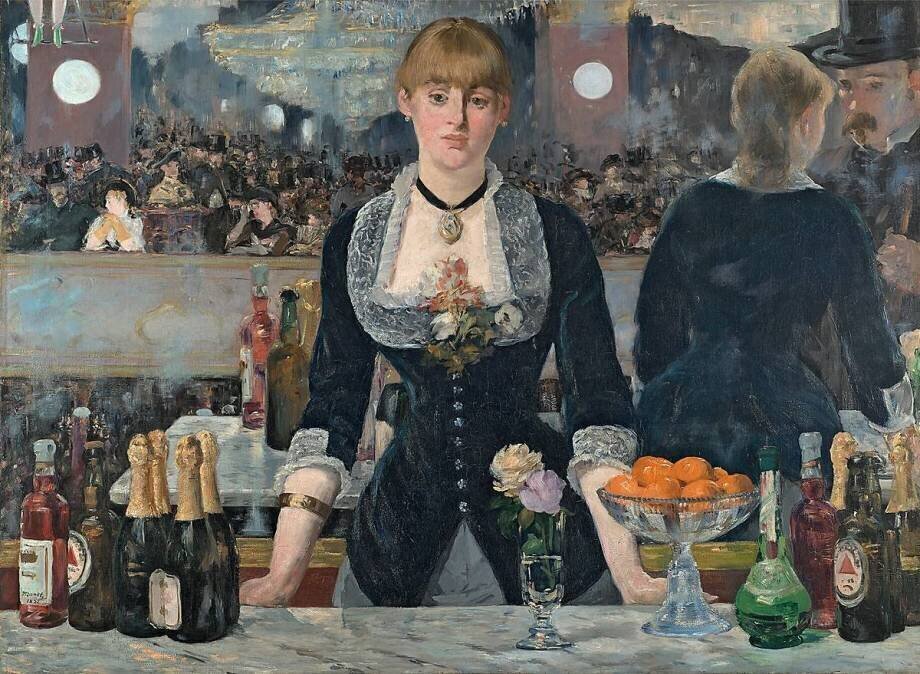
A Bar at the Folies Bergère, painted by Édouard Manet in 1882, is not only the artist’s last major work before his death the following year, but an iconic painting that captures the vibrancy of Parisian life in the late 19th century and challenges the viewer with its narrative and pictorial complexity. Housed at the Courtauld Gallery in London, this 96 x 130 cm oil on canvas continues to fascinate and provoke multiple interpretations.
A Bar at the Folies Bergère by Édouard Manet: at the heart of Parisian nightlife
The Folies Bergère, opened in 1869, were much more than just a café-concert; they were a veritable microcosm of Parisian society, a popular entertainment venue where people from all social classes mingled, seeking the thrill of varied performances, from ballets to acrobatic acts. It is in this vibrant and cosmopolitan atmosphere, a symbol of modernity and the capital’s fleeting pleasures, that Manet drew his inspiration. Although weakened by illness, the meticulous artist recreated the scene in his studio on Rue d’Amsterdam, drawing on sketches made on site and the account of a real employee of the Folies Bergère, Suzon, who served as his model. This final work keenly depicts the ‘modern way of life’, the shimmering lights, and the sometimes hushed atmosphere—almost ‘gloomy’ according to some contemporaries—of a place where the frenetic bustle struggles to mask a form of urban loneliness. Through this painting, Manet offers a visual chronicle of his time, marking the height of his reflection on the representation of contemporary life.
A Bar at the Folies Bergère by Édouard Manet: a spectacle within a spectacle
At first glance, A Bar at the Folies Bergère plunges us into the heart of a lively scene. The skilfully orchestrated composition centres on the figure of the waitress, Suzon, positioned behind a marble bar lavishly stocked. This foreground is a still life in its own right, where bottles of alcohol (champagne, beer, liqueurs), fruit in a crystal bowl and a vase of flowers create an almost pyramidal structure, with the bouquet adorning Suzon’s bodice forming its apex. Behind her, a huge mirror spans the entire width of the canvas, reflecting not only the young woman from behind, but also the Folies Bergère auditorium teeming with people. One can make out the elegant crowd on the balconies, the sparkling chandeliers, and even the green-clad legs of a trapeze artist in mid-performance in the top left corner. Manet plays with textures, the brilliance of the glass and marble, the velvet of the bodice, and the artificial light that sculpts the forms and creates an atmosphere that is both festive and strangely distant. His style, at the crossroads of realism and impressionism, is evident in the precise brushstrokes in the foreground and a blurrier, almost hazy treatment of the reflection, conveying the immediacy and bustle of the scene.
Suzon: the silent enigma of the Folies Bergère bar
The character of Suzon, the barmaid, forms the emotional and narrative centrepiece of the painting. Dressed in a square-necked dress adorned with a bouquet of flowers, a medallion around her neck, she stands upright, her hands resting on the bar. Her expression is one of the most discussed aspects of the work. Her gaze, direct yet evasive, seems lost in space, tinged with a sense of melancholy, weariness or indifference to the hustle and bustle around her. Some critics see in this a form of isolation, the waitress being both the centre of attention and profoundly alone, a mere cog in the machinery of entertainment and consumption. Her face, with its delicate features and fresh complexion, contrasts with the liveliness of her reflection in the mirror. Indeed, in the reflection, we see her from behind, leaning slightly forward, in the midst of a conversation with a customer wearing a top hat. This duality between the Suzon facing us, passive and introspective, and her double in the mirror, engaged in social interaction, fuels the mystery and psychological complexity of the character.
A Bar at the Folies Bergère by Édouard Manet: the unsettling play of mirrors
The mirror is the key element of the composition and the symbolism of the painting, introducing a fascinating distortion between the real and the reflected. Manet defies the laws of traditional perspective: Suzon’s reflection is not aligned with her silhouette from the front, and the customer with whom she is conversing in the mirror does not appear in front of her in the ‘real’ space of the bar, where the viewer would logically be standing. This anomalies, whether deliberate or not, has prompted countless analyses. It could symbolise the illusory nature of appearances, the superficiality of interactions in this place of pleasure, or even the ambiguous position of women, as both objects of desire and workers. The objects on the bar are no exception: the side-by-side presence of champagne, the drink of the elite, and beer, the more popular choice, may evoke the social mix at the Folies Bergère. Some have seen in this a form of modern vanity, where fleeting pleasures and material possessions mask a more disenchanted reality. The figure of Suzon herself, through her demeanour and surroundings, has sometimes been associated with the theme of prostitution, a social reality that Manet did not hesitate to address in other works.
A Bar at the Folies Bergère by Édouard Manet: the eternal echo of a pictorial farewell
A Bar at the Folies Bergère was Manet’s last major contribution to the art world before his premature death. Exhibited at the Paris Salon in 1882, the work was both praised for its modernity and criticised for its apparent spatial inconsistencies. Nevertheless, it cemented Manet’s place as one of the most innovative painters of his time, a pioneer of modern art who broke with academic conventions to depict the life of his era with unprecedented frankness and complexity. The painting is regarded as a bridge between realism and impressionism, exerting a lasting influence on generations of artists. Its impact lies in its ability to capture the fleeting effects of light, its compositional boldness, notably the use of the mirror to question the nature of perception and representation, and its psychological depth. By placing the viewer in an active, almost unsettling position, facing the scene and its reflection, Manet invites them to reflect beyond mere aesthetic contemplation, questioning social dynamics, the role of the artist and the fleeting nature of modern life. The work remains a icon of art history, testifying to Manet’s genius in capturing the essence of an era whilst paving the way for new pictorial explorations.
This artwork is a painting from the modern period. It belongs to the impressionism style.
« A Bar at the Folies-Bergere » is kept at The Courtauld Gallery, London, UK.
Find the full description of A Bar at the Folies-Bergere by Edouard Manet on Wikipedia.
Other artworks by Edouard Manet
-
From52.11 €£44.2943.42 €£36.91
-
From82.54 €£70.1668.78 €£58.46
-
From61.78 €£52.5151.48 €£43.76
-
From76.72 €£65.2263.94 €£54.35
-
From73.24 €£62.2561.03 €£51.88
-
From35.9 €£30.5229.92 €£25.43
-
From45.13 €£38.3637.61 €£31.97
-
From41.64 €£35.3934.7 €£29.49
-
From64.14 €£54.5253.45 €£45.43
-
From63.94 €£54.3553.28 €£45.29


Other artworks in the same colors
-
From38.52 €£32.7432.1 €£27.28
-
From48.03 €£40.8240.02 €£34.02
-
From37.79 €£32.1231.49 €£26.77
-
From65.58 €£55.7454.65 €£46.45
-
From59.27 €£50.3849.39 €£41.98
-
From70.58 €£59.9958.82 €£49.99
-
From38.89 €£33.0632.41 €£27.55
-
From47.04 €£39.9839.2 €£33.32


Other similar artworks
-
From37.54 €£31.9131.29 €£26.59
-
From38.76 €£32.9532.3 €£27.46
-
From37.3 €£31.731.08 €£26.42
-
From41.69 €£35.4334.74 €£29.53
-
From70.8 €£60.1859 €£50.15
-
From63.98 €£54.3853.31 €£45.32