
Customise
Your art print
Femmes de Tahiti ou Sur la plage OF Paul Gauguin
Femmes de Tahiti ou Sur la plage
Echoes of a dream paradise: the genesis of Paul Gauguin's Women of Tahiti
In 1891, Paul Gauguin, fleeing a Europe he perceived as artificial and decadent, arrived in Tahiti. His journey was a journey of self-discovery, a journey of artistic exploration, a journey of spiritual awakening. In 1891, Paul Gauguin, fleeing a Europe he perceived as artificial and decadent, arrived in Tahiti. His journey was a quest for a preserved Eden, a primitive authenticity capable of regenerating his art and his soul. Aspiring to live far from the turmoil of Paris, it was in this context that he painted Women of Tahiti, also known as On the Beach. This oil on canvas, measuring 69 by 91 centimetres, is one of the first major works of his Polynesian sojourn. It bears witness to his initial encounter with this much-fantasised-about otherworld, a world he sought to capture with a renewed palette. The work does not seek to provide a faithful ethnographic representation, but rather a visual translation of the Western imagination and the artist's idealised vision of this supposed earthly paradise. The material history of the painting is also noteworthy: initially given by Gauguin to Captain Arnaud in Tahiti, it passed through several private collections, including that of Viscount Guy de Cholet, before being accepted by the French State in 1923 and finally assigned to the Musée d'Orsay in Paris, where it is now preserved and admired as an important milestone in post-impressionism.
Visual composition of Paul Gauguin's Women of Tahiti: a silent harmony
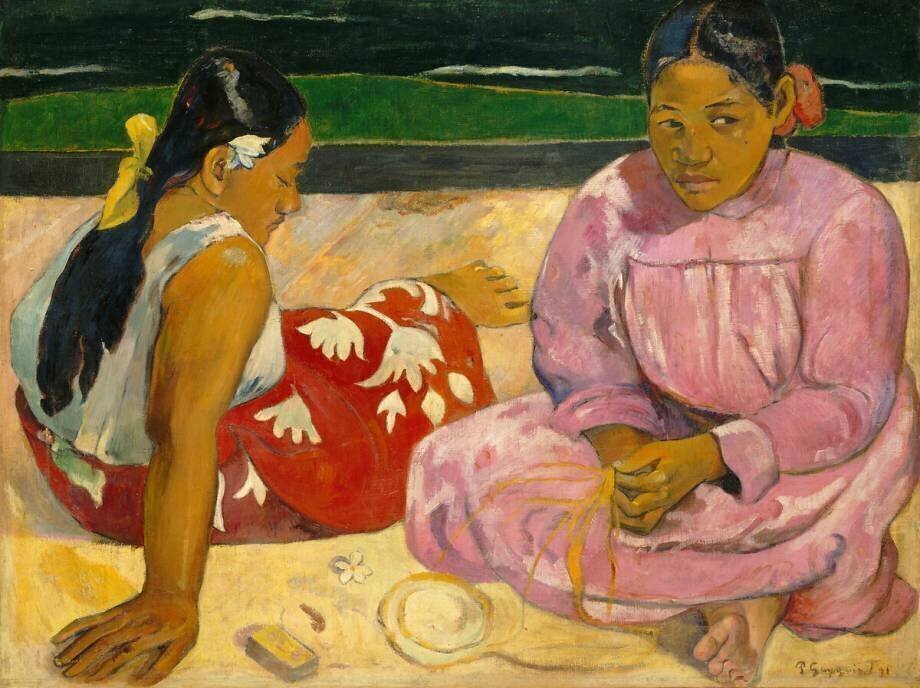
The composition of Women of Tahiti is striking for its apparent simplicity and quiet strength. Two Tahitian women are seated on a beach, the sand occupying a wide strip in the foreground. The background is dominated by the sea, rendered in flat areas of colour ranging from deep blue to emerald green, punctuated by fine white lines suggesting waves on the horizon. The line separating the beach from the ocean divides the canvas horizontally, creating a stable yet vibrant balance thanks to the treatment of the colours. Here, Gauguin uses the principles of synthetism developed in Pont-Aven: simplified forms outlined with a dark line and large areas of bright, non-naturalistic colours aimed at expressing an emotion or idea rather than imitating reality. The palette is rich and contrasting, contrasting the warm tones of the sarongs and skin with the cooler tones of the ocean. The artist plays on decorative harmonies, creating a pictorial surface that is almost abstract in places, where patterns and colours respond to each other, already heralding the chromatic audacity of the Fauves, particularly Matisse. The space seems both flat and deep, thanks in particular to the diagonal position of the woman on the left.
Motionless figures in the light of the Pacific: the central subject of Paul Gauguin's Femmes de Tahiti
At the heart of this composition are the two female figures, the central and enigmatic subject of the work. Sitting side by side, they nevertheless seem isolated from each other, lost in inner contemplation or gentle melancholy. The woman on the left, seen slightly in foreshortening, creates a diagonal line that energises the space. Dressed in a traditional floral-patterned sarong, she embodies a certain image of Tahitian exoticism. Her form is full, her posture stable, but her face, perhaps with closed or downcast eyes, suggests an impenetrable interiority. Next to her, the second woman is seated cross-legged. She is wearing a loose-fitting pink cotton dress with long sleeves and a high collar – a Western-influenced garment introduced by missionaries, contrasting with the pareo. This outfit conceals her figure and accentuates her silhouette. Her gesture is suspended: she delicately holds what appear to be plant fibres between her fingers, perhaps for weaving. Her expression is impassive, even sulky. Gauguin may have used the same model, possibly his young companion Teha'amana, for both figures, accentuating the effect of duplication and silent meditation that emanates from the scene.
Between myth and melancholy: the symbolism of Paul Gauguin's Women of Tahiti
Beyond simple representation, Women of Tahiti is imbued with complex symbolism, reflecting Gauguin's aspirations and disillusionments. Above all, the work embodies the Western myth of the Polynesian paradise, a place of innocence and primitive beauty far from European corruption. The bright colours, simplified forms and sensuality emanating from the figures contribute to this idealised vision. However, a closer look reveals an underlying tension. The contrast between the traditional pareo and the missionary's robe may symbolise cultural confrontation and the impact of colonisation on local traditions. The reserved, melancholic and silent attitude of the women (‘Always this silence,’ wrote Gauguin) contradicts the image of a simple and carefree joie de vivre. It could represent a form of passive resistance, nostalgia for a disappearing world, or even reflect the artist's own loneliness and existential questions in the face of a paradise that perhaps did not entirely live up to his expectations. The painting thus becomes less a description of Tahiti than a projection of Gauguin's state of mind and a meditation on loss, beauty and the mystery of otherness.
Women of Tahiti by Paul Gauguin: a seminal painting with a controversial legacy
Women of Tahiti occupies a significant place both in the career of Paul Gauguin and in the history of modern art. Painted at the beginning of his first stay in Polynesia, it marks a decisive step in his stylistic evolution, affirming the principles of synthetism and paving the way for an increasingly bold and subjective use of colour and form. This work, like others from his Tahitian period, would have a considerable influence on subsequent generations, notably the Fauves and the Expressionists, who were fascinated by its expressive power and its break with Western tradition. It helped forge Gauguin's image as a cursed and visionary artist, seeking the absolute at the ends of the earth. However, the legacy of Gauguin and his Tahitian works is now being re-evaluated through a postcolonial lens. The fascination with the ‘primitive’ and the representation of Tahitian women are being questioned, raising debates about exoticism, cultural appropriation and the power relations inherent in the colonial context, complicating the reception of this major painting, which continues to fascinate and provoke questions. Its impact remains undeniable, crystallising both a pictorial revolution and the ambiguities of a Western view of the Other.
This artwork is a painting from the modern period. It belongs to the post-impressionism style.
« Femmes de Tahiti ou Sur la plage » is kept at Musee d'Orsay, Paris, France.
Find the full description of Femmes de Tahiti ou Sur la plage by Paul Gauguin on Wikipedia.
Other artworks by Paul Gauguin
-
From42.66 €£36.2635.55 €£30.22
-
From39.98 €£33.9833.32 €£28.32
-
From40.96 €£34.8134.13 €£29.01
-
From42.91 €£36.4735.76 €£30.39
-
From42.66 €£36.2635.55 €£30.22
-
From42.88 €£36.4535.74 €£30.38
-
From49.24 €£41.8641.04 €£34.88
-
From36.9 €£31.3730.75 €£26.14
-
From43.15 €£36.6835.96 €£30.56
-
From39.98 €£33.9833.32 €£28.32


Other artworks in the same colors
-
From40.39 €£34.3333.66 €£28.61
-
From44.13 €£37.5136.78 €£31.26
-
From41.2 €£35.0234.33 €£29.18


Other similar artworks
-
From36.81 €£31.2930.68 €£26.07
-
From63.38 €£53.8852.82 €£44.9
-
From40.47 €£34.433.72 €£28.67
-
From42.17 €£35.8535.15 €£29.87
-
From39.74 €£33.7833.11 €£28.15
-
From44.13 €£37.5136.77 €£31.26
-
From39.74 €£33.7833.11 €£28.15
-
From34.37 €£29.2228.64 €£24.35
-
From39.98 €£33.9833.32 €£28.32
-
From55.8 €£47.4346.5 €£39.52