
Customise
Your art print
Fishermen at Sea OF Joseph Mallord William Turner
Fishermen at Sea
Fishermen at Sea by J. M. W. Turner: at the origins of the storm
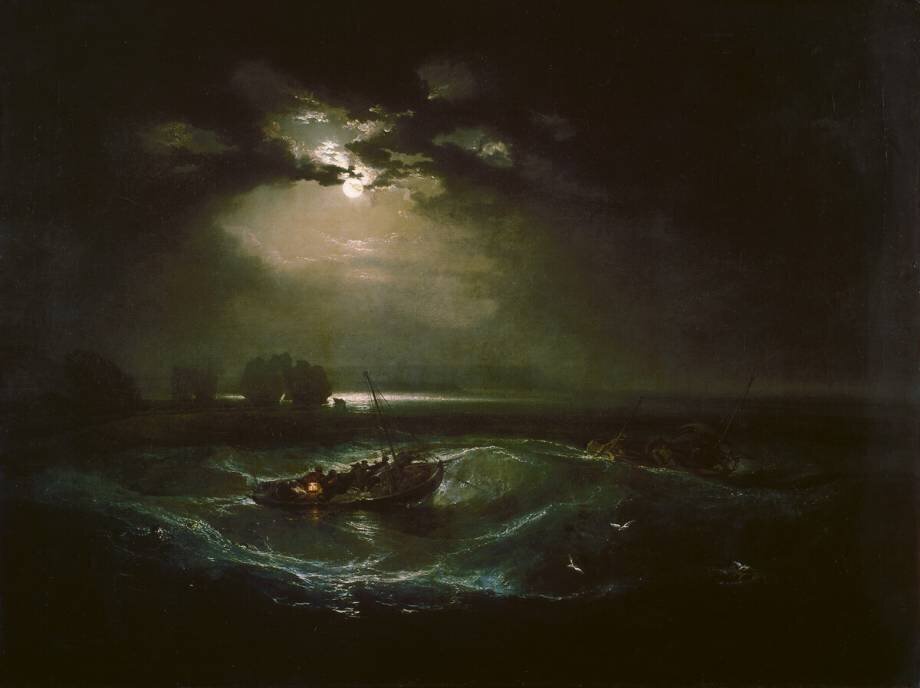
Fishermen at Sea (Fishermen at Sea) by Joseph Mallord William Turner, painted in 1796 when Turner was just twenty-one years old, was the first oil on canvas that the artist exhibited at the Royal Academy in London. At that time, marine painting enjoyed great popularity in England, an island nation proud of its naval power and maritime traditions. Influenced by the Dutch masters of the 17th century, such as Willem van de Velde the Younger, as well as by contemporaries like Philip James de Loutherbourg and Claude Joseph Vernet, Turner followed in this tradition whilst bringing a new sensibility to it, foreshadowing Romanticism. The young artist, already recognised for his watercolours, sought through this work to establish himself as an oil painter and to gain academic recognition. The historical context is also marked by the Napoleonic Wars, a period of tension and uncertainty that is reflected in the dramatic depiction of nature and the human condition in the face of its forces. The work is inspired by a scene observed by Turner off the coast of the Isle of Wight, notably the famous rock formations of the Needles, although some art historians suggest that it may depict the cliffs of Freshwater Bay. This direct confrontation with the elements of the sea fuels the artist’s imagination and provides him with the raw material for a pictorial exploration of the sublime, that aesthetic concept theorised by Edmund Burke which blends terror and fascination in the face of nature’s grandeur.
Fishermen at Sea by J. M. W. Turner: a nocturnal ballet of light and shadow
At first glance, Fishermen at Sea captivates the viewer with its nocturnal and dramatic atmosphere. The scene is dominated by a rough sea, whose dark and menacing waves crash violently. The sky, laden with stormy clouds, allows only a pale, intermittent moonlight to filter through, casting a ghostly glow over certain parts of the composition. Turner’s palette here is relatively restrained, playing on powerful contrasts between the deep blues, stormy greys and foamy whites of the sea, as well as the warmer, more delicate tones of the fishermen’s lantern. The composition is dynamic, organised around a diagonal suggested by the alignment of the boats and the direction of the waves. The jagged silhouettes of the cliffs on the left anchor the scene and reinforce the sense of danger. The chiaroscuro effect, inherited from the old masters but reinterpreted by Turner with a personal touch, accentuates the tension and mystery of the scene. The brushwork, although relatively detailed for this period of his career, already hints at the freedom of gesture and the emphasis placed on atmospheric effects that would become the artist’s trademark. The sea and sky seem to merge in places, creating a sense of immensity and infinity that overwhelms the frail boats.
Fishermen at Sea by J. M. W. Turner: the fragile epic of man facing the immensity
At the heart of this stormy sea, the central subject consists of two small fishing boats battling against the elements. The boat in the foreground, more clearly visible, is tossed about by the waves, its occupants struggling as best they can to stay on course and protect their modest catch. A lantern, a source of warm, flickering light, contrasts sharply with the cold moonlight and symbolises the human presence, precarious yet persistent, amidst an untamed natural world. The fishermen’s silhouettes are barely sketched, more suggested than precisely defined, which reinforces their vulnerability in the face of the overwhelming power of the sea. Their night-time toil, dangerous and arduous, is highlighted. Turner does not seek to glorify these figures, but rather to emphasise their everyday courage and their dependence on the whims of the ocean. The second boat, further away and partially in shadow, accentuates the depth of the scene and serves as a reminder that others share this same perilous fate. This depiction of the lives of seafarers reflects an interest in the daily lives and living conditions of the working classes, a recurring theme in a certain strand of Romanticism.
Fishermen at Sea by J. M. W. Turner: symbols of a sovereign nature
Fishermen at Sea is a work rich in symbolism, in which every element contributes to the dramatic and philosophical significance of the painting. The raging sea embodies the raw and indifferent power of nature, a force that is both creative and destructive. The tumultuous waves and jagged rocks represent the dangers and obstacles to which man is constantly confronted. The moon, the principal yet capricious source of light, symbolises mystery, the fickleness of fate and perhaps a form of distant and inscrutable divinity. In contrast, the small fishermen’s lantern, though fragile, represents the light of reason, of hope and of human resilience in the face of adversity. It is the warm focal point in a cold and threatening environment, a testament to the perseverance of the human spirit. The dark and imposing cliffs can be interpreted as the limits of human existence, insurmountable obstacles, or even silent witnesses to the smallness of man in the face of the immensity of the cosmos. The composition as a whole tends to illustrate the concept of the sublime: nature in its terrifying grandeur inspires both awe and admiration, reminding man of his own finitude but also of his capacity to experience intense emotions when faced with the spectacle of the world.
Fishermen at Sea by J. M. W. Turner: an inaugural masterstroke
The exhibition of Fishermen at Sea at the Royal Academy in 1796 was a notable critical success for the young Turner. The work was praised for its dramatic power, its innovative treatment of light and its immersive atmosphere. It helped establish Turner’s reputation not only as a talented watercolourist, but also as an emerging master of oil painting and a specialist in seascapes. This painting, measuring 91 centimetres in height and 122 centimetres in width, marks a decisive stage in his career, affirming his interest in the themes of nature, the sublime and the human condition, which would remain central throughout his artistic career. Fishermen at Sea, now held at Tate Britain in London, already foreshadows Turner’s future experiments with light, colour and texture, which would lead him towards increasing abstraction and establish him as one of the precursors of Impressionism and modern art. The impact of this work on art in general lies in its ability to transcend mere topographical representation to express deep emotions and universal questions. It paved the way for a new approach to landscape painting, no longer treating the landscape as mere scenery, but as a full-fledged participant in the human drama, capable of reflecting the artist’s state of mind and evoking an intense emotional response in the viewer. Even today, Fishermen at Sea continues to fascinate with its evocative power and its timeless modernity.
This artwork is a painting from the classical period. It belongs to the romanticism style.
« Fishermen at Sea » is kept at Tate Britain, Londres, Royaume-Uni.
Find the full description of Fishermen at Sea by Joseph Mallord William Turner on Wikipedia.
Other artworks by Joseph Mallord William Turner
-
From65.44 €£55.6254.53 €£46.35
-
From65.6 €£55.7654.66 €£46.47
-
From65.76 €£55.954.8 €£46.58
-
From72.75 €£61.8360.62 €£51.53
-
From47.78 €£40.6139.82 €£33.85
-
From69.66 €£59.2158.05 €£49.34
-
From73.88 €£62.861.57 €£52.33
-
From74.05 €£62.9461.7 €£52.45
-
From64.63 €£54.9353.86 €£45.78
-
From65.11 €£55.3554.26 €£46.12


Other artworks in the same colors
-
From47.54 €£40.4139.62 €£33.68
-
From38.76 €£32.9532.3 €£27.46
-
From42.17 €£35.8535.15 €£29.87
-
From81.35 €£69.1567.79 €£57.62
-
From34.86 €£29.6329.05 €£24.69
-
From79.55 €£67.6266.29 €£56.35
-
From74.05 €£62.9461.7 €£52.45


Other similar artworks
-
From54.62 €£46.4345.52 €£38.69
-
From61.7 €£52.4551.42 €£43.71
-
From41.2 €£35.0234.33 €£29.18
-
From34.37 €£29.2228.64 €£24.35
-
From51.68 €£43.9343.07 €£36.61
-
From46.32 €£39.3738.6 €£32.81
-
From51.59 €£43.8542.99 €£36.54
-
From59.95 €£50.9649.96 €£42.47