


Customise
Your art print
La diseuse de Bonne Aventure OF Georges de La Tour
La diseuse de Bonne Aventure
The Fortune Teller: echoes of a bygone era
The Fortune Teller, an iconic work by the Lorraine painter Georges de La Tour, is an oil on canvas generally dated to the 1630s, more specifically between 1635 and 1638. This period corresponds to a phase of artistic maturity for de La Tour, who was then working in the Duchy of Lorraine, a region at the crossroads of multiple cultural influences, notably French, Germanic and Italian. The painting is part of a European artistic movement fascinated by genre scenes, popularised in particular by the followers of Caravaggio, the Caravaggisti.
These scenes, often moralising, depict episodes of daily life, sometimes trivial or picturesque, featuring characters from different strata of society. The precise origin of the commission for The Fortune Teller remains a matter of debate amongst art historians. However, the richness of the costumes and the complexity of the composition suggest a wealthy and cultured patron, sensitive to the narrative ingenuity and psychological subtlety of the scene.
After a long period of obscurity, the painting was rediscovered in the 20th century, with its attribution to Georges de La Tour being established more definitively in the 1940s, notably thanks to the work of Charles Sterling and François Georges Pariset. Today, this major work is carefully preserved at the Metropolitan Museum of Art in New York, where it continues to fascinate visitors with its technical mastery and captivating narrative. Its dimensions—101.9 cm high by 123.5 cm wide—give it a striking presence, allowing the viewer to immerse themselves fully in the scene depicted.
The Fortune Teller by Georges de La Tour: a silent theatre
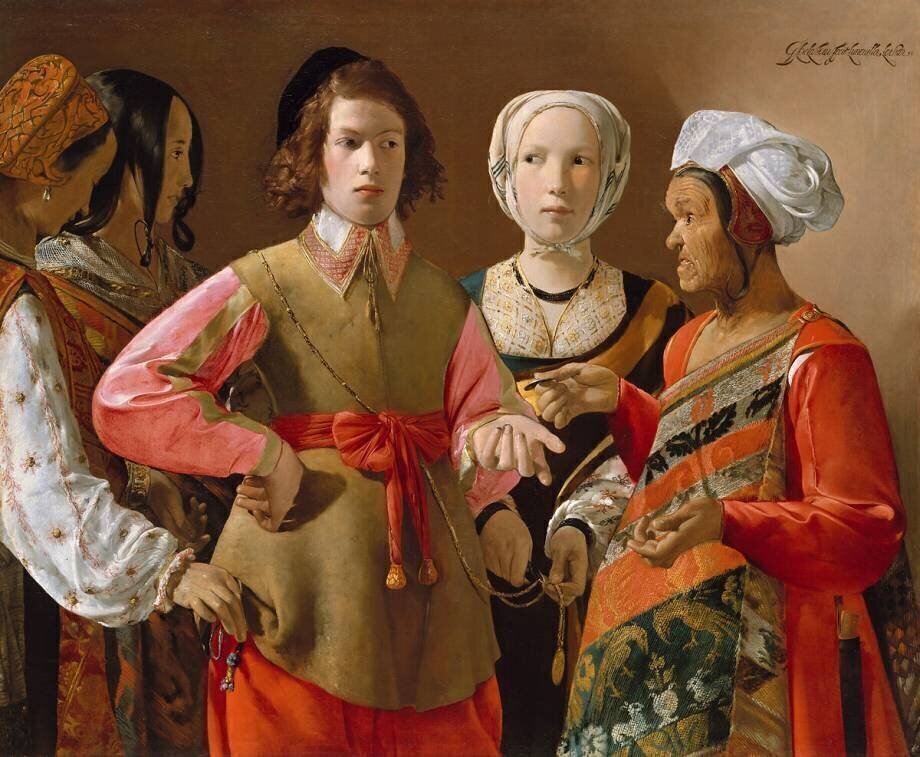
From the very first glance, The Fortune Teller strikes the viewer with its rigorous composition and the intensity of the interplay of gazes that structure the pictorial space. Georges de La Tour, often associated with his candlelit nocturnal scenes, demonstrates here his mastery of daylight effects, albeit subdued. The colour palette is rich and contrasting, dominated by warm tones – ochres, browns, reds – which lend the scene an atmosphere that is both intimate and laden with subtext.
The textures of the fabrics are rendered with remarkable precision, from sumptuous velvets to delicate brocades, emphasising the characters’ social status and adding a tactile dimension to the work. The scene is organised around a group of five figures, whose postures and expressions create a complex dynamic. In the centre, slightly to the left, a richly dressed young man holds out his palm to an old woman, the fortune-teller, who occupies the right-hand side of the composition. Around them, three young women, accomplices of the old gypsy, go about their business discreetly.
The artist employs a tight frame, placing the figures in the foreground, which reinforces the impression of witnessing an intimate, almost confidential scene. The light, coming from an unseen source to the left, sculpts the forms, accentuates the volumes and creates areas of shadow that conceal as much as they reveal, contributing to the ambiguity and dramatic tension of the whole. The background, sober and neutral, allows all attention to be focused on the figures and their interactions.
The Fortune Teller: chronicle of an orchestrated deception
The central subject of The Fortune Teller is a scene of theft by trickery, a popular theme in 17th-century genre painting, often used to illustrate the naivety of youth in the face of the world’s cunning. At the heart of the narrative is a young man, clearly from a wealthy background, as evidenced by his luxurious clothes and his somewhat vain demeanour. He is absorbed in having his palm read by an old woman with a wrinkled face and a piercing expression, the eponymous fortune-teller. Her gaze is fixed on the young man’s palm, but her posture and the presence of her accomplices suggest a skilfully orchestrated duplicity.
Whilst the young man’s attention is diverted by the old gypsy woman’s predictions, three young women act in silence. One, standing behind the young man on his right in the painting, is about to cut the chain of a gold medallion. Another, situated on the left of the painting, deftly slips her hand into the pocket of his doublet to steal his purse. The third, bareheaded, watches her accomplice, perhaps to retrieve the stolen loot.
The tension is palpable, with each character playing a specific role in this little silent drama where gullibility is exploited with cold efficiency. La Tour excels at capturing this moment of deception, freezing the gestures and expressions at their climax.
The Fortune Teller by Georges de La Tour: the secret language of appearances
Beyond a mere anecdote, The Fortune Teller is a work rich in symbols and moral allusions, characteristic of genre painting of the period. The theme of palmistry, or the reading of the lines of the hand, is in itself ambivalent: it evokes human curiosity about the future, but also superstition and the ease with which one can be deceived by false promises. The young man’s youth and inexperience are symbolised by his innocent gaze and his focus on the fortune-teller’s words, rendering him blind to the theft unfolding around him.
His fine clothes, a sign of his wealth, become here a lure for the thieves. The coin he is about to give to the old woman, or which he has just received from her as a decoy, may symbolise the price of deception or the vanity of material possessions. The faces of the young accomplices, though attractive, bear calculating and unempathetic expressions, embodying temptation and treachery. The old woman, the central figure of the deception, represents misguided wisdom, experience put to the service of evil.
Her dark complexion and weathered features contrast with the lighter skin and finer features of the young people, perhaps highlighting a contrast between age and cunning, youth and naivety. The scene as a whole can be interpreted as an allegory of Prudence in the face of the world’s dangers, a warning against deceptive appearances and false seductions. Through this composition, La Tour invites the viewer to reflect on the fragility of fortune and the need for vigilance.
Georges de La Tour and The Fortune Teller: the influence and legacy of a singular artist
The rediscovery of The Fortune Teller and its definitive attribution to Georges de La Tour in the mid-20th century played a crucial role in the re-evaluation of the artist and his work. Long overshadowed by other great names in 17th-century French painting, de La Tour is now recognised as one of the most original and profound painters of his time. This painting, in particular, is significant as it belongs to his “daytime scenes”, which are fewer in number or less well-preserved than his famous candlelit nocturnes, such as The Newborn or The Cheat with the Ace of Diamonds.
The Fortune Teller has helped to broaden our understanding of La Tour’s stylistic range, demonstrating his ability to excel equally in compositions bathed in more natural light, whilst retaining that atmosphere of silence and psychological tension which characterises his art. The work bears witness to the influence of Caravaggio and his followers, particularly in the realistic treatment of the figures and the use of chiaroscuro, but de La Tour brings a personal touch to it, a simplification of forms and a geometrisation of the compositions that are unique to him. From an art-historical perspective, the painting is a masterful example of genre painting, illustrating the moral and social concerns of the era.
Its complex narrative, the subtlety of the psychological analysis of the characters and its exceptional pictorial quality make it a centrepiece not only of Georges de La Tour’s oeuvre, but also of 17th-century European painting. Its presence at the Metropolitan Museum of Art ensures international visibility for the art of Georges de La Tour, contributing to his renown and the ongoing study of his artistic legacy.
This artwork is a painting from the classical period. It belongs to the baroque style.
« La diseuse de Bonne Aventure » is kept at Metropolitan Museum of Art, New York, USA.
Find the full description of La diseuse de Bonne Aventure by Georges de La Tour on Wikipedia.
Other artworks by Georges de La Tour
-
From58.77 €£49.9648.98 €£41.63
-
From59.93 €£50.9449.94 €£42.45
-
From51.55 €£43.8242.96 €£36.52
-
From54.01 €£45.9145.01 €£38.26
-
From66.28 €£56.3455.24 €£46.95
-
From59.93 €£50.9449.94 €£42.45
-
From50.97 €£43.3342.48 €£36.11
-
From58.63 €£49.8448.86 €£41.53
-
From56.46 €£47.9947.05 €£40
-
From49.1 €£41.7340.92 €£34.78


Other artworks in the same colors
-
From66.86 €£56.8355.72 €£47.36
-
From51.27 €£43.5842.72 €£36.31
-
From53.66 €£45.6144.71 €£38.01
-
From56.61 €£48.1247.17 €£40.1
-
From88.96 €£75.6174.13 €£63.01
-
From57.47 €£48.8547.9 €£40.71
-
From32.43 €£27.5727.03 €£22.97


Other similar artworks
-
From59.93 €£50.9449.94 €£42.45
-
From70.74 €£60.1358.95 €£50.11
-
From61.56 €£52.3351.3 €£43.61
-
From37.94 €£32.2531.62 €£26.87
-
From61.7 €£52.4551.42 €£43.71
-
From61.85 €£52.5751.54 €£43.81
-
From54.15 €£46.0345.13 €£38.36
-
From46.4 €£39.4438.66 €£32.86