
Customise
Your art print
Magdalene with the Smoking Flame OF Georges de La Tour
Magdalene with the Smoking Flame
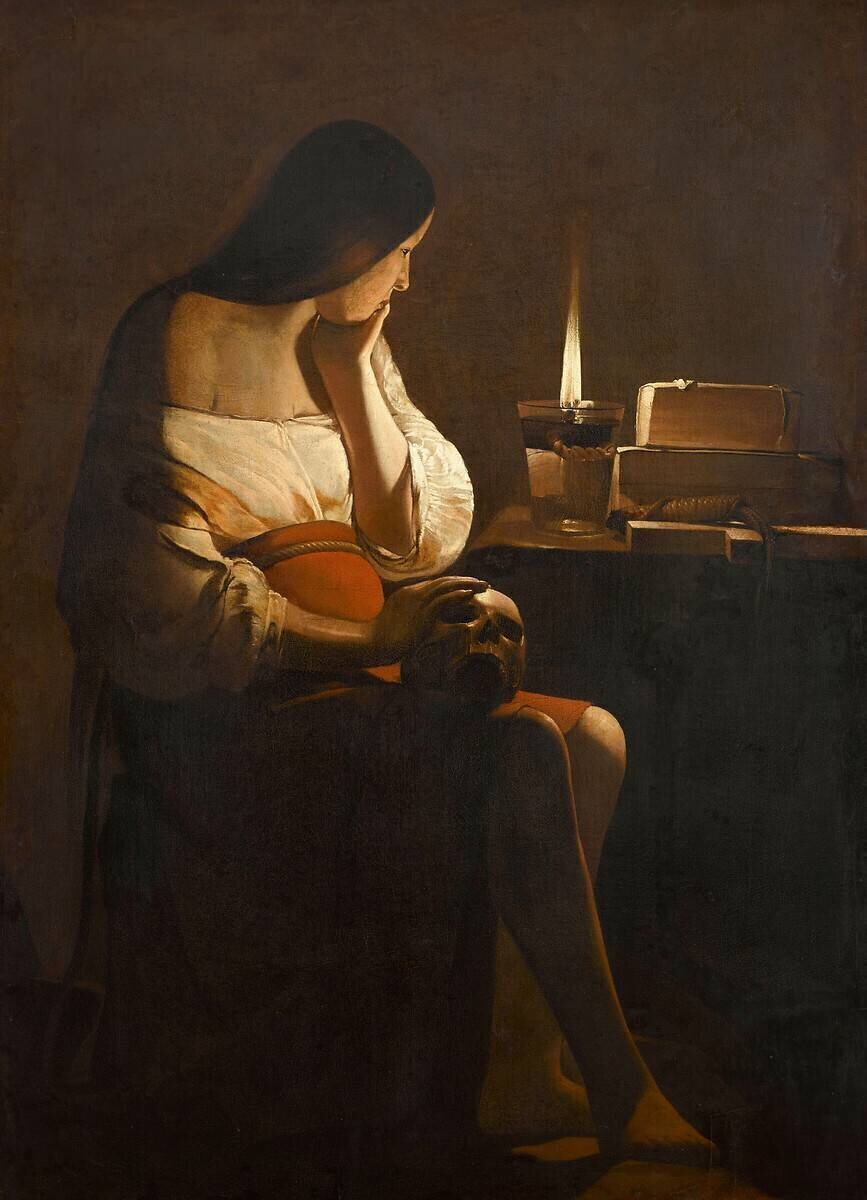
Georges de La Tour, the master of Lorraine chiaroscuro, produced The Magdalene by the Lamp, an iconic work now carefully preserved at the Louvre Museum in Paris. This oil on canvas, measuring 128 cm in height and 94 cm in width, invites deep introspection through its refined composition and intense symbolic meaning. Painted between 1642 and 1644, it continues to fascinate with its modernity and the spirituality it exudes.
Magdalene with the Smoking Flame by Georges de La Tour: a glimmer of light in Lorraine during the Grand Siècle
In the mid-17th century, the Duchy of Lorraine, the birthplace of Georges de La Tour, was a border region ravaged by political and religious upheaval, notably the Thirty Years’ War and epidemics. It is against this backdrop of spiritual fervour stemming from the Catholic Counter-Reformation, which emphasised the figures of repentant saints and personal meditation, that Magdalene with the Smoking Flame is set. Georges de La Tour, although appointed Ordinary Painter to King Louis XIII and having had the opportunity to work at the Louvre, chose to remain and develop his art in Lorraine, in Lunéville.
His style, characterised by a reinterpreted Caravaggism, is distinguished by a particular focus on nocturnal scenes, illuminated by a single, intimate light source. This work forms part of a series of several paintings devoted to Mary Magdalene, a theme that was very popular at the time for its ability to embody penance and redemption. The Louvre’s version, acquired in 1949 after having been hidden in a German salt mine during the Second World War to protect it from bombing, is considered one of the most accomplished in this series, bearing witness to the painter’s artistic maturity.
An intimate dialogue with the invisible: The composition of Magdalene with the Smoking Flame by Georges de La Tour
The visual impact of Magdalene with the Smoking Flame lies in its disarming simplicity and the exceptional mastery of chiaroscuro. The scene is bathed in deep twilight, from which emerges the figure of Mary Magdalene, theatrically illuminated by the solitary flame of an oil lamp placed before her. This single light source sculpts the forms, creates striking contrasts between areas of warm light and enveloping shadows, and focuses the viewer’s attention on the saint’s contemplative face and the symbolic objects surrounding her.
The colour palette is deliberately restricted, dominated by browns, ochres and dark reds, reinforcing the austere and meditative atmosphere. Georges de La Tour excels in the geometrisation of forms, lending the composition an almost architectural structure and great sobriety. The drapery of Mary Magdalene’s shirt, though simple, is rendered with a monumentality that accentuates the figure’s dignity. The artist eliminates all superfluous detail; every element contributes to the expressive power of the whole, inviting the viewer to enter a space of silence and contemplation.
Mary Magdalene: a figure of contemplation and penance
At the centre of this poignant painting stands Mary Magdalene, depicted not in her former glory as a sinner or in mystical ecstasy, but in a moment of profound introspection and penance. Seated, barefoot, dressed in a simple shirt of coarse linen and a dark skirt, she embodies humility and renunciation of worldly vanities. Her face, with its pure features, is turned towards the flame of the night light, a source of both physical and metaphorical light.
Her left hand delicately supports her chin in a classic gesture of melancholy and meditation, whilst her right hand rests on a skull placed upon her lap. Her gaze is not vacant, but filled with intense inner concentration, as though she were contemplating the mystery of life, death and faith. Georges de La Tour succeeds in conveying, with remarkable economy of means, the complexity of his subject’s emotions: regret for the past, an awareness of the fragility of existence, and a longing for a purified spiritual life. She thus becomes a universal allegory of the quest for meaning and reflection on the human condition.
Magdalene with the Smoking Flame by Georges de La Tour: a ballet of shadows and symbols
The power of The Magdalene by the Night Light lies not only in its formal beauty, but also in the symbolic richness of the objects accompanying the saint in her meditation. The night light, whose flickering flame is the focal point of the composition, is a multifaceted symbol. It represents divine light, the faith that illuminates the darkness of doubt and sin, but also the transience of human life, destined to burn out.
The skull, which Madeleine touches with her hand, is an eloquent ‘memento mori’, a reminder of inevitable death and the vanity of earthly pleasures, inviting detachment and spiritual preparation. Beside her, two devotional books evoke the importance of prayer, the study of sacred texts and meditation on the path to redemption. Occasionally, in other versions by La Tour, a discipline (a small whip) is present, emphasising the aspect of bodily mortification associated with penance. Each object, carefully illuminated, contributes to this silent dialogue on the themes of life, death, the passing of time and spirituality, transforming the scene into a veritable philosophical still life, which some critics, such as Pierre Rosenberg, have described as ‘cubist’ ahead of its time due to its stylisation and depth.
The legacy of Georges de La Tour and the aura of his Magdalene
Although Georges de La Tour enjoyed a certain degree of recognition during his lifetime, even being appointed the king’s official painter, his work fell into near-total obscurity for nearly three centuries after his death in 1652. It was not until the early 20th century, notably thanks to the work of the German art historian Hermann Voss in 1915, that his genius was rediscovered and his body of work gradually reconstructed. Magdalene with the Smoking Flame, and more broadly the series of Madeleines, occupies a central place in this rediscovery and in the appreciation of his art.
These paintings perfectly illustrate his stylistic maturity, his unrivalled mastery of chiaroscuro, and his ability to infuse scenes of great formal restraint with profound spirituality and restrained emotion. The work has not only enabled a reassessment of Georges de La Tour’s importance in 17th-century French and European painting, establishing him as an original and powerful interpreter of Caravaggism, but it has also left a lasting mark on the collective imagination. The figure of this contemplative Mary Magdalene has inspired artists and writers, such as the poet René Char, and continues to resonate with contemporary audiences through its timeless modernity and universal invitation to introspection. It remains one of the jewels of the Louvre Museum and a poignant testament to the human quest for meaning.
This artwork is a painting from the classical period. It belongs to the baroque style.
« Magdalene with the Smoking Flame » is kept at Louvre, Paris, France.
Find the full description of Magdalene with the Smoking Flame by Georges de La Tour on Wikipedia.
Other artworks by Georges de La Tour
-
From67.59 €£57.4556.33 €£47.88
-
From68.92 €£58.5857.43 €£48.82
-
From59.29 €£50.3949.41 €£42
-
From62.11 €£52.7951.76 €£43.99
-
From76.23 €£64.7963.52 €£53.99
-
From59.27 €£50.3849.39 €£41.98
-
From58.62 €£49.8348.85 €£41.52
-
From67.42 €£57.3156.19 €£47.76
-
From64.93 €£55.1954.11 €£45.99
-
From56.46 €£47.9947.05 €£40


Other artworks in the same colors
-
From61.87 €£52.5951.56 €£43.82
-
From80.38 €£68.3266.98 €£56.93
-
From66.09 €£56.1855.07 €£46.81
-
From75.89 €£64.5163.25 €£53.76
-
From38.52 €£32.7432.1 €£27.28


Other similar artworks
-
From67.42 €£57.3156.19 €£47.76
-
From77.94 €£66.2564.95 €£55.21
-
From57.32 €£48.7247.77 €£40.6
-
From57.16 €£48.5847.63 €£40.49
-
From64.27 €£54.6353.56 €£45.52
-
From67.42 €£57.3156.19 €£47.76
-
From49.31 €£41.9241.09 €£34.93