


Customise
Your art print
Les Cribleuses de blé OF Gustave Courbet
Les Cribleuses de blé
Gustave Courbet’s *The Wheat Sifters*: At the Earth’s Roots
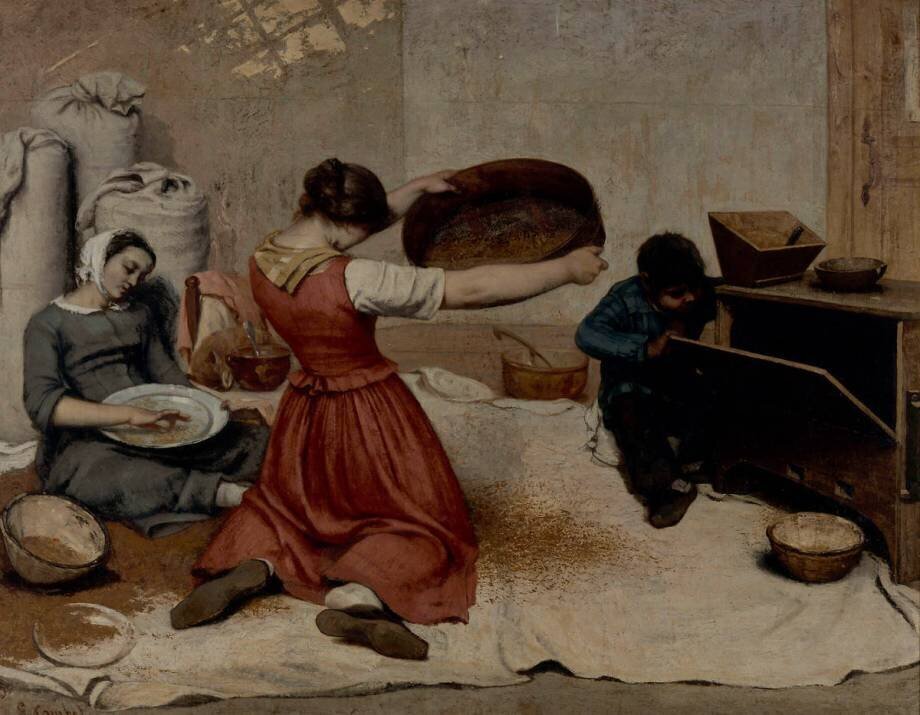
The Wheat Sifters, carefully preserved at the Nantes Museum of Art, has its origins in Gustave Courbet’s deep attachment to his native Franche-Comté and its people. Painted in Ornans during the winter of 1853–1854, this large canvas, measuring 131 x 167 cm, forms part of a series of works dedicated to rural life, following on from paintings such as The Village Girls. Courbet chose his models from among his relatives: his two sisters, Zoé, who embodies the central, energetic figure engaged in winnowing, and Juliette, seated, sorting the grain more passively. The young boy observing the tarare, a mechanical sorting device, is believed to be Désiré Binet, the painter’s illegitimate son. This choice of familiar models anchors the work in an intimate reality, whilst giving it universal significance. The historical context is that of a rural France undergoing profound change, where agricultural labour, though arduous, forms the backbone of the economy. By choosing to glorify this daily toil, Courbet went against the grain of the noble or mythological subjects then in vogue at the Academy, thereby affirming his desire to paint the ‘real’. The work bears witness to the dynamism of a peasantry keen to make their land profitable, in a region of the Doubs where cereal farming, particularly wheat, was predominant in supplying the growing towns.
The Wheat Sifters by Gustave Courbet: visual harmony of labour
At first glance, The Wheat Sifters strikes the viewer with its balanced composition and the richness of its colour palette, dominated by a monochrome of warm ochres that evokes the golden dust of the ever-present wheat. The wheat piles up on a large beige sheet covering most of the floor, creating a tangible and immersive workspace. In the centre, the figure of Zoé, kneeling and seen in three-quarter profile from behind, commands attention through an almost sculptural monumentality and the intensity of her orange-red dress, the true focal point of the composition. This vibrant colour contrasts with the cooler tones of Juliette’s dress and the little boy’s jacket, positioned on either side, establishing a subtle chromatic dialogue. The soft, natural light seems to bathe the scene, illuminating the precise gestures of the women at work and the textures of the sacks of grain, the copper and earthenware utensils, the wicker basket and even the ginger cat sleeping on a small chair. The pictorial space, devoid of a traditional vanishing point, focuses attention on the figures and their interaction with their immediate surroundings, emphasising the confinement and concentration required by the task.
Gustave Courbet’s The Wheat Sifters: the sifter, an allegory of effort
The central subject, the sifter portrayed by Zoé Courbet, is a figure of remarkable strength and dignity. Kneeling, her body tense with effort, she energetically wields the van, a large sieve used to separate the good grain from the chaff and impurities. Her face is largely concealed, lending her action a universal character, that of the anonymous yet essential worker. The musculature of her arms, suggested beneath the fabric of her dress, and the broad, repetitive movement with which she wields her tool convey the physical strength required for this gruelling task. Her posture, though turned away, exudes a ‘muscular expansiveness’ and a tension that radiates throughout the canvas. Some analysts have even noted the disturbing sensuality of this position and this body straining with effort. She is not merely winnowing the wheat; she appears to be performing an ancestral ritual, a sort of offering to Mother Earth, as suggested by the impression she gives of presenting the fruit of her labour. The precision of the gesture, the visible concentration despite the absence of detailed facial features, make this figure a true allegory of peasant labour in its noblest and most arduous form.
Gustave Courbet’s Wheat Sifters: symbols and interpretations of a peasant scene
The Wheat Sifters lends itself to multiple levels of interpretation, enriching its realistic dimension with a profound symbolic significance. Art historian Linda Nochlin saw in it a representation of technical progress in agriculture: on the left, Juliette is sorting by hand, a slow and traditional method; in the centre, Zoé is using the sieve, a more efficient and vigorous method; finally, on the right, the young boy examines the tarare, a machine that mechanises the process of winnowing and sorting grain, thus embodying the future and modernisation. This interpretation suggests a transition between old methods and new technological advances that were beginning to transform the rural world. Other analyses see the figure of the woman sifting grain as a metaphor for the painter himself: her gesture of throwing the grains onto the cloth can be likened to the artist’s gesture of applying paint to the canvas, each grain becoming a stroke of paint. The sleeping woman on the left could thus symbolise the hand holding the palette. The sturdiness of the sifter’s arm has also been compared to that of Michelangelo’s Libyan Sibyl, lending a classical nobility to this scene of everyday life. Work absorbs the figures, and the numerous realistic details – the sacks, the bowls, the cat – anchor the scene in an authenticity that invites reflection on the human condition and the value of labour.
The Wheat Sifters by Gustave Courbet: the mark of a giant
Whilst The Wheat Sifters may not have caused the same scandal as other works by Courbet such as A Burial at Ornans or the iconic The Origin of the World, it remains nonetheless a masterpiece in the artist’s career and a significant milestone in art history. By choosing to depict a scene of peasant life with such monumentality and such seriousness, Courbet continues to challenge academic conventions and the hierarchy of pictorial genres. This work is fully in keeping with his commitment to realism, aimed at ‘bringing art to life’ and depicting the customs, ideas and appearance of his era. Acquired by the Nantes Museum as early as 1861, the painting bears witness to the gradual recognition of his talent, despite the often virulent criticism he faced. More broadly, Courbet’s realism, of which The Wheat Sifters is an eloquent example, had a considerable impact on the evolution of painting. It paved the way for new artistic approaches, notably Impressionism, by legitimising the depiction of everyday life and encouraging a more direct observation of reality. Courbet’s influence extended far beyond this, reaching artists of later movements, including major figures of the 20th century such as Picasso, who recognised the power and modernity of his pictorial approach. Thus, The Wheat Sifters contributes to the revolution in perception that Courbet initiated, marking a step towards modernity in art.
This artwork is a painting from the classical period. It belongs to the realism style.
« Les Cribleuses de blé » is kept at Musée des Beaux-Arts, Nantes, France.
Find the full description of Les Cribleuses de blé by Gustave Courbet on Wikipedia.
Other artworks by Gustave Courbet
-
From51.84 €£44.0743.2 €£36.72
-
From53 €£45.0544.17 €£37.54
-
From51.96 €£44.1743.3 €£36.81
-
From35.12 €£29.8529.27 €£24.88
-
From53.58 €£45.5444.65 €£37.95
-
From53.43 €£45.4244.53 €£37.85
-
From36.21 €£30.7830.17 €£25.65
-
From65.42 €£55.654.51 €£46.34
-
From53.43 €£45.4244.53 €£37.85
-
From52.56 €£44.6843.8 €£37.23


Other artworks in the same colors
-
From37.44 €£31.8331.2 €£26.52
-
From36.86 €£31.3330.71 €£26.11
-
From41.13 €£34.9634.27 €£29.13
-
From32.22 €£27.3926.85 €£22.82
-
From35.19 €£29.9129.32 €£24.93


Other similar artworks
-
From48.43 €£41.1740.36 €£34.31
-
From61.23 €£52.0551.02 €£43.37
-
From58.32 €£49.5748.6 €£41.31
-
From51.68 €£43.9343.07 €£36.61
-
From57.89 €£49.2148.24 €£41.01
-
From54.79 €£46.5745.65 €£38.81
-
From52.95 €£45.0144.13 €£37.51