
Customise
Your art print
Salome with the Head of John the Baptis... OF Caravaggio
Salome with the Head of John the Baptist
Caravaggio’s *Salome with the Head of Saint John the Baptist*: the origins of a silent biblical drama
Painted between 1607 and 1610, during Caravaggio’s late Neapolitan period, this version of Salome with the Head of Saint John the Baptist, now in the National Gallery in London, was created against a backdrop of flight and hope for the artist. Sentenced to death for murder in Rome, Caravaggio sought refuge and protection, whilst hoping to obtain papal pardon. This work, like others from this period, is imbued with a sombre atmosphere and a palpable introspection, perhaps reflecting the painter’s own anxieties and quest for redemption. The painting, measuring approximately 91 cm in height by 106 cm in width, was rediscovered in a private collection as late as 1959 before joining the prestigious collections of the National Gallery in London, where it continues to fascinate visitors. The exact provenance and the original patron remain a matter of debate amongst art historians, but the intensity of the scene and the technical mastery leave no doubt as to the Lombard master’s authorship, as he was at the height of his artistry towards the end of his life. This period of his career was marked by a creative urgency, producing works of rare emotional power.
Caravaggio’s Salome with the Head of Saint John the Baptist: a scene bathed in striking light and shadow
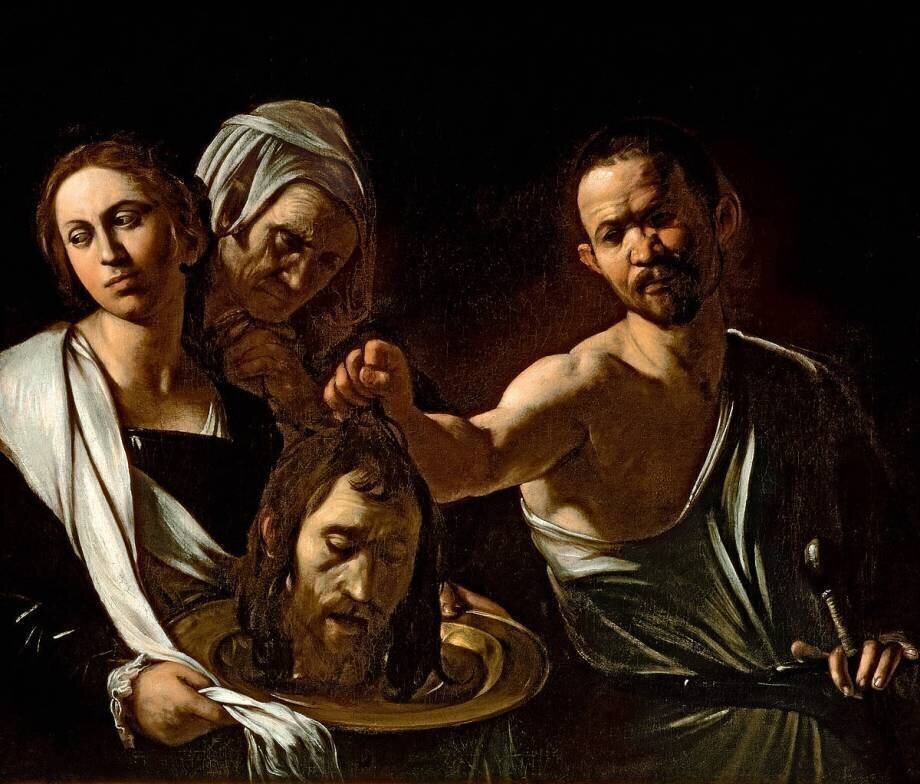
The composition of the painting is a masterful example of Caravaggesque tenebrism, where the figures emerge from a dark background thanks to powerful, directed side lighting. The light, coming from the left of the canvas, sculpts the forms, accentuates the textures of the drapery and flesh, and intensifies the psychological drama unfolding. The colours are subdued, dominated by deep browns, ochres and dark reds, contrasting with the luminous whiteness of the clothing and the pallid skin of John the Baptist’s head. This restricted palette reinforces the solemnity and gravity of the scene. Caravaggio arranges his figures into a compact group, depicted from the waist up, creating an immediate sense of closeness with the viewer, almost as if we were direct witnesses to this tragic moment. The overall atmosphere is heavy and silent, with every detail contributing to a contained yet explosive dramatic tension. The pictorial quality, particularly the rendering of fabrics such as velvet or linen, and the flesh tones of the figures, bears witness to the keen observation of reality that characterises Caravaggio’s revolutionary naturalism, even in his later works, which are marked by greater sobriety.
Caravaggio’s Salome with the Head of Saint John the Baptist: the macabre ballet of the protagonists
At the heart of the canvas, the biblical scene of the presentation of John the Baptist’s head to Salome is rendered with remarkable psychological intensity. Salome, young and dressed with simple elegance, stands on the left. Her face, though bathed in light, is turned away from the saint’s head, her gaze lost beyond the frame, expressing a complex mix of emotions: perhaps a cold detachment, a hint of regret, or an inability to face the horror of her deed. She holds the platter on which the executioner has just placed the prophet’s head. The executioner, a sturdy, shadowed figure in the centre, tilts John the Baptist’s head onto the platter with an almost mechanical gesture, his face rough and impassive, as if accustomed to the violence of his task. To Salome’s right, an old woman, often identified as Herodias, the girl’s instigating mother, gazes at the head with an expression of horror and intense pain, her hands clasped in a gesture of despair or belated prayer. This figure contrasts sharply with Salome’s youth and her apparent indifference. The head of John the Baptist, livid and with closed eyes, is of a raw realism, a macabre centre of the composition towards which, paradoxically, few gazes converge directly.
Salome with the Head of Saint John the Baptist by Caravaggio: the silent polyphony of symbols
Every element of Salome with the Head of Saint John the Baptist carries a profound symbolic significance, contributing to the work’s interpretative richness. The decapitated head of John the Baptist, a symbol of martyrdom for truth and justice, lies on the silver platter, an object that may evoke both the wealth and the macabre reward of King Herod. The interplay of gazes is crucial: Salome avoids direct confrontation with the consequence of her fateful dance, suggesting a possible dissociation or inner conflict. Her avoiding gaze can be interpreted as a form of budding guilt or calculated coldness. The old servant, or Herodias depending on the interpretation, through her expression of explicit grief, embodies the moral conscience or remorse in the face of the deed done, acting as an emotional counterpoint to Salome. The executioner, a mere instrument of cruelty, represents blind brutality. The intense light that falls upon Salome and the head, whilst leaving the executioner and part of Herodias in shadow, could symbolise the bringing to light of the truth and its consequences, despite attempts at moral obfuscation. The work thus explores the universal themes of seduction, revenge, death, guilt and regret, with each character playing a part in this silent drama of the human condition.
Salome with the Head of Saint John the Baptist: the immortal echo of a tormented artist
Salome with the Head of Saint John the Baptist is an emblematic work from the final period of Caravaggio, marking a high point of his artistic maturity whilst having been painted in the final years of his tragic life. The impact of this painting, and more broadly of his late style, was considerable. The dramatic naturalism, the revolutionary use of chiaroscuro to intensify the emotion and psychological depth of the characters, left a profound mark on his contemporaries and subsequent generations, notably the Caravaggisti active in Naples and elsewhere in Europe, such as Battistello Caracciolo and Jusepe de Ribera. For Caravaggio himself, works such as this, often interpreted as reflections on death, justice and the possibility of forgiveness, may have been desperate attempts to secure papal pardon and return to Rome. The violence of the subject, treated with poignant restraint, may also echo his own existence, marked by brawls and acts of violence. Thus, this version of Salome with the Head of Saint John the Baptist is not only a biblical masterpiece, but also a poignant testimony to the inner struggle of a brilliant yet cursed artist, whose influence redefined the currents of Baroque painting and continues to resonate in art to this day.
This artwork is a painting from the classical period. It belongs to the baroque style.
« Salome with the Head of John the Baptist » is kept at National Gallery, London, United Kingdom.
Find the full description of Salome with the Head of John the Baptist by Caravaggio on Wikipedia.
Other artworks by Caravaggio
-
From37.79 €£32.1231.49 €£26.77
-
From51.8 €£44.0343.17 €£36.69
-
From50.99 €£43.3442.49 €£36.12
-
From56.02 €£47.6246.68 €£39.68
-
From62.68 €£53.2852.23 €£44.4
-
From65.11 €£55.3554.26 €£46.12
-
From65.44 €£55.6254.53 €£46.35
-
From64.44 €£54.7753.7 €£45.64
-
From74.69 €£63.4962.25 €£52.91
-
From65.28 €£55.4954.4 €£46.24


Other artworks in the same colors
-
From62.68 €£53.2852.23 €£44.4
-
From49.31 €£41.9241.09 €£34.93
-
From66.76 €£56.7555.63 €£47.29
-
From46.64 €£39.6538.87 €£33.04
-
From61.45 €£52.2351.21 €£43.52


Other similar artworks
-
From65.28 €£55.4954.4 €£46.24
-
From58.79 €£49.9748.99 €£41.64
-
From69.58 €£59.1557.99 €£49.29
-
From61.11 €£51.9550.93 €£43.29
-
From71.08 €£60.4259.23 €£50.35
-
From62.77 €£53.3652.31 €£44.47
-
From41.51 €£35.2934.59 €£29.41