

Customise
Your art print
Self Portrait with Bandaged Ear and Pip... OF Vincent van Gogh
Self Portrait with Bandaged Ear and Pipe
Self-Portrait with Bandaged Ear and Pipe: a journey into Van Gogh’s soul
Self-Portrait with Bandaged Ear and Pipe by Vincent van Gogh, painted in January 1889, remains one of the artist’s most poignant and introspective works. It bears witness to a period of profound crisis whilst affirming a determination to persevere and an undiminished artistic mastery. Currently held in a private collection belonging to the Niarchos family, this 51 x 45 cm oil on canvas continues to fascinate with its emotional power and symbolic complexity.
Self-Portrait with Bandaged Ear and Pipe by Vincent van Gogh: at the source of turmoil
The creation of the Self-Portrait with Bandaged Ear and Pipe took place against a biographical backdrop that was particularly dramatic for Vincent van Gogh. Settled in Arles, in the south of France, the artist harboured the dream of founding a ‘atelier du Midi’, a community of artists sharing ideals and creativity. Paul Gauguin joined him there in October 1888, but their cohabitation quickly proved stormy, punctuated by artistic and personal tensions.
The situation came to a tragic head on the night of 23 December 1888. Following a violent argument with Gauguin, Van Gogh, in an act of self-mutilation that has remained infamous, cut off part of his left ear with a razor blade. This event marked the abrupt end of his collaboration with Gauguin and plunged Van Gogh into a deep psychological distress. It was therefore a few weeks after this episode, having barely recovered from his injury and the crisis that accompanied it, that the artist chose to paint a self-portrait.
Painted in January 1889, this self-portrait is one of two created after the incident; this one shows him with a pipe, an accessory laden with meaning. The work thus arose from an inner necessity: to confront his wounded image and to bear witness, through the act of painting, to an attempt at reconstruction.
Self-Portrait with Bandaged Ear and Pipe: a visual dialogue with Vincent van Gogh
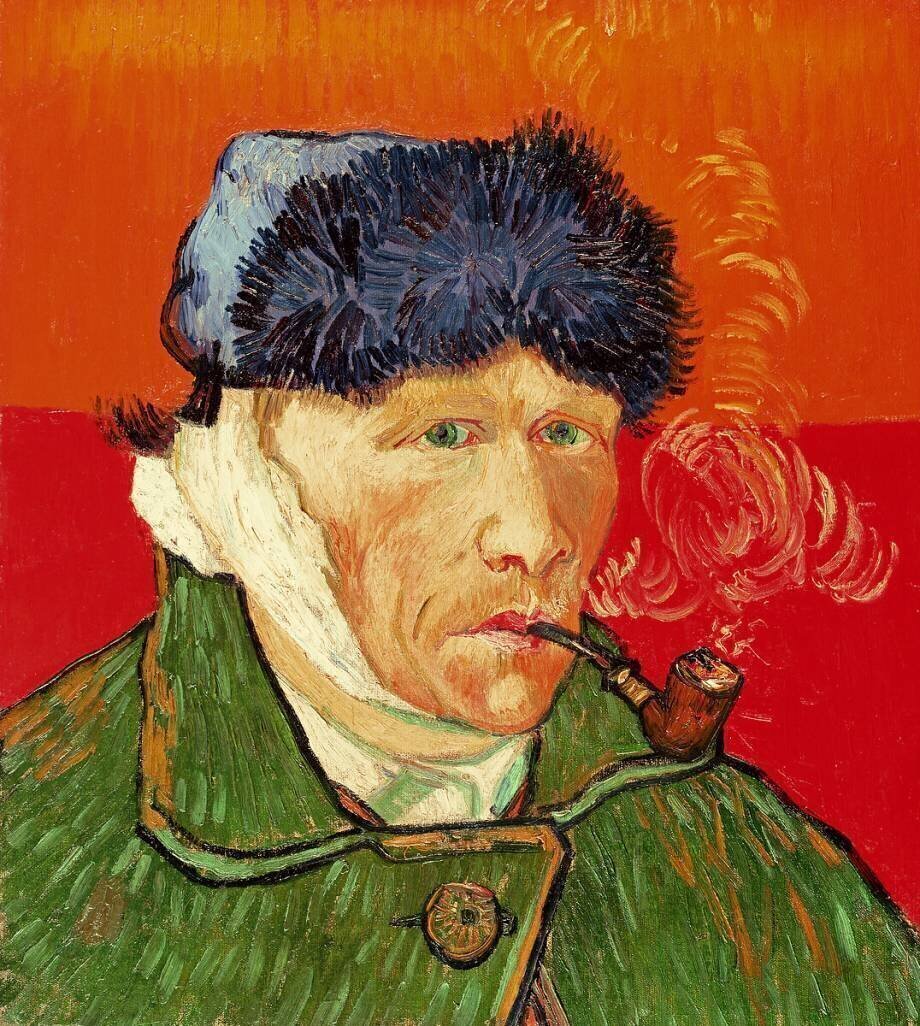
The Self-Portrait with Bandaged Ear and Pipe offers a carefully crafted composition in which every element contributes to the overall atmosphere of the work. Van Gogh depicts himself in three-quarter profile, his face turned towards the viewer’s right (in reality his left, as the image is reversed by the use of a mirror to paint the self-portrait). He occupies a prominent position within the frame, his torso filling a large part of the space.
The artist wears a thick jacket in green, fastened high up at the neck, and a blue and grey fur cap that covers part of his head. The most striking feature is, of course, the white bandage wrapped around his head, concealing his injured ear. The pipe, which he holds in his mouth, releases light wisps of white smoke, creating a subtle contrast with the apparent rigidity of his posture. The background is divided into two distinct and vibrant colour planes: a lower section of intense red and an upper section of luminous orange, tinged with touches of yellow. The colour palette, though vivid, is used with a sense of harmony and balance, characteristic of Van Gogh’s Post-Impressionist style, with its visible, expressive brushstrokes that structure the forms and enliven the surface of the canvas.
Vincent van Gogh at the heart of the storm in his Self-Portrait with Bandaged Ear and Pipe
The central subject of this work is none other than Vincent van Gogh himself, captured in a moment of extreme vulnerability and confrontation with his own suffering. His face, marked by hardship, expresses a profound weariness. His features are drawn, his jaw appears clenched, and his gaze, though direct, seems lost in an inner contemplation, perhaps shying away from direct contact with the viewer. Despite being 35 years old at the time of its creation, the artist seems to bear the weight of a much longer life, his expression betraying palpable fatigue and sadness.
The white bandage, a silent witness to his self-harm, is impossible to ignore, a constant reminder of the recent tragedy. However, the presence of the pipe, held firmly between his lips, introduces a nuance. It suggests an attempt to regain a semblance of calm, a form of serene resignation in the face of adversity. Van Gogh does not seek to hide his injury or his distress, but presents himself with disarming honesty, offering the viewer a raw image of his physical and psychological state, an unvarnished account of his inner struggle.
Van Gogh’s Self-Portrait with Bandaged Ear and Pipe: the symbolic significance of the elements
Every component of the Self-Portrait with Bandaged Ear and Pipe is imbued with a symbolic significance that enriches the interpretation of the work. The bandage, quite obviously, symbolises the physical and psychological trauma suffered, the pain and the bout of madness. It is the visible mark of his vulnerability and of the episode that turned his life and his relationship with Gauguin upside down.
In contrast, the pipe is traditionally associated with tranquillity, meditation and a form of domestic serenity. By depicting himself smoking a pipe, Van Gogh may have been expressing a desire for inner peace, an attempt to regain his balance and reassure himself, as well as his loved ones—particularly his brother Theo—of his ability to overcome this ordeal. The smoke rising from it can be seen as a breath of life, a sense of continuity despite the injury. The vivid colours of the background, red and orange, contrast with the gravity of the subject.
These warm colours, often used by the artist to express intense emotions, could here symbolise both the ever-present creative passion and the vibrant environment of Arles, a source of both inspiration and torment. The work as a whole thus becomes an affirmation of the artist’s survival and his unwavering commitment to his art; a madman, as he suggests, could not produce a work of such mastery and harmony.
The echo of a severed ear: resonances of the Self-Portrait with Bandaged Ear and Pipe
This self-portrait had a considerable impact, firstly on the artist’s perception of himself and on his determination to continue painting despite his mental illness which was becoming increasingly overwhelming. For Van Gogh, it was a form of catharsis, a way of documenting his condition whilst affirming his persistence as a painter. Although Van Gogh received very little recognition during his lifetime, this self-portrait, like his entire body of work, gained international renown after his death.
It has become emblematic of the figure of the cursed artist, brilliant yet misunderstood, battling his inner demons. The episode of his severed ear, immortalised in this painting, played a major role in forging this myth. Artistically, the Self-Portrait with Bandaged Ear and Pipe is a powerful example of Post-Impressionism, illustrating the subjective use of colour and form to express intense emotions. The brutal honesty and psychological intensity that emanate from his self-portraits have profoundly influenced subsequent generations of artists, notably the Expressionists of the early 20th century, who saw Van Gogh as a forerunner in the exploration of the human soul and its torments through painting. His work continues to provoke analysis and admiration, testifying to art’s ability to transcend personal suffering to achieve a moving universality.
This artwork is a painting from the modern period. It belongs to the post-impressionism style.
« Self Portrait with Bandaged Ear and Pipe » is kept at Kunsthaus, Zurich, Switzerland.
Other artworks by Vincent van Gogh
-
From39.49 €£33.5732.91 €£27.97
-
From40.89 €£34.7634.07 €£28.96
-
From40.22 €£34.1933.52 €£28.49
-
From39.74 €£33.7833.11 €£28.15
-
From40.22 €£34.1933.52 €£28.49
-
From40.96 €£34.8134.13 €£29.01
-
From39.89 €£33.9133.24 €£28.26
-
From39.14 €£33.2732.62 €£27.73
-
From40.47 €£34.433.72 €£28.67
-
From32.91 €£27.9727.43 €£23.31




Other artworks in the same colors
-
From40.47 €£34.433.72 €£28.67
-
From40.71 €£34.6133.93 €£28.84
-
From45.1 €£38.3437.58 €£31.95
-
From70.15 €£59.6358.46 €£49.69
-
From45.34 €£38.5437.79 €£32.12
-
From63.11 €£53.6452.59 €£44.7
-
From51.31 €£43.6242.76 €£36.35
-
From42.14 €£35.8235.11 €£29.85


Other similar artworks
-
From46.56 €£39.5838.8 €£32.98
-
From61.38 €£52.1751.15 €£43.48
-
From34.86 €£29.6329.05 €£24.69
-
From63.33 €£53.8352.77 €£44.86