

Customise
Your art print
Sorrow of the King OF Henri Matisse
Sorrow of the King
The Sadness of the King by Matisse: a disguised self-portrait
Created in 1952, The Sadness of the King emerged during a particular period in the life of Henri Matisse. Weakened by illness following major surgery for colon cancer in 1941, the artist found himself physically impaired, often confined to bed or a wheelchair. Far from extinguishing his creative flame, this physical constraint prompted him to explore a new technique: cut-out gouache papers. Unable to wield a paintbrush with the same ease as before, he ‘drew with scissors’, cutting directly into sheets of paper that had been coloured with gouache by his assistants. These cut-out shapes were then assembled and mounted on canvas under his direction. La Tristesse du roi (The King's Sadness), created in Nice at his residence in the Hôtel Régina, is one of the monumental works from this late period. It is often interpreted as a final self-portrait, in which the ageing artist depicts himself as a melancholic king. The thematic inspiration draws on art history, notably Rembrandt's painting, David Playing the Harp Before Saul, in which music soothes royal melancholy, but also potentially in Baudelaire's poem La Vie antérieure (The Previous Life), which he had illustrated, evoking the superimposition of old age and memories soothed by music and beauty. This work is therefore the result of a physical necessity transformed into radical artistic innovation, a testament to creative resilience in the face of adversity.
The Sadness of the King by Matisse: a visual symphony
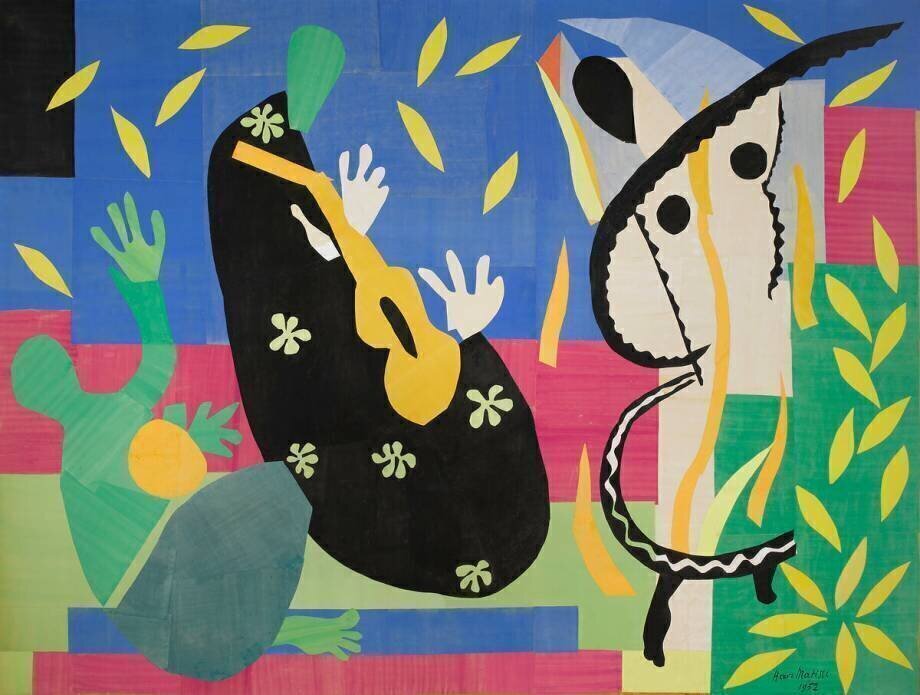
The Sadness of the King is striking for its imposing dimensions (292 x 386 cm) and the bold brilliance of its pure colours, applied in flat areas using the technique of cut-out gouache papers. Housed at the Centre Pompidou in Paris, the work unfolds like a complex composition in which geometric and organic forms interact. The background is structured by large vertical bands of bright colours: ultramarine blue, magenta red and green. Against this vibrant backdrop, the simplified silhouettes of characters and symbolic elements stand out. Matisse uses a deliberately limited but intense colour palette, juxtaposing colours to create strong and dynamic contrasts, characteristic of his Fauvist heritage but reinvented through the technique of cutting. The absence of modelling or traditional perspective accentuates the decorative effect and flatness of the surface, while giving the forms an immediate and powerful presence. Cutting directly into the colour, ‘à vif’, gives the contours a singular sharpness and energy. The whole evokes a scene that is both static and animated, where the arrangement of coloured shapes creates a visual rhythm comparable to a musical score, orchestrating a total sensory experience where colour and form reign supreme.
The melancholic monarch at the heart of the dance of forms
At the centre of this abundant composition sits the figure of the king, identified by Matisse himself as a symbolic self-portrait. Represented by a large, static black form, a massive, simplified seated silhouette, he embodies the ‘sadness’ evoked by the title. This sombre, almost abstract figure contrasts sharply with the colourful and dynamic elements surrounding him, suggesting melancholy and the weight of age and illness. Around him is a scene evoking music and dance, sources of consolation and escape. To his left, a crouching green figure, perhaps a musician playing an instrument suggested by a circular shape, participates in this sound environment. To his right, a female silhouette twirls, evoking a dancer depicted with great freedom, her movement suggested by curves and bright colours. The king, although central, seems to be both the subject and the spectator of this interior scene, a distillation of his memories, his passions and his present condition. He is the immobile axis around which life, beauty and art swirl, the ultimate ramparts against finitude.
La Tristesse du roi by Henri Matisse: a colourful rebus
La Tristesse du roi is not just a play on shapes and colours; it is also laden with symbols that refer to Matisse's personal and artistic universe. The central black figure, the artist-king, embodies old age, illness and melancholy, but also the artist's central position as creator and observer. The scattered yellow shapes, resembling petals or leaves escaping from an invisible instrument held by the king (sometimes interpreted as a guitar), symbolise music, its joyful and volatile notes capable of dispelling sadness. The green figure on the left, often seen as an odalisque or a musician, represents Matisse's attraction to the Orient, a recurring theme in his work, synonymous with sensuality, luxury and decorative harmony. The whirling dancer on the right is a vibrant tribute to the female body in motion, another of the artist's favourite subjects, capturing vital energy and grace. Other abstract forms, such as plant or floral motifs, dot the composition, evoking nature, the beauty of gardens and interiors dear to Matisse. The whole work functions as an artistic testament, a synthesis of the major themes that marked his career, orchestrated in a final composition where colour directly expresses emotion and meaning.
Artistic epitaph and revolutionary legacy of Henri Matisse's La Tristesse du roi
La Tristesse du roi, completed two years before Matisse's death in 1954, represents much more than just a painting in his long career. It is the spectacular culmination of his papiers découpés technique, a method he developed out of necessity but elevated to a major art form, merging drawing, painting and sculpture. This work is considered an essential milestone in 20th-century art, demonstrating that physical constraints can become a powerful driver of stylistic innovation. It sums up the essence of Matisse's quest: the primacy of colour and form to express pure emotion, freed from the constraints of realistic representation. The impact of this work and of cut-outs in general was considerable, influencing generations of artists, particularly in the fields of abstraction and Pop Art (think of the use of flat colour by artists such as Ellsworth Kelly or Warhol's silkscreen prints). By transforming a technique initially perceived as minor into a monumental and expressive visual language, Matisse pushed the boundaries of painting and affirmed his position as a pioneer of modern art until the end of his life. La Tristesse du roi thus remains a paradoxical celebration of life, colour and creation in the face of the shadow of finitude.
This artwork is a drawing from the modern period. It belongs to the fauvism style.
« Sorrow of the King » is kept at Musee National d'Art Moderne, Centre Pompidou, Paris, France.
Find the full description of Sorrow of the King by Henri Matisse on Wikipedia.
Other artworks by Henri Matisse
-
From56.37 €£47.9246.98 €£39.93
-
From39.3 €£33.4132.75 €£27.84
-
From41.08 €£34.9234.23 €£29.1
-
From47.17 €£40.0939.3 €£33.41
-
From47.9 €£40.7239.92 €£33.93
-
From59.5 €£50.5849.59 €£42.15
-
From44.98 €£38.2437.49 €£31.86
-
From55.23 €£46.9546.03 €£39.12
-
From51.75 €£43.9943.13 €£36.66
-
From57.23 €£48.6447.69 €£40.53


Other artworks in the same colors
-
From38.57 €£32.7832.14 €£27.32
-
From39.55 €£33.6232.96 €£28.01
-
From43.24 €£36.7536.03 €£30.63
-
From39.3 €£33.4132.75 €£27.84
-
From40.29 €£34.2433.57 €£28.54
-
From39.3 €£33.4132.75 €£27.84
-
From72.24 €£61.460.2 €£51.17
-
From38.32 €£32.5731.94 €£27.14


Other similar artworks
-
From41.52 €£35.2934.6 €£29.41
-
From40.78 €£34.6633.98 €£28.88
-
From39.55 €£33.6232.96 €£28.01
-
From42.5 €£36.1235.42 €£30.1
-
From103.41 €£87.986.18 €£73.25
-
From40.53 €£34.4533.78 €£28.71
-
From35.87 €£30.4929.89 €£25.4
-
From41.76 €£35.534.8 €£29.58
-
From39.55 €£33.6232.96 €£28.01