

Customise
Your art print
The Absinthe Drinker or Glass of Absint... OF Edgar Degas
The Absinthe Drinker or Glass of Absinthe
L'Absinthe by Edgar Degas, a snapshot of Parisian melancholy
Painted between 1875 and 1876, the work was originally titled In a Café before being renamed Absinthe. It was created during a pivotal period for Edgar Degas and the Impressionist movement. The scene takes place at the Café de la Nouvelle Athènes, located on Place Pigalle in Paris, an iconic venue that had succeeded the Café Guerbois as a gathering place for the avant-garde artists of the time, including the Impressionists. Degas, known for his keen observation of contemporary customs, chose this familiar setting to depict a scene of Parisian life. He had two of his friends pose for him: the actress Ellen Andrée and the engraver and painter Marcellin Desboutin. This choice of well-known models, embodying figures of the artistic bohemian world, anchors the work in a specific social reality. The painting was first presented to the public at the second Impressionist exhibition in 1876, but far from being a hit, it immediately provoked mixed reactions, even hostile ones, heralding the stormy reception that would accompany the work for years to come. Degas's aim was to explore, through the prism of realism dear to some of his contemporaries such as Zola, the less glamorous aspects of modern life, particularly the isolation and potential ravages of alcoholism that preoccupied French society at the end of the 19th century.
L'Absinthe by Edgar Degas: a look at the visual structure
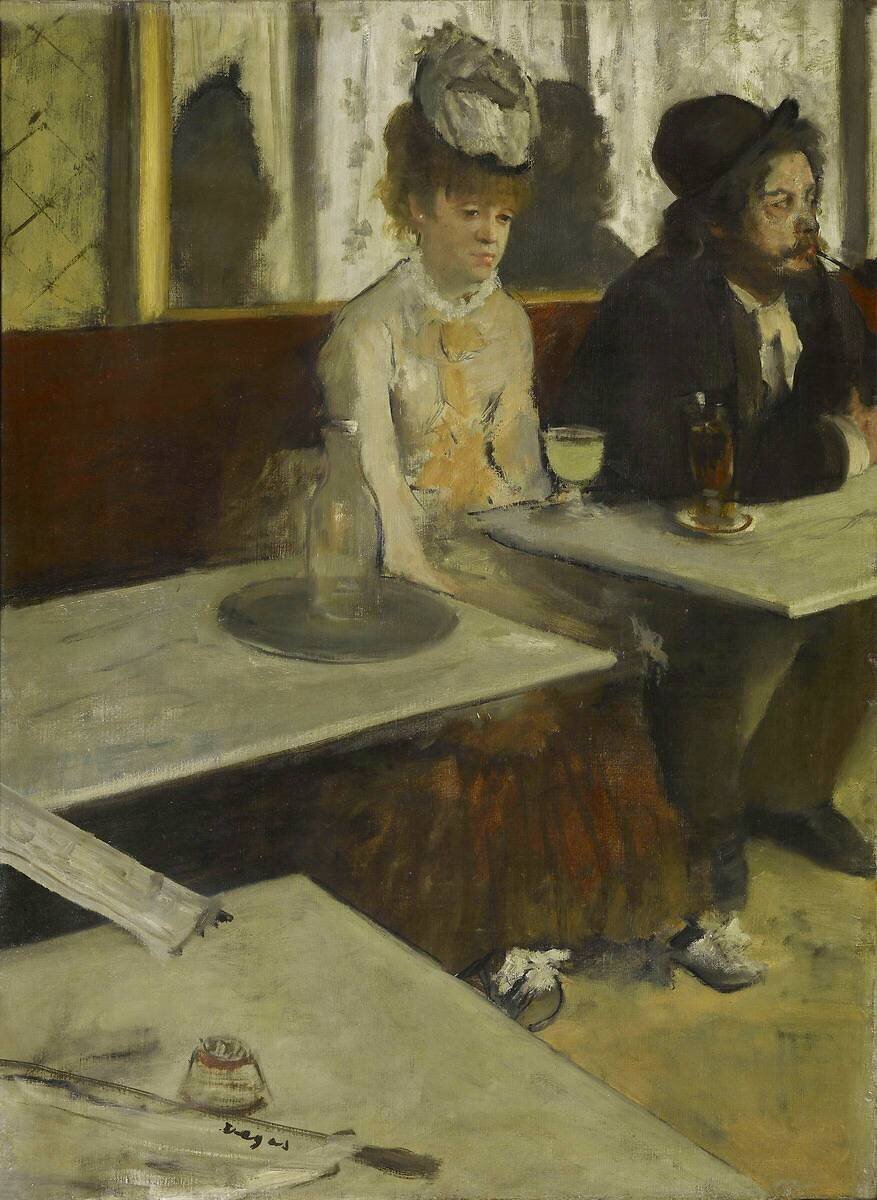
L'Absinthe stands out for its particularly innovative and daring composition for the time. The oil on canvas, measuring 92 x 68.5 cm, immediately strikes the viewer with its off-centre framing, inspired by Japanese prints, which were very popular at the time. This gives the scene the impression of a photographic snapshot, as if the viewer were observing the scene from a neighbouring table. The main characters are not in the centre but shifted to the right, leaving a large empty space on the left and in the foreground, occupied by a series of marble café tables seen in a receding perspective. These tables, with their cold, sharp geometric lines, create a visual barrier between the viewer and the characters, reinforcing their isolation. The perspective is rising, accentuating the diving effect. The colour palette is dominated by dark, earthy tones, creating a gloomy and heavy atmosphere. Only the murky green-yellow touch of the glass of absinthe in front of the woman subtly illuminates the canvas, drawing the eye to this key element. The background is treated in a more blurred manner, with the indistinct reflection of the characters and the setting in a large mirror above the bench, adding to the spatial complexity and the feeling of confinement.
At the heart of Edgar Degas's L'Absinthe: figures of isolation
The central subject of L'Absinthe lies in the representation of these two figures sitting side by side on the red bench of a Parisian café, but clearly strangers to each other. On the right, Marcellin Desboutin, recognisable by his bushy beard and soft hat, smokes a pipe, his gaze turned to the right, outside the frame, seeming to observe something or someone in the café. To his left, Ellen Andrée embodies a woman with slumped shoulders, her face marked by fatigue or despondency, her gaze empty and lost, fixed downward, seemingly absorbed in deep melancholy. In front of her, the glass filled with the famous greenish liqueur, absinthe, gives the work its title and its most immediate key to interpretation. Their physical proximity contrasts sharply with their total lack of interaction and communication, emphasising a shared loneliness amid the supposed bustle of the café. Degas does not seek to idealise his models; on the contrary, he presents them unvarnished, in a posture that evokes boredom, weariness and perhaps the moral and physical decline associated with absinthe consumption, describing them as ‘urban wrecks’ in the words of historian Françoise Cachin.
The Green Fairy and her ghosts: symbolism of an era
Beyond a simple genre scene, L'Absinthe is imbued with powerful symbolism, reflecting the social and moral concerns of the late 19th century. The glass of absinthe, placed prominently, is not a mere accessory but the catalyst for interpretation. Nicknamed the ‘green fairy’, this highly alcoholic and controversial drink was associated with artistic bohemianism, but also with addiction, madness and social decline. Its representation here crystallises the unease of a society undergoing industrial and urban change, confronted with new forms of alienation. The isolation of the characters, their absent or evasive gaze, symbolises modern loneliness, the inability to communicate even within the Parisian crowd. The off-centre composition and broken lines of the tables can be seen as a metaphor for the fragmentation of social life and traditional landmarks. The mirror in the background, reflecting a blurred and ghostly image, could symbolise the loss of identity or dissociation caused by alcohol. Some critics have seen it as a denunciation of the ravages of alcoholism, while others point to a broader critique of a certain emptiness in bourgeois or bohemian existence. The work thus becomes a powerful symbol of the melancholy and anxiety of modern life.
L'Absinthe by Edgar Degas: the lasting impact of a provocative painting
From its first presentation in 1876 at the Second Impressionist Exhibition, then during its exhibition in London in 1893, L'Absinthe caused a real scandal. Critics and the public were shocked by the crudeness of the subject matter, which was deemed ugly, vulgar and immoral. Degas was criticised for depicting misery and degradation without any embellishment, going against academic conventions and bourgeois good taste. The work was perceived as an attack on morality, particularly by the Victorian English public. However, despite this virulent criticism, or perhaps because of it, L'Absinthe left a lasting mark on people's minds and on art history. Today, it is considered a major work, not only in Degas's career, but also for the Realist and Impressionist movements, due to its formal and thematic audacity. It demonstrates Degas's ability to capture the dark aspects of modernity with psychological and sociological acuity. Its influence can be seen in later artists, as evidenced by Picasso's 1901 painting La Buveuse d'absinthe (The Absinthe Drinker). After belonging to several collectors, including Count Isaac de Camondo, who bequeathed it to the French State, the work is now preserved and exhibited at the Musée d'Orsay in Paris, where it continues to fascinate and intrigue visitors with its evocative power.
This artwork is a painting from the modern period. It belongs to the impressionism style.
« The Absinthe Drinker or Glass of Absinthe » is kept at Musee d'Orsay, Paris, France.
Find the full description of The Absinthe Drinker or Glass of Absinthe by Edgar Degas on Wikipedia.
Other artworks by Edgar Degas
-
From36.4 €£30.9430.33 €£25.78
-
From37.15 €£31.5830.96 €£26.31
-
From42.88 €£36.4535.74 €£30.38
-
From45.88 €£38.9938.23 €£32.5
-
From49.87 €£42.3941.55 €£35.32
-
From33.15 €£28.1827.63 €£23.48
-
From41.14 €£34.9734.28 €£29.14
-
From46.13 €£39.2138.44 €£32.67
-
From39.39 €£33.4832.83 €£27.9
-
From43.13 €£36.6635.94 €£30.55


Other artworks in the same colors
-
From38.76 €£32.9532.3 €£27.46
-
From44.13 €£37.5136.77 €£31.26
-
From41.14 €£34.9734.28 €£29.14
-
From48.03 €£40.8240.02 €£34.02
-
From38.27 €£32.5331.9 €£27.11
-
From49 €£41.6540.83 €£34.71
-
From49.82 €£42.3541.52 €£35.29


Other similar artworks
-
From46.62 €£39.6338.85 €£33.03
-
From45.83 €£38.9638.19 €£32.46
-
From64.93 €£55.1954.11 €£45.99
-
From38.03 €£32.3331.69 €£26.94
-
From60.28 €£51.2450.24 €£42.7
-
From69.66 €£59.2158.05 €£49.34
-
From48.03 €£40.8240.02 €£34.02