
Customise
Your art print
The Kiss OF Francesco Hayez
The Kiss
The origins of an embrace: the genesis and historical significance of Hayez’s The Kiss
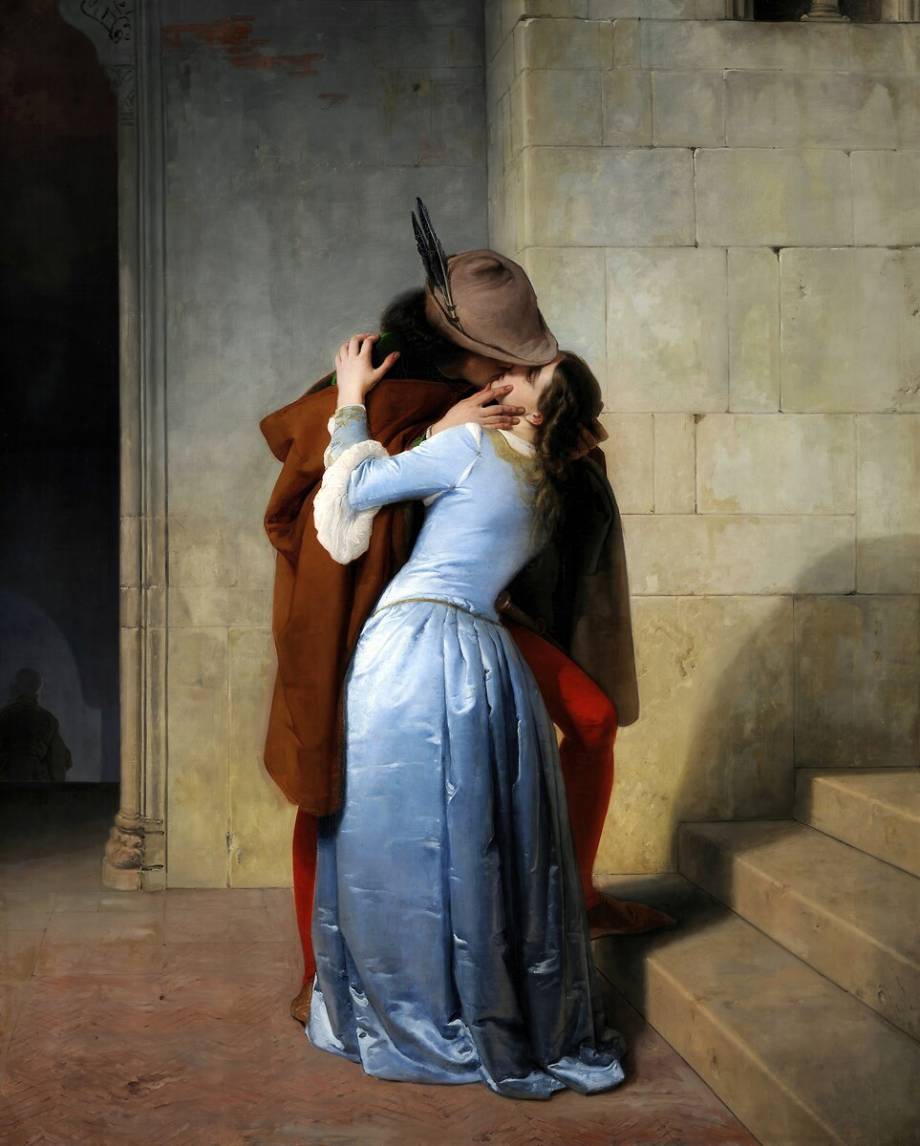
The Kiss by Francesco Hayez, carefully preserved at the Pinacoteca di Brera in Milan, is much more than a simple depiction of a romantic exchange. This oil on canvas, measuring 112 x 88 cm, has become an icon of Italian Romanticism and a powerful symbol of the aspirations of a nation in the midst of transformation.
Created in 1859, The Kiss came into being against a particularly turbulent political and social backdrop for Italy: the Risorgimento. This tumultuous period, marked by a profound desire for national unity and independence from foreign rule—particularly Austrian domination—is vividly reflected in the work of Hayez. The painting was, in fact, commissioned by Count Alfonso Maria Visconti di Saliceto, himself an ardent patriot and campaigner for Italian unification, who donated it to the Pinacoteca di Brera.
The year of its creation, 1859, was a pivotal one: it coincided with the Second Italian War of Independence, a conflict that proved decisive for the formation of the Kingdom of Italy, proclaimed two years later in 1861. The original title of the work, The Kiss. An Episode from Youth. 14th-Century Costumes, anchors the scene in an idealised medieval past, a common practice of the romantic troubadour style, allowing feelings to be magnified and contemporary messages to be conveyed under the veil of history. Hayez, already recognised as a leading figure of Milanese Romanticism, thus crystallised the hopes and passions of an entire era, turning this embrace into a veritable pictorial manifesto.
A canvas of passion: a visual immersion in The Kiss
At first glance, The Kiss plunges the viewer into an intimate atmosphere charged with emotion, characteristic of the Romantic style. The scene unfolds at the foot of a stone staircase, within a medieval architectural setting that is understated yet evocative. The composition, dominated by a chiaroscuro inherited from the Italian masters, highlights the two protagonists whilst leaving certain areas in a mysterious twilight.
Hayez, a master at rendering textures and lighting effects, employs a colour palette that is both rich and restrained. The young woman is dressed in a sumptuous, shimmering blue silk gown, whose sheen catches the light, whilst the man wears an earthy brown coat and bright red tights. The artist excels at rendering the velvety texture of the fabrics, the coldness of the stone and the warmth of the skin tones. The whole scene exudes a palpable tension, accentuated by the dynamic posture of the figures.
The man, whose face is almost entirely concealed, leans his head intently towards his companion, one foot resting on the first step of the staircase, suggesting an imminent departure or a hurried arrival. To the left, a discreet silhouette can be glimpsed in the shadows, descending or ascending the staircase, adding an element of enigmatic narrative to the scene.
Hayez’s The Kiss : fervent union at the heart of the composition
The central subject, which gives the work its title, is the passionate embrace and the kiss exchanged between the two young people. Hayez succeeds in capturing a rare emotional intensity, focusing on this moment of intimate union. The man’s face remains hidden, which universalises the male figure and allows each viewer to project their own emotions onto it or to see in it an allegorical figure. The woman’s face, though partially visible, expresses a trusting surrender.
Her left hand rests delicately on her lover’s shoulder, whilst her body arches slightly under the power of the kiss. The man, for his part, tenderly supports the young woman’s head with one hand, a gesture that emphasises both passion and a sense of protection. The contact of their lips lies at the very centre of the dramatic tension, a point of convergence where their souls seem to meet. This gesture, imbued with a restrained yet powerful sensuality, transcends a mere romantic anecdote to evoke universal themes such as love, desire, the possibility of separation, and the urgency of emotion in the face of danger or an uncertain fate. The power of this depiction lies in its ability to freeze a fleeting moment whilst imbuing it with eternal significance, embodying the romantic ideal of absolute love.
Hayez’s The Kiss : the secret messages of a patriotic embrace
Whilst The Kiss is universally recognised as an ode to passionate love, its interpretation goes far beyond a mere romantic scene, particularly when viewed within the context of its creation. The work is, in fact, imbued with strong patriotic and political symbolism, becoming an allegory of the Risorgimento. The colours of the characters’ clothing are not insignificant: the woman’s blue dress and white sleeve, combined with the red of the man’s tights and a subtle touch of green on the lapel of his coat, subtly evoke the colours of the French and Italian flags.
This colour scheme has been interpreted as a celebration of the Franco-Piedmontese alliance against Austria during the Second War of Independence. The kiss itself would thus symbolise the union of the young Italian nation with its ideals of freedom and unity, or the farewell of a patriot setting off to fight for his country. The male figure, foot on the step, ready to leap, and the fleeting shadow on the staircase reinforce this idea of secrecy, conspiracy and imminent departure for a noble cause. Thus, individual love blends with love of country, and the embrace becomes a symbol of total commitment—both personal and collective—to a better future and a unified Italy.
Legacy and posterity of Hayez’s The Kiss
From the moment it was unveiled, The Kiss was a resounding success, propelling Francesco Hayez into the pantheon of the most celebrated Italian artists of his time and ensuring the work an exceptional legacy. The painting was immediately regarded as one of his masterpieces, indeed his most iconic work, and it cemented his reputation as a leading figure of Romanticism in Italy. The painting’s popularity was such that Hayez had to produce several versions to meet demand.
The impact of this work extends far beyond the circle of art lovers. It became a true popular icon, reproduced on various media, as evidenced by its use by the Perugina company on the boxes of its famous ‘Baci’ chocolates in the 1920s. Beyond its commercial circulation, The Kiss left a lasting mark on the collective imagination, inspiring other artists in various fields, such as the filmmaker Luchino Visconti, who drew inspiration from it for a famous scene in his 1954 film Senso. The work is now regarded as a key milestone in 19th-century European painting, embodying not only the height of Italian Romanticism but also the spirit of an era and the aspirations of a people. For Hayez, who was appointed senator of the Kingdom of Italy in 1860 in recognition of his contribution to culture, The Kiss represented a major accolade, cementing his place in art history.
This artwork is a painting from the classical period. It belongs to the romanticism style.
« The Kiss » is kept at Pinacoteca di Brera, Milan, Italy.
Find the full description of The Kiss by Francesco Hayez on Wikipedia.
You may also like
-
From68.2 €£57.9756.83 €£48.31
-
From32.91 €£27.9727.43 €£23.31
-
From56.35 €£47.946.96 €£39.91
-
From50.86 €£43.2342.39 €£36.03
-
From64.63 €£54.9353.86 €£45.78
-
From41.64 €£35.3934.7 €£29.49
-
From50.36 €£42.8141.97 €£35.67
-
From53.6 €£45.5644.67 €£37.97
-
From56.02 €£47.6246.68 €£39.68
-
From50.36 €£42.8141.97 €£35.67


Other artworks in the same colors
-
From40.71 €£34.6133.93 €£28.84
-
From47.78 €£40.6139.82 €£33.85
-
From39.64 €£33.733.04 €£28.08
-
From70.15 €£59.6358.46 €£49.69
-
From79.57 €£67.6366.31 €£56.36
-
From43.88 €£37.336.57 €£31.08
-
From40.39 €£34.3333.66 €£28.61
-
From38.52 €£32.7432.1 €£27.28
-
From38.52 €£32.7432.1 €£27.28
-
From70.31 €£59.7658.59 €£49.8


Other similar artworks
-
From75.67 €£64.3263.06 €£53.6
-
From84.77 €£72.0570.64 €£60.05
-
From58.62 €£49.8348.85 €£41.52
-
From72.24 €£61.460.2 €£51.17
-
From41.93 €£35.6434.94 €£29.7
-
From64.1 €£54.4953.42 €£45.41