

Customise
Your art print
The Naked Maja OF Francisco de Goya
The Naked Maja
Goya’s *La Maja Desnuda*: an ode to the flesh and to scandal
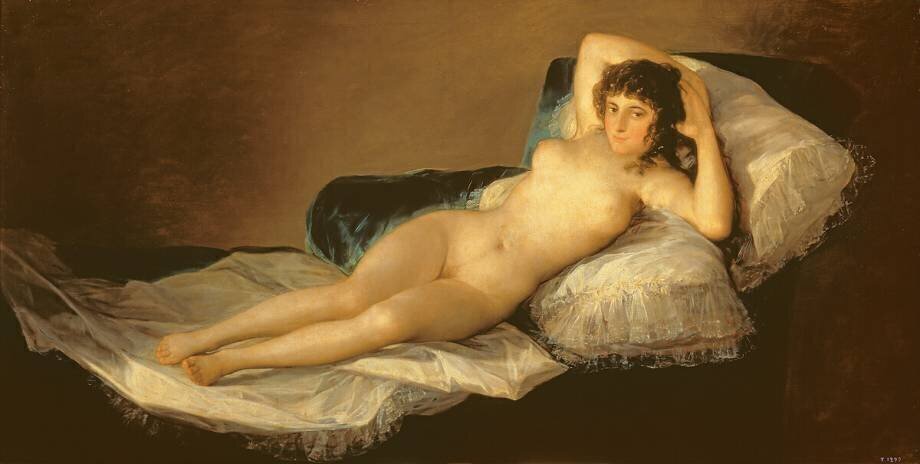
The history of art is punctuated by works which, through their boldness and uniqueness, have marked a break with convention and redefined aesthetic standards. Among these, The Naked Maja by Francisco Goya occupies a place of honour. Painted between 1790 and 1800, this large-scale oil on canvas (97 x 190 cm), now carefully preserved at the Prado Museum in Madrid, continues to fascinate and provoke, bearing witness to the genius of an artist who did not hesitate to challenge the conventions of his time. More than just a nude, The Naked Maja is a statement, an enigma and a pictorial revolution whose echoes still resonate.
The Naked Maja by Francisco Goya: between private commission and a breath of freedom
Late 18th-century Spain, the setting in which Goya lived, was a society in the throes of change, torn between the dawning Enlightenment and the weight of tradition, particularly that of the all-powerful Inquisition, which severely condemned the depiction of the nude outside mythological or allegorical contexts. It was in this particular climate that The Naked Maja came into being, probably commissioned by Manuel Godoy, then Prime Minister and an influential figure at the court of King Charles IV.
Intended for his private study, far from public view, the work was likely accompanied by its counterpart, The Clothed Maja, painted a few years later. An ingenious mechanism is even said to have allowed the nude version to be concealed behind the clothed version, adding a playful and secretive dimension to this bold commission. The identity of the model remains a mystery, with speculation ranging from Pepita Tudó, Godoy’s mistress, to the charismatic Duchess of Alba, Goya’s friend and muse. This ambiguity contributes to the aura of mystery that still surrounds the painting, an embodiment of a “maja”, a popular figure in Madrid celebrated for her beauty and outspokenness.
The Naked Maja by Francisco Goya: a refined composition in the service of sensuality
At first glance, The Naked Maja strikes the viewer with the bold simplicity of its composition. The female subject occupies almost the entire pictorial space, stretched out at full length on a divan covered with white sheets and soft cushions in greenish and grey tones. Goya chose a relatively limited colour palette, in which the cool tones of the fabrics and the neutral brown background contrast powerfully with the pearly warmth of the model’s skin.
A skilful lighting, likely coming from the side, sculpts the body’s forms with a diffuse softness, creating a delicate modelling and a palpable sense of three-dimensionality. The precise and decisive line work emphasises the sinuous contours of the figure, whilst the brushwork, though characteristic of Goya’s energetic style, becomes more caressing and subtle in the rendering of the flesh. The model’s lascivious pose, with her arms crossed behind her head, offers her body unreservedly to the viewer’s gaze, in a composition that favours a frontal perspective and direct impact.
The Naked Maja: the face of a modern Eve
The true beating heart of the painting lies in the figure of the Maja herself. Far removed from ethereal goddesses or penitent biblical figures, Goya confronts us with a real woman, a contemporary figure whose presence is of a startling modernity. Her body, offered up in complete nudity, is depicted with a raw realism for the time. A particularly subversive detail is the explicit depiction of pubic hair, a boldness almost unheard of in Western art for a non-mythological nude devoid of any obvious negative connotation.
Goya thus highlights the feminine form, emphasising the body’s natural sensuality. But it is above all the Maja’s gaze that captivates and unsettles. Fixed squarely on the viewer’s eyes, it is devoid of any false modesty. A faint hint of a smile plays on her lips, conveying a quiet self-assurance, an awareness of her own beauty and perhaps even a touch of defiance. She is not a passive object at the mercy of desire, but an active subject, conscious of her power of seduction and asserting her presence with a disarming confidence.
The Naked Maja by Francisco Goya: symbols of a silent revolution
Beyond her formal beauty, The Naked Maja is imbued with powerful symbolism, rooted in her era yet far transcending it. Above all, it embodies the transgression of social, moral and religious norms. By choosing to paint a real woman, naked, without the screen of mythology, Goya breaks a major taboo and marks a break with academic tradition.
The direct and confident gaze of the model, far from expressing the expected shame or submission, becomes the symbol of a new form of female self-assertion, or at least of an individuality that refuses to be objectified without responding. Nudity itself, so frank and so unidealised, becomes a celebration of the human body in its truth, stripped of allegorical artifice. In this respect, the painting can be seen as an ode to individual freedom and carnal beauty, a assertion of the artist’s right to explore all aspects of the human condition, including the most intimate.
The shockwave: the fate of a work, the fate of an artist
The impact of The Naked Maja was considerable, both on the life of Francisco Goya and on the evolution of art. Following the fall of Godoy and the return of Ferdinand VII to the Spanish throne, the Inquisition took up the case. In 1815, Goya was summoned and had to explain himself regarding this work, which was deemed obscene, risking the wrath of the ecclesiastical court. Although he was ultimately acquitted, the episode bears witness to the dangers he faced. The painting, deemed too scandalous, remained hidden from the public for a long time, kept in the storerooms of the Royal Academy of San Fernando before moving to the Prado Museum in the early 20th century.
For Goya, this work marked a further step in his exploration of more personal and daring themes, affirming his artistic independence. The Naked Maja is also a cornerstone of art history. It is often regarded as one of the first modern nudes, paving the way for a more direct and less idealised depiction of the female body, and influencing major artists of subsequent generations, such as Édouard Manet with his Olympia. Its boldness continues to provoke, as evidenced by the scandal caused by its appearance on Spanish stamps in 1930, proving that its subversive power remains intact.
This artwork is a painting from the classical period. It belongs to the romanticism style.
« The Naked Maja » is kept at Prado, Madrid, Spain.
Find the full description of The Naked Maja by Francisco de Goya on Wikipedia.
Other artworks by Francisco de Goya
-
From83.14 €£70.6769.28 €£58.89
-
From47.87 €£40.6939.89 €£33.91
-
From48.51 €£41.2440.43 €£34.36
-
From63.98 €£54.3853.31 €£45.32
-
From54.56 €£46.3845.47 €£38.65
-
From48.62 €£41.3340.52 €£34.44
-
From73.74 €£62.6761.45 €£52.23
-
From47.87 €£40.6939.89 €£33.91
-
From61.45 €£52.2351.21 €£43.52
-
From47.37 €£40.2739.48 €£33.56


Other artworks in the same colors
-
From62.61 €£53.2252.17 €£44.35
-
From72.24 €£61.460.2 €£51.17
-
From62.77 €£53.3652.31 €£44.47
-
From49.57 €£42.1341.31 €£35.11


Other similar artworks
-
From78.27 €£66.5365.22 €£55.44
-
From99.86 €£84.8883.22 €£70.74
-
From62.28 €£52.9351.9 €£44.11
-
From63.65 €£54.1153.04 €£45.09
-
From62.28 €£52.9351.9 €£44.11
-
From64.1 €£54.4953.42 €£45.41
-
From63.38 €£53.8852.82 €£44.9
-
From49.31 €£41.9241.09 €£34.93
-
From68.04 €£57.8356.7 €£48.19
-
From49.49 €£42.0741.24 €£35.05