
Customise
Your art print
The Triumph of Galatea OF Raffaello
The Triumph of Galatea
Raphael’s *The Triumph of Galatea*: the origins of an immortal fresco
It was around 1513 that Raphael was commissioned to create The Triumph of Galatea, a commission from the wealthy Sienese banker and patron Agostino Chigi. Chigi, wishing to adorn his sumptuous Roman residence, the Villa Farnesina, called upon the greatest artists of his time. The fresco, measuring 295 centimetres in height by 224 centimetres in width, and still preserved today within the Villa Farnesina, was intended for the residence’s open gallery, forming part of a decorative programme of a broader scope, inspired in particular by the Stanze per la giostra of the poet Angelo Politian. This context of a private commission by a man of immense wealth, eager to create a space imbued with humanist culture and references to Antiquity, was decisive for the nature of the work. Raphael, then at the height of his fame and already engaged in work on the Vatican Chambers, demonstrates with this work his ability to adapt to secular and mythological themes with remarkable ease and inventiveness, far removed from the strictly religious subjects that occupy a large part of his output. The Villa Farnesina itself, through its architecture and decorative ambition, is intended as a showcase for such artistic expressions, celebrating beauty, love and classical culture.
Raphael’s Triumph of Galatea: a divinely orchestrated aquatic ballet
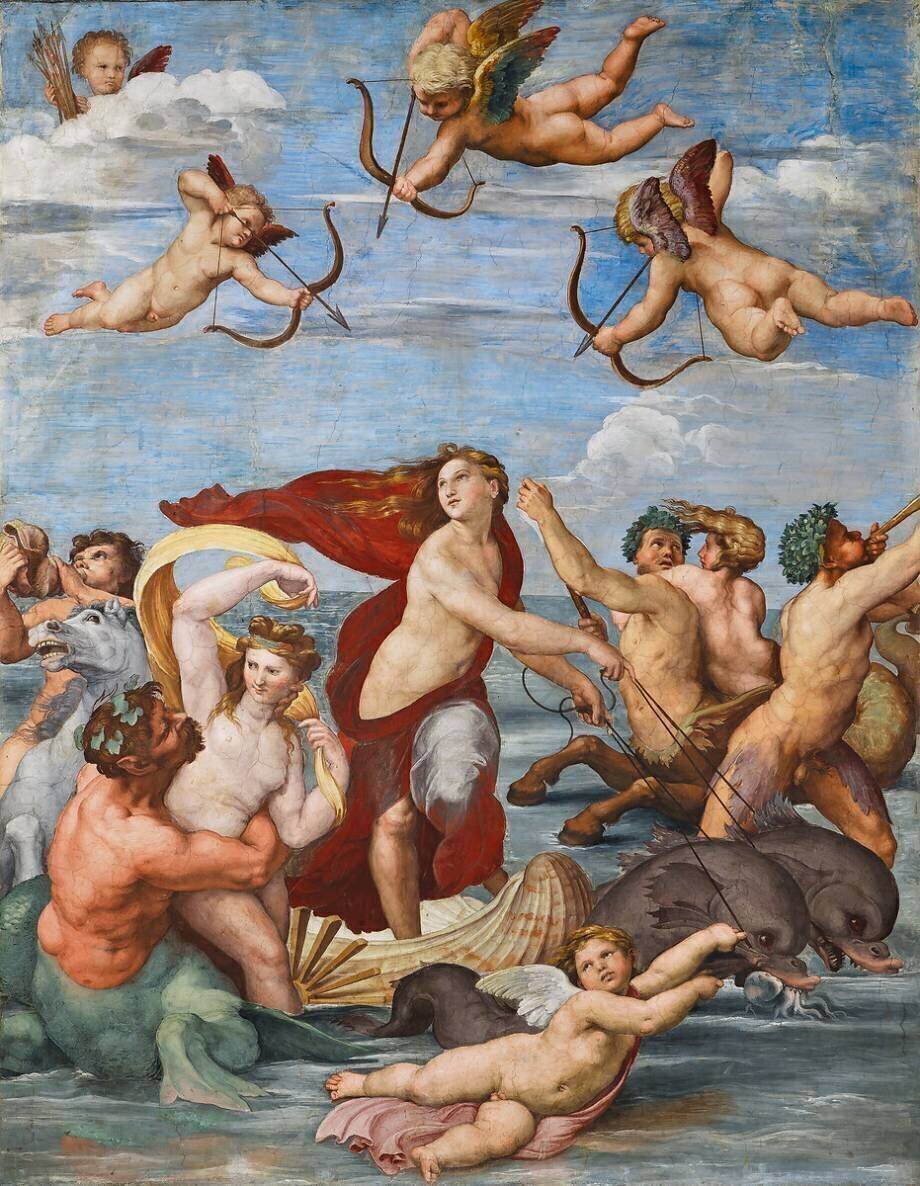
The composition of The Triumph of Galatea is a veritable visual symphony in which every element contributes to a sense of harmony and dynamic movement. Raphael structures his fresco with consummate mastery, organising the scene around a large imaginary circle from which the figures seem to emanate and radiate. The horizon line divides the work horizontally, whilst the slender form of Galatea herself forms a powerful vertical axis. The colours, bright and vibrant, evoke the shimmering palette of Mediterranean nature and the richness of frescoes from Roman antiquity, a major source of inspiration for Renaissance artists. The light bathes the scene, modelling the bodies with a softness that accentuates their volume and grace. The whole exudes a sense of fluidity and contained energy, as if the figures were captured in a snapshot of a joyful and tumultuous dance. The treatment of the drapery, lifted by an invisible sea breeze, contributes to this dynamism, as does the depiction of the water, stirred by the divine procession. Raphael achieves the feat of creating a complex, crowded scene without ever sacrificing the clarity of the visual narrative or the overall balance of the composition, with every gaze and every gesture seeming to converge on the central figure whilst contributing to the collective effervescence.
Raphael’s The Triumph of Galatea
At the centre of this exuberant maritime celebration sits Galatea, the nymph of the seas, whose beauty radiates throughout the entire fresco. Depicted in a contrapposto pose of exquisite elegance, one leg bent and the other stretched out, her body and head turned in opposite directions, she embodies an ideal of feminine grace. Her gaze is raised towards the sky, towards the mischievous Cupids who are preparing to shoot their arrows, deliberately ignoring the crude songs of the Cyclops Polyphemus, whose presence is suggested off-screen but whose fruitless serenade is a key element of the myth. Galatea stands proudly upon a sea shell, an improvised chariot drawn by two spirited dolphins that cut through the waves with vigour. Around her, a lively procession of sea creatures joins in her triumph: muscular tritons, one of whom is carrying off a Nereid whilst another blows a conch shell like a trumpet, sensual nymphs and playful putti. Each figure, though secondary, is treated with particular care; their powerful or delicate anatomies bear witness to Michelangelo’s influence, yet are always tempered by the gentleness and harmony characteristic of Raphael. The central nymph, through her posture, expression and dominant position, instantly captures the eye and anchors the composition.
Raphael’s The Triumph of Galatea: divine whispers and earthly passions
The Triumph of Galatea is not merely a display of pictorial virtuosity; the work is also rich in symbolic meanings, drawing on classical mythology to explore universal themes. The figure of Galatea herself, through her posture and her gaze turned towards the celestial Cupids rather than towards the brutal, earthly advances of the cyclops Polyphemus (who is not depicted but whose song is the catalyst for the scene), is often interpreted as an allegory of platonic love triumphing over carnal passion and coarseness. She embodies ideal beauty that rises above the tumultuous desires of the world. The dolphins pulling her chariot are traditionally associated with speed, intelligence and rescue, and may here symbolise the journey of the soul or the controlled passage through life’s trials. The tritons and Nereids who escort her, figures from marine mythology, reinforce the atmosphere of pagan celebration and the exaltation of the forces of nature. The numerous Cupids or putti flying around Galatea, pointing their arrows at her, are not merely decorative elements; they emphasise the theme of love and the inescapable power of this emotion. The scene as a whole, bathed in sunlight and imbued with a contagious joie de vivre, can thus be read as an ode to beauty, to love in its purest form, and to universal harmony—themes dear to Renaissance Neoplatonic thought.
The immortal legacy of Raphael and his Triumph of Galatea
The Triumph of Galatea marks a significant milestone in Raphael’s career and leaves a lasting mark on art history. For the artist, this fresco was an opportunity to demonstrate his exceptional mastery of mythological subjects, moving away from the predominant religious themes to explore the pagan world with unrivalled sensuality and harmony. The work cements his reputation as an artist capable of rivalling the Ancients, not only through his impeccable technique but also through his ability to breathe life and emotion into his figures. The dynamic and balanced composition, the grace of the figures and the vibrancy of the colours thus became benchmarks. His Galatea, in particular, established itself as an ideal of feminine beauty, admired and copied by generations of artists. The influence of this fresco is evident in the development of classicism, where the clarity of form, the balance of composition and the idealisation of nature, so dear to Raphael, are established as fundamental principles. For centuries, European art academies regarded Raphael’s style, as masterfully expressed in The Triumph of Galatea, as an absolute model. The work bears witness to Raphael’s ability to synthesise the influences of his contemporaries, notably the sculptural power of Michelangelo, whilst retaining a gentleness and elegance all his own, elevating painting to a level of perfection that defined the High Renaissance and continued to inspire far beyond, its influence extending to the avant-garde movements of the 20th century and even touching contemporary art.
This artwork is a painting from the renaissance period. It belongs to the classicism style.
Find the full description of The Triumph of Galatea by Raffaello on Wikipedia.
Other artworks by Raffaello
-
From85.03 €£72.2770.86 €£60.23
-
From62.68 €£53.2852.23 €£44.4
-
From58.12 €£49.4148.44 €£41.17
-
From66.09 €£56.1855.07 €£46.81
-
From61.7 €£52.4551.42 €£43.71
-
From62.35 €£5351.96 €£44.17
-
From56.96 €£48.4247.47 €£40.35
-
From46.62 €£39.6338.85 €£33.03
-
From67.26 €£57.1756.05 €£47.64
-
From61.78 €£52.5151.48 €£43.76


Other artworks in the same colors
-
From40.47 €£34.433.72 €£28.67
-
From62.61 €£53.2252.17 €£44.35
-
From65.93 €£56.0454.94 €£46.7
-
From51.29 €£43.5942.74 €£36.33
-
From81.03 €£68.8767.52 €£57.39
-
From67.87 €£57.6956.56 €£48.08
-
From65.76 €£55.954.8 €£46.58
-
From38.27 €£32.5331.9 €£27.11
-
From77.39 €£65.7864.49 €£54.82


Other similar artworks
-
From68.92 €£58.5857.43 €£48.82
-
From86.52 €£73.5472.1 €£61.29
-
From75.56 €£64.2362.97 €£53.52
-
From40.89 €£34.7634.07 €£28.96
-
From70.58 €£59.9958.82 €£49.99
-
From72.9 €£61.9760.75 €£51.64
-
From75.4 €£64.0962.83 €£53.41