
Customise
Your art print
Woman with a Parasol - Madame Monet and... OF Claude Monet
Woman with a Parasol - Madame Monet and Her Son
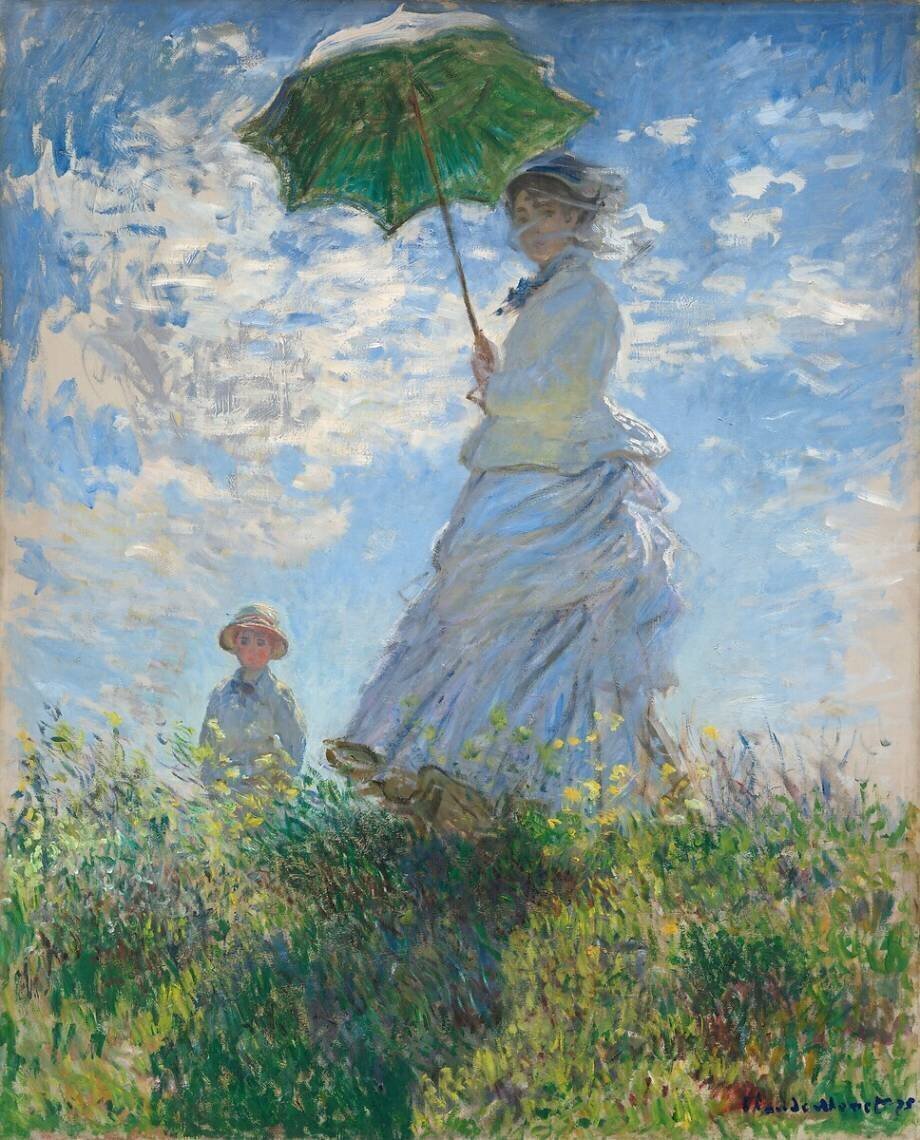
Woman with a Parasol – Madame Monet and Her Son, painted by Claude Monet in 1875, is an iconic work of the Impressionist movement. Housed at the National Gallery of Art in Washington D.C., this oil on canvas measuring 100 cm by 81 cm captures an intimate moment in the artist’s life with striking freshness and spontaneity.
The Walk by Claude Monet: the genesis of an outdoor snapshot
In 1875, Claude Monet was living in Argenteuil, a Parisian suburb that became a veritable laboratory for the nascent Impressionist movement. It was during this fruitful summer, probably in a single outdoor session, that Monet painted La Promenade. The work forms part of a series of paintings in which the artist explores the depiction of human figures set within luminous landscapes, moving away from the academic conventions of the posed studio portrait. The context is that of a quest for pictorial modernity, where the fleetingness of the moment and the changing effects of natural light become the main subjects. Monet, then aged 35, was going through a period of intense creativity, seeking to translate his immediate visual sensations. This painting, featuring his wife Camille and their son Jean, is a perfect illustration of this approach, capturing a scene of everyday family life with an apparent simplicity that conceals great technical mastery and a revolutionary artistic vision. The work was also exhibited at the second Impressionist exhibition in 1876, where it attracted attention, demonstrating Monet’s boldness and originality.
Woman with a Parasol by Claude Monet: a symphony of light and fleeting brushstrokes
Visually, Woman with a Parasol is a celebration of light and colour, fundamental characteristics of Impressionism. Monet uses a light and vibrant palette, dominated by the luminous whites of Camille’s dress, the shifting greens of the grass and the parasol, and the blues and whites of the shifting sky. The composition is bold, with a low-angle viewpoint that slightly monumentalises Camille’s figure, positioning her as a focal point standing out against the immensity of the sky. The pictorial touch is swift, fragmented and visible, conveying the urgency of capturing the fleeting impression of a moment. The brushstrokes, applied with vigour, suggest rather than describe the forms, leaving it to the viewer’s eye to reconstruct the scene. The wind is an invisible yet palpable presence, ruffling Camille’s veil, the folds of her dress and the tall grass, infusing the canvas with dynamism and life. The interplay of light and shadow is subtle, particularly the colourful reflections on the dress and the cast shadow of the parasol, which anchor the figures in their sun-drenched surroundings.
Woman with a Parasol by Claude Monet: a family idyll captured in the moment
At the heart of this rural scene are Camille Monet, the artist’s wife and muse, and their eldest son, Jean, then aged around eight. Camille is depicted elegantly dressed in a white summer dress, wearing a hat adorned with a light veil and holding a green parasol that shields her from the sun whilst creating a play of colours contrasting with her outfit. Her face, sketched rather than detailed, is turned towards the viewer or slightly in profile, expressing a gentle and contemplative presence. She seems to have paused her stroll for a moment, just long enough for Monet to capture this image. Just behind her, on the hillside, Jean is partially visible, as if emerging from the tall grass. This composition suggests a relaxed family stroll, a moment of simple, shared happiness. Monet is not seeking a formal portrait, but rather to capture the essence of his loved ones in their natural surroundings, giving them a living presence that is integrated into the landscape, rather than isolating them as separate subjects.
Woman with a Parasol by Claude Monet: the poetry of a rural scene
Woman with a Parasol transcends the simple depiction of a family scene to touch upon a broader symbolism. Above all, it embodies the quintessence of the Impressionist ideal: the capture of the fleeting moment, the pure sensation of a moment spent outdoors. The parasol, a recurring element in Impressionist art, is not merely a fashion accessory; it becomes a pictorial motif that allows the artist to play with light, shadows and colours, whilst symbolising a certain elegance and protection from the heat of the sun, marking a moment of leisure and well-being. The presence of the wind, suggested by the movement of the clothing and vegetation, evokes the changing nature and the fleeting nature of time. The scene, bathed in summer light, can be interpreted as an ode to nature, to the simple joy of a sunny day and to the harmony between man and his environment. The family intimacy that emanates from it, far removed from grand historical or mythological scenes, also reflects the Impressionists’ interest in modern life and everyday pleasures.
Woman with a Parasol by Claude Monet: resonances in Monet’s art and career
Woman with a Parasol had a significant impact both on Claude Monet’s career and on art history in general. For Monet, this work, and the series of figures en plein air that it inaugurated, marked an important stage in his mastery of the representation of light and atmosphere, as well as in his exploration of the human figure integrated into the landscape. The relative critical success and the attention it attracted at the second Impressionist exhibition helped to establish his reputation as one of the movement’s leading figures. Ten years later, Monet would revisit this theme of the woman with a parasol on a hill in another series of paintings, demonstrating the importance of this motif in his imagination. More broadly, La Promenade has become an icon of Impressionism, perfectly illustrating its founding principles: plein air painting, the primacy of subjective visual perception, the divided brushstroke, and the study of variations in light. It helped to popularise a new way of seeing and painting, influencing generations of artists and marking a decisive break with academic traditions, paving the way for modernity in painting.
This artwork is a painting from the modern period. It belongs to the impressionism style.
« Woman with a Parasol - Madame Monet and Her Son » is kept at National Gallery of Art, Washington DC, USA.
Other artworks by Claude Monet
-
From48.37 €£41.1140.31 €£34.26
-
From42.17 €£35.8535.15 €£29.87
-
From40.71 €£34.6133.93 €£28.84
-
From41.44 €£35.2334.54 €£29.36
-
From36.4 €£30.9430.33 €£25.78
-
From32.67 €£27.7727.22 €£23.14
-
From59.59 €£50.6549.66 €£42.21
-
From40.89 €£34.7634.07 €£28.96
-
From32.67 €£27.7727.22 €£23.14
-
From39.25 €£33.3632.71 €£27.8


Other artworks in the same colors
-
From38.03 €£32.3331.69 €£26.94
-
From52.66 €£44.7643.88 €£37.3
-
From47.87 €£40.6939.89 €£33.91
-
From61.78 €£52.5151.48 €£43.76
-
From42.42 €£36.0635.35 €£30.05
-
From37.4 €£31.7931.17 €£26.49
-
From39.98 €£33.9833.32 €£28.32
-
From66.25 €£56.3155.21 €£46.93
-
From39.98 €£33.9833.32 €£28.32
-
From44.13 €£37.5136.77 €£31.26


Other similar artworks
-
From38.76 €£32.9532.3 €£27.46
-
From48.12 €£40.940.1 €£34.08
-
From47.54 €£40.4139.62 €£33.67
-
From47.78 €£40.6139.82 €£33.85
-
From42.42 €£36.0635.35 €£30.05
-
From44.61 €£37.9237.18 €£31.6
-
From40.71 €£34.6133.93 €£28.84
-
From55.35 €£47.0546.13 €£39.21
-
From38.03 €£32.3331.69 €£26.94
-
From52.17 €£44.3443.47 €£36.95