

Customise
Your art print
La Grenouillère OF Claude Monet
La Grenouillère
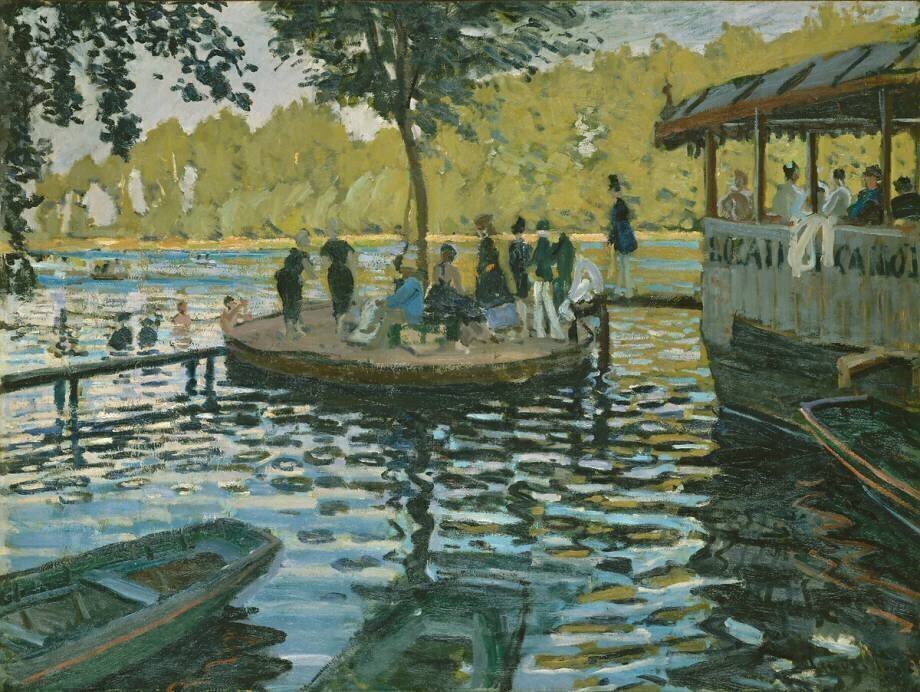
La Grenouillère, painted by Claude Monet in 1869, is an iconic painting that brilliantly captures the buzz of a leisure spot popular with Parisians and marks a crucial milestone in the emergence of Impressionism. Housed at the Metropolitan Museum of Art in New York, this oil on canvas measuring 74.6 cm × 99.7 cm continues to fascinate with its modernity and the vividness of its brushstrokes.
La Grenouillère by Claude Monet: echoes of a revolutionary summer
The summer of 1869 was a pivotal period for Claude Monet and his friend Auguste Renoir. Together, settled on the banks of the Seine near Paris, they set up their easels at La Grenouillère, a bathing establishment and floating restaurant then very much in vogue amongst the bourgeoisie and the Parisian middle classes eager for relaxation and entertainment. Facing financial difficulties, Monet was at this time seeking new artistic directions, moving away from academic conventions. At this leisure spot, the two artists set themselves the challenge of capturing the fleeting impressions of light and water, working en plein air to capture the immediacy of the scenes. It was in this context of emulation and exploration that the beginnings of the Impressionist technique emerged. Rapid brushstrokes, the fragmentation of colours and an interest in fleeting atmospheric effects became the tools of a new vision of the world. La Grenouillère is not merely a subject for Monet; it is an open-air laboratory where he experiments with and refines a pictorial language that would revolutionise modern art. These studies are probably preparatory sketches for a larger painting intended for the Salon, but they possess in themselves a strength and completeness that herald the maturity of his style.
La Grenouillère by Claude Monet: light and movement on the Seine
La Grenouillère unfolds like a veritable visual symphony in which light plays the leading role, shaping the forms and animating the surface of the water. The composition is organised around the ‘Camembert’, a circular islet with a single tree, and the footbridges connecting it to the restaurant boats. Monet uses a palette dominated by the various greens of the lush vegetation on the banks, the shifting blues of the water and sky, punctuated by the darker touches of the silhouettes and the bright flashes of the women’s dresses and reflections. Monet’s technique here is particularly innovative: his brushstrokes are fragmented, rapid, sometimes in commas or dashes – the MET even describes “Morse code-like dashes” to represent the lapping of the water. These visible and vibrant brushstrokes do not seek to smooth the pictorial surface but to convey the very sensation of the movement of the water, the ceaseless shimmer of the sun and the joyful bustle of the scene. The reflections are treated with particular boldness, the colours of the sky and trees blending and breaking on the surface of the Seine. The artist also uses patches of pure white to suggest the brightest flashes of light, creating an impression of dynamism and freshness.
La Grenouillère by Claude Monet: a snapshot of life
At the heart of the painting, it is modern life and its pleasures that are depicted. La Grenouillère is thus a place of socialising par excellence, where people come to row, swim, or simply stroll and observe. Monet captures this atmosphere with an apparent spontaneity. The ‘Camembert’, that central islet connected by narrow planks, is a focal point around which the activity is organised. One can make out sketched figures, couples chatting, and strollers. In the water, bathers, men and women in period swimwear, are enjoying the coolness of the Seine. A few boats glide peacefully by, their dark shapes contrasting with the bright reflections. The figures are treated as elements of the overall scene rather than as individualised portraits; they are animated silhouettes, suggested by quick touches of colour, which contribute to the overall impression. Their presence is essential to conveying the lively, working-class atmosphere of the place. Monet does not dwell on psychological details but on the way these figures blend into the landscape, how they contribute to the vibrant light and the buzz of this summer’s day. It is a social chronicle as much as a landscape study, a testimony to the emergence of the leisure culture.
Claude Monet’s La Grenouillère: modernity in reflections
Whilst La Grenouillère does not lend itself to a traditional symbolic interpretation, peppered with hidden allegories, it nevertheless carries a profound significance regarding the perception of modernity and the new role of painting. Above all, the work symbolises a fascination with the present moment, a desire to capture the fleeting. The shifting reflections on the water, the vibrating light, the fleeting movements of the figures: everything combines to express the transitory nature of experience. The technique itself, with its rapid, visible brushstrokes, becomes a metaphor for this fragmented and dynamic perception of reality, characteristic of modern life. By choosing as his subject a place of popular entertainment, Monet also embraces a resolutely modern theme: that of the leisure pursuits of the new urban society. La Grenouillère, with its mix of social classes and its atmosphere of carefree relaxation, represents a microcosm of this modernity. The influence of Japanese prints, particularly in the simplification of forms and the boldness of the composition, can also be seen, opening up Western painting to new aesthetic perspectives and symbolising a break with academic traditions and an interest in capturing beauty in everyday life.
La Grenouillère by Claude Monet: a seminal painting
The studies produced at La Grenouillère during the summer of 1869, although they may not have met with immediate commercial success for a Monet then struggling with financial difficulties, were absolutely decisive for his career and for the history of art. It was there, alongside Renoir, that Monet truly forged the tools of Impressionism. This experience of plein air painting, focused on direct perception and the rendering of light sensations, radically transformed his way of painting and established him as one of the leading figures of the nascent movement. The boldness of the brushstroke, the liberation of colour and the dissolution of forms into the atmosphere are all characteristics that would become the hallmark of Impressionism. La Grenouillère and the contemporary works mark a clear break with academic painting, paving the way for a new conception of art, based on the subjectivity of the artist’s vision and the primacy of impression. The impact of these works was considerable, influencing generations of artists and helping to make Impressionism one of the major movements in modern painting. They not only defined a new aesthetic but also legitimised the depiction of modern life and familiar landscapes as subjects worthy of artistic interest.
This artwork is a painting from the classical period. It belongs to the impressionism style.
« La Grenouillère » is kept at Metropolitan Museum of Art, New York, USA.
Find the full description of La Grenouillère by Claude Monet on Wikipedia.
Other artworks by Claude Monet
-
From42.06 €£35.7535.05 €£29.79
-
From36.67 €£31.1730.56 €£25.98
-
From35.4 €£30.0929.5 €£25.08
-
From36.04 €£30.6330.03 €£25.53
-
From31.65 €£26.9126.38 €£22.42
-
From28.41 €£24.1523.67 €£20.12
-
From51.82 €£44.0443.18 €£36.7
-
From35.56 €£30.2229.63 €£25.19
-
From28.41 €£24.1523.67 €£20.12
-
From34.13 €£29.0128.44 €£24.18


Other artworks in the same colors
-
From35.34 €£30.0429.45 €£25.03
-
From37.95 €£32.2531.62 €£26.88
-
From56.18 €£47.7546.81 €£39.79
-
From37.1 €£31.5330.91 €£26.28
-
From60.43 €£51.3750.36 €£42.81
-
From68.62 €£58.3357.19 €£48.61
-
From30.95 €£26.3125.79 €£21.92
-
From32.43 €£27.5727.03 €£22.97
-
From55.54 €£47.2146.28 €£39.34


Other similar artworks
-
From50.13 €£42.6141.77 €£35.51
-
From37.31 €£31.7131.09 €£26.43
-
From34.55 €£29.3728.79 €£24.48
-
From51.96 €£44.1743.3 €£36.81
-
From34.55 €£29.3728.79 €£24.48
-
From46.5 €£39.5338.75 €£32.94
-
From34.77 €£29.5528.97 €£24.63
-
From43.46 €£36.9436.21 €£30.78
-
From33.92 €£28.8328.26 €£24.03
-
From52.36 €£44.5143.63 €£37.09