
Customise
Your art print
Man with a Glove OF Tiziano
Man with a Glove
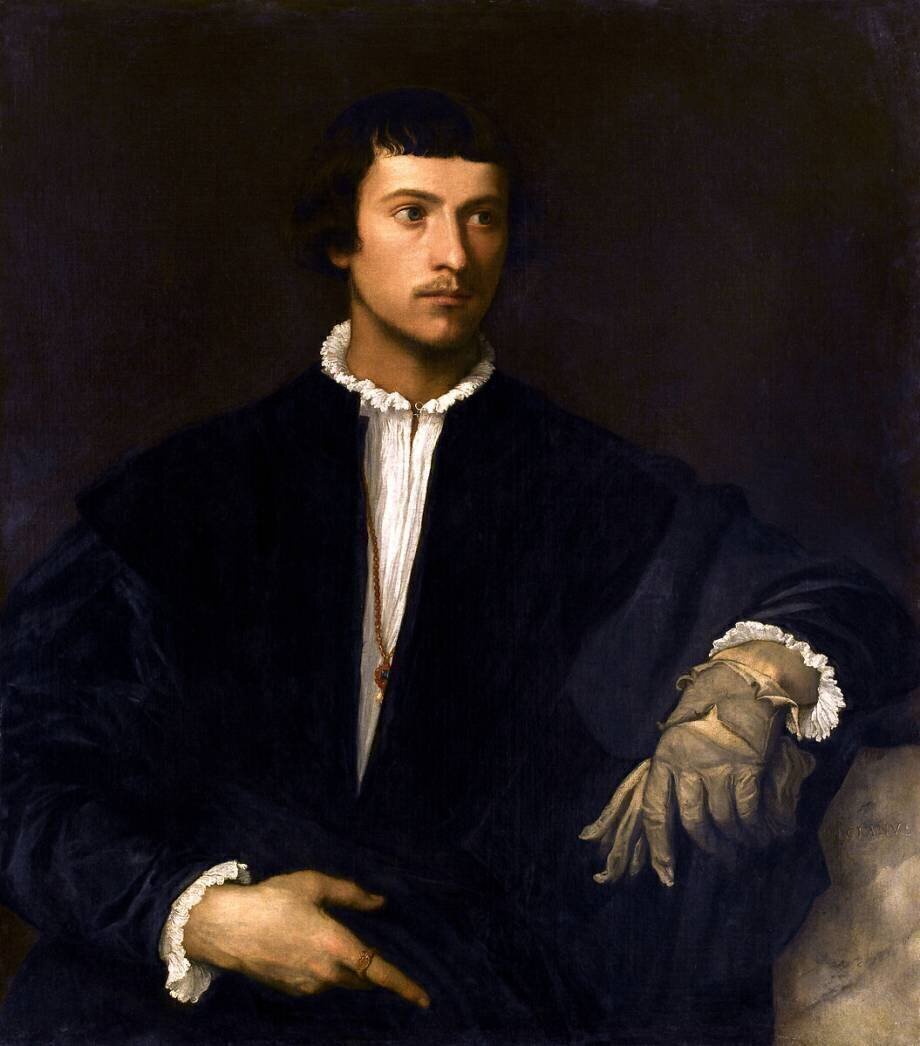
Man with a Glove, a masterful oil on canvas by Titian, remains one of the most iconic and most studied portraits of the Italian High Renaissance. Painted around 1520 to 1523, this work, carefully preserved at the Louvre Museum in Paris, continues to fascinate with its psychological depth and its technical virtuosity. Measuring 100 centimetres in height and 89 centimetres in width, the canvas provides a space within which the artist has captured the essence of an era and the individuality of a young man whose exact identity remains a matter of debate, adding a layer of mystery to its contemplation.
Titian’s Man with a Glove : the genesis and context of an iconic portrait
In the early 16th century, Venice flourished as one of Europe’s most important artistic and commercial centres. It was within this atmosphere of cultural and intellectual effervescence that Titian, whose real name was Tiziano Vecellio, established himself as a leading figure of the Venetian school. The Serenissima, bolstered by its maritime power and commercial ties with the East, provided fertile ground for artistic creation, where colour and light became paramount elements. The Man with a Glove is a product of this prosperous period in which portraiture took on new significance, reflecting the assertion of the individual and their social status. The patrons, often wealthy merchants, nobles or clergymen, sought faithful representations that were also imbued with a certain idealisation. The work of Titian is distinguished by his ability to probe the soul of his subjects, transcending mere physical resemblance to reach a profound psychological dimension. Whilst the precise identity of the young man depicted remains uncertain – historians have suggested Girolamo Adorno, or even Ferrante Gonzaga, although the latter hypothesis is less widely accepted today – it is undeniable that he belonged to the elite of his time. The creation of this portrait coincides with a period of stylistic maturity for Titian, during which he perfected his subtle use of glazing and his mastery of chiaroscuro, techniques that lend his works a remarkable presence and vitality.
Titian’s Man with a Glove: the discreet elegance of a presence
From the very first glance, Man with a Glove strikes one with its simplicity and the intensity it exudes. The young man is depicted in half-length, standing out against a dark and neutral background that highlights the clarity of his face and hands. The composition is rigorous, almost austere, yet animated by a subtle dynamism. The figure is turned slightly in three-quarter profile, his gaze directed towards something outside the painting; the light, coming from an unseen source to the left, sculpts the forms with great finesse, shaping the facial features, emphasising the curve of the shoulder and drawing attention to the hands, the central elements of the composition. The colour palette is dominated by dark tones – blacks, browns, greys – enhanced by the whiteness of the linen and the delicate complexion of the model. This restraint in the use of colour contributes to the atmosphere of melancholy and introspection that emanates from the painting. The texture of the clothing, notably the black velvet of the doublet and the delicacy of the kidskin glove, is rendered with exceptional virtuosity, testifying to Titian’s talent for suggesting the materiality of fabrics. The overall balance of the work rests on a skilful interplay of guiding lines, both oblique and curved, which direct the viewer’s gaze and lend the composition a discreet yet powerful harmony.
Titian’s The Man with the Glove : a psychological portrait of a melancholic gentleman
The central subject of the painting is a young man of about twenty, whose expression is marked by a gentle melancholy and a palpable introspection. His face, with its fine, regular features, is framed by silky brown hair. His forehead is high, his nose straight, his lips delicately defined. But it is above all his gaze that captivates: dark, deep eyes that seem lost in an inner reverie, with a disturbing intensity seeking to communicate beyond the canvas. This duality between introspection and communication lends the figure an enigmatic presence. His posture is both noble and slightly weary. He wears dark clothing, typical of the men’s fashion of the time, which emphasises his elegance and distinction. His right hand rests on his chest, whilst his gloved left hand holds a second glove with a studied nonchalance. These hands, rendered with particular care, play a crucial role in the characterisation of the figure. They reveal his youth, his sensitivity and perhaps a certain vulnerability. The absence of ostentatious attributes, apart from the discreet gold chain hanging from his neck, suggests nobility of blood or spirit rather than a display of material wealth. Titian thus succeeds in creating a portrait that goes far beyond mere physical representation, offering a genuine exploration of the psyche of his subject.
Titian’s Man with a Glove: the silent language of objects
In The Man with the Glove, every detail, every object depicted seems to carry a meaning that enriches the interpretation of the work. The glove, the eponymous element of the painting, is particularly laden with symbolism. In the Renaissance, gloves were luxury accessories, signs of refinement and membership of a high social class. They could also symbolise loyalty and honour, or be offered as a token of love. The bare hand, often associated with sincerity and vulnerability, contrasts with the gloved hand, which may represent a certain reserve or protection. The gold chain, discreet yet visible, is another indicator of social status, but its delicacy could also evoke a bond, a connection, whether romantic, friendly or one of loyalty to a suzerain. Even the dark background, far from being insignificant, contributes to the overall atmosphere by focusing attention on the figure and reinforcing the sense of introspection and solitude. The light illuminating the face and hands, contrasting with the surrounding darkness, could symbolise knowledge, self-awareness, emerging from the darkness of ignorance or melancholy.
The Legacy of The Man with a Glove in Titian’s Career and Art History
The Man with a Glove marks a significant milestone in Titian’s career, affirming his mastery of the psychological portrait and his status as a leading painter. Through its sensitivity and depth, this work helped establish his reputation far beyond the borders of Venice, opening the doors to princely and papal courts. Titian’s ability to capture not only the physical resemblance but also the inner essence of his subjects revolutionised the art of portraiture. He elevated this genre, sometimes regarded as minor, to the status of a major artistic exploration. The influence of Man with a Glove and Titian’s portraits in general is evident in the work of many artists of subsequent generations. Masters such as Rubens, Van Dyck, Rembrandt and Velázquez studied and admired his work, drawing inspiration from his technique, his use of colour and light, and his ability to convey the psychology of his subjects. The painting thus played a role in the evolution of portraiture in Europe, encouraging a more naturalistic and introspective approach. Even today, The Man with a Glove is regarded as an absolute masterpiece, bearing witness to the genius of Titian and the richness of the Venetian Renaissance. Its presence in the Louvre allows millions of visitors each year to contemplate this enigmatic figure and to ponder the secrets it holds, thus perpetuating the artist’s lasting impact on art history.
This artwork is a painting from the renaissance period. It belongs to the italian renaissance style.
« Man with a Glove » is kept at Louvre, Paris, France.
Find the full description of Man with a Glove by Tiziano on Wikipedia.
Other artworks by Tiziano
-
From58.29 €£49.5548.58 €£41.29
-
From60.45 €£51.3850.37 €£42.82
-
From60.78 €£51.6650.65 €£43.05
-
From60.41 €£51.3450.34 €£42.79
-
From72.74 €£61.8360.62 €£51.52
-
From69.82 €£59.3558.19 €£49.46
-
From51.31 €£43.6242.76 €£36.35
-
From54.4 €£46.2445.33 €£38.53
-
From57.13 €£48.5647.61 €£40.47
-
From60.78 €£51.6650.65 €£43.05


Other artworks in the same colors
-
From41.69 €£35.4334.74 €£29.53
-
From65.82 €£55.9554.85 €£46.62
-
From44.13 €£37.5136.77 €£31.26
-
From59.62 €£50.6849.68 €£42.23
-
From65.1 €£55.3354.25 €£46.11
-
From37.79 €£32.1231.49 €£26.77


Other similar artworks
-
From58.46 €£49.6948.71 €£41.41
-
From60.41 €£51.3450.34 €£42.79
-
From59.92 €£50.9349.93 €£42.44
-
From41.64 €£35.3934.7 €£29.49
-
From64.27 €£54.6353.56 €£45.52
-
From55.53 €£47.246.28 €£39.34
-
From63.77 €£54.2153.14 €£45.17
-
From60.95 €£51.8150.79 €£43.17
-
From68.52 €£58.2557.1 €£48.54