


Customise
Your art print
Monk by the sea OF Caspar David Friedrich
Monk by the sea
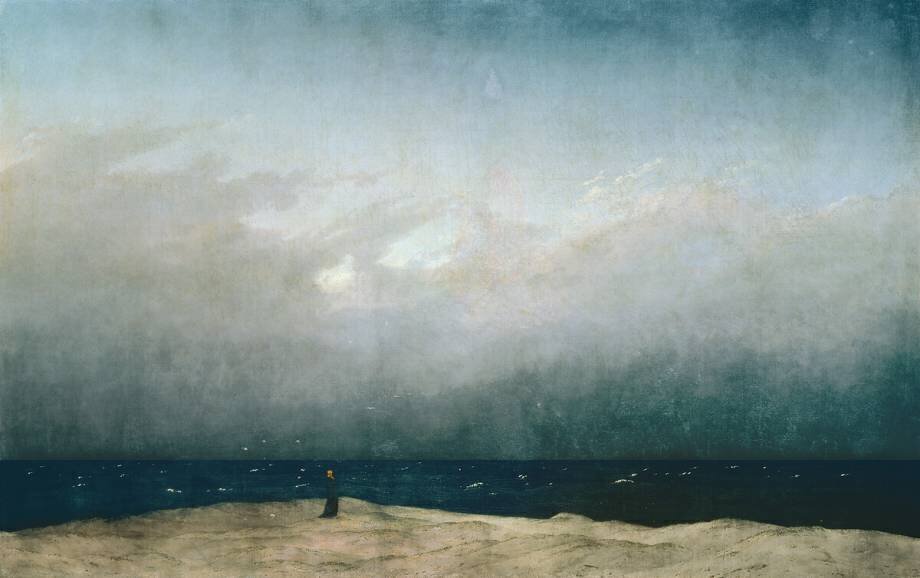
The Monk by the Sea by Caspar David Friedrich, a large-scale oil on canvas (110 x 171.5 cm) held at the Alte Nationalgalerie in Berlin, remains one of the most iconic and radical works of German Romanticism. It continues to fascinate and challenge the viewer with its bold composition and its meditative depth.
The genesis of Caspar David Friedrich’s Monk by the Sea in a tumultuous Europe
Painted between 1808 and 1810 in Dresden, The Monk by the Sea emerged against a historical backdrop that was particularly turbulent. Germany was then fragmented and largely under Napoleonic rule since the Battle of Jena in 1806, a situation that fuelled a sense of uncertainty and a burgeoning nationalism. It was against this backdrop that German Romanticism flourished, emphasising the expression of individual emotions, spirituality and the confrontation with the raw power of a nature perceived as the mirror of the soul. Caspar David Friedrich, already recognised for his innovative approach to landscape painting following the controversy surrounding The Tetschen Altarpiece in 1808—which established him as a ‘Romantic’ figure—conceived this work in parallel with The Abbey in an Oak Forest. Exhibited together at the Berlin Academy of Arts in 1810, The Monk by the Sea hanging above The Abbey in an Oak Forest at the artist’s request, these paintings marked a turning point. The acquisition of The Monk by the Sea by the Prussian Crown Prince Frederick William III attests to the immediate impact of this artistic vision, although the initial critical reception was mixed, oscillating between fascination and rejection in the face of such a break with landscape conventions.
Caspar David Friedrich’s The Monk by the Sea: a visual symphony of immensity and austerity
The first encounter with The Monk by the Sea is an experience of visual immersion. Friedrich radically departs from the traditional rules of perspective and landscape composition. The painting is structured into three distinct, almost abstract horizontal bands: a narrow strip of pale ochre-yellow in the foreground, a dark, almost black expanse of water in the middle, and an immense, threatening sky that occupies nearly five-sixths of the canvas. This sky, leaden grey and turbulent, lightens subtly towards the top, revealing shades of blue and violet—perhaps a distant glimmer of hope or simply the unfathomable infinite. There is no smooth transition between these layers, no path to guide the eye according to classical conventions. The artist had initially painted two small sailing boats on the horizon, but chose to erase them, thereby reinforcing the sense of an infinite void and absolute solitude. This extremely pared-back composition, where space seems to stretch out to infinity, creates an atmosphere of an abyss, of hovering between day and night, hope and despair, giving the viewer, as Heinrich von Kleist pointed out, the sensation “that one’s eyelids had been cut off”.
The solitary figure: a silent dialogue with eternity
At the heart of this immensity stands the tiny, enigmatic figure of the monk. Depicted from behind, in a “Rückenfigur” – a recurring motif in Friedrich’s work – he is clad in a simple, sombre monk’s robe that almost blends him into the dark hues of the sea and the beach. His posture is one of contemplation, turned towards the infinite horizon, lost in thought before the overwhelming spectacle of nature. He is the sole vertical element in this horizontal landscape, but his paltry stature against the expanse of sky and ocean emphasises his vulnerability and apparent insignificance. His position, slightly offset to the left, avoids any heroic centrality and accentuates his isolation. The fact that he is shown from behind invites the viewer to identify with him, to share his perspective and his meditation in the face of the unknown. The choice of a monk, a figure traditionally associated with spirituality, renunciation and the quest for meaning, lends the scene a mystical and philosophical dimension, transforming it into a symbol of the human condition confronted with the infinite.
Caspar David Friedrich’s The Monk by the Sea: the language of the raging elements
Every element of The Monk by the Sea is imbued with profound symbolic power, transforming the landscape into a meditation on existence. The monk himself embodies the solitude of the human being, his spiritual quest in the face of forces beyond his control, and the confrontation with the unknown, Friedrich himself having described his work as an evocation of “the unknown of the beyond”. The dark and turbulent sea symbolises the abysses of existence, the inner turmoil, the unconscious, but also the indomitable and sometimes threatening force of nature. The vast sky, alternating between darkness and diffuse glimmers, may represent both the oppression of fate and a possible transcendence, an inaccessible beyond or a faint glimmer of hope. The layered composition – the solid yet cramped land, the perilous water, and the unattainable air – has been interpreted as a ‘ladder to the unattainable’, highlighting the smallness of the human sphere in the face of the universe. The work has also been seen as an allegory of the state of Germany at the time, overwhelmed yet seeking renewal. The restricted colour palette and strong contrasts reinforce this atmosphere of ‘terrifying sublime’, that feeling mingled with fascination and dread in the face of a beauty that surpasses us and confronts us with our own finitude.
Caspar David Friedrich’s E The Monk by the SeaE : resonances of a metaphysical landscape
The exhibition of The Monk by the Sea in 1810, although it provoked mixed reactions, marked an important milestone in the career of Caspar David Friedrich and in the history of art. Its acquisition by the Prussian Crown Prince and Friedrich’s admission to the Berlin Academy that same year attested to a growing recognition, establishing him as a leading figure of German Romanticism. This painting is considered one of the boldest and purest expressions of the Romantic aesthetic, redefining the landscape genre by imbuing it with an unprecedented emotional and philosophical intensity. Its influence was considerable and enduring. It inspired generations of artists, from J.M.W. Turner to Claude Monet, and later the Expressionists, the Surrealists, as evidenced by a 1939 article in the journal Minotaure describing him as the ‘painter of romantic anguish’, and even contemporary artists such as Gerhard Richter and Gotthard Graubner. The radical nature of his composition, his ability to evoke the sublime – that confrontation with the infinite power of nature, arousing both fear and wonder – and his profound exploration of human solitude in the face of the universe continue to resonate, making Monk by the Sea a timeless and universal work.
This artwork is a painting from the classical period. It belongs to the romanticism style.
« Monk by the sea » is kept at Alte Nationalgalerie, Berlin, Germany.
Find the full description of Monk by the sea by Caspar David Friedrich on Wikipedia.
Other artworks by Caspar David Friedrich
-
From60.86 €£51.7350.71 €£43.11
-
From54.36 €£46.2145.3 €£38.51
-
From52.24 €£44.4143.54 €£37.01
-
From59.3 €£50.4149.42 €£42.01
-
From54.01 €£45.9145.01 €£38.26
-
From57.89 €£49.2148.24 €£41.01
-
From55.49 €£47.1746.24 €£39.31
-
From59.16 €£50.2949.3 €£41.91
-
From60.15 €£51.1350.13 €£42.61
-
From60.29 €£51.2550.24 €£42.71


Other artworks in the same colors
-
From63.54 €£54.0152.95 €£45.01
-
From64.95 €£55.2154.13 €£46.01
-
From50.88 €£43.2542.4 €£36.04
-
From33.92 €£28.8328.26 €£24.03
-
From57.04 €£48.4947.53 €£40.4
-
From69.61 €£59.1758.01 €£49.31
-
From40.07 €£34.0633.39 €£28.38
-
From33.07 €£28.1127.56 €£23.42


Other similar artworks
-
From65.94 €£56.0554.95 €£46.71
-
From92.2 €£78.3776.84 €£65.31
-
From38.58 €£32.7932.15 €£27.33
-
From31.59 €£26.8526.32 €£22.37
-
From53.43 €£45.4244.53 €£37.85
-
From42.88 €£36.4535.73 €£30.37
-
From39.11 €£33.2432.59 €£27.7
-
From36.97 €£31.4230.8 €£26.18