
Customise
Your art print
Napoleon I on His Imperial Throne OF Jean-Auguste-Dominique Ingres
Napoleon I on His Imperial Throne
Napoleon I on the Imperial Throne: the genesis of an imperial icon
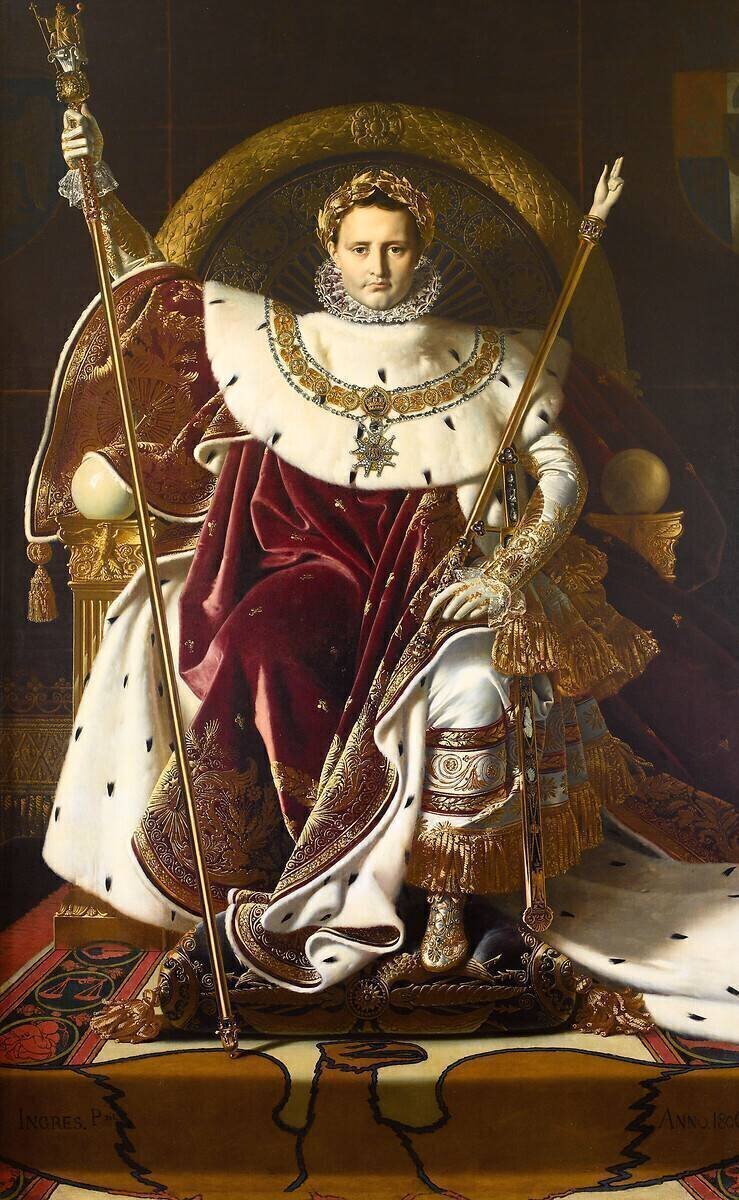
Painted in 1806, as indicated by the signature “INGRES P” and the date “ANNO 1806” at the bottom of the painting, Napoleon I on the Imperial Throne is set within a specific historical context: that of the assertion of power by Napoleon Bonaparte, who had become Emperor of the French two years earlier. The work was created by Jean-Auguste-Dominique Ingres, then a young artist, and depicts Napoleon in his coronation robes. The exact origin of this commission remains a matter of debate; some historians suggest it was initially commissioned by an Italian institution to depict Napoleon as King of Italy, but was rejected due to its bold iconography. It was ultimately acquired by the Legislative Body. The creation of this monumental portrait was part of Napoleon’s desire to establish his legitimacy by symbolically linking himself to previous dynasties, notably the Bourbons, but also to the great imperial figures of the past, from the Roman Empire to Charlemagne. The painting thus aimed to project an image of absolute power, unchallenged authority and a claimed historical legacy, fixing for posterity the image of a sovereign at the height of his glory and power.
Napoleon I on the Imperial Throne: majesty frozen in visual eternity
The first impression left by this imposing work, now housed at the Musée de l’Armée in Paris and measuring 263 by 163 centimetres, is one of overwhelming solemnity and abundant ornamental richness. In Napoleon I on the Imperial Throne, Ingres adopts a frontal and strictly symmetrical composition, placing the Emperor at the exact centre of the canvas, seated on an imposing throne of which only the circular backrest and the armrests adorned with ivory globes are visible. The dominant colours are the deep purple of the imperial mantle, the dazzling white of the tunic and the ermine, and the omnipresent gold of the embroidery, the laurel wreath, the insignia and the throne’s ornaments. Ingres’s style is characterised here by extreme precision in the rendering of details, a smooth, almost photographic finish that enhances the sumptuousness of the materials – velvet, satin, ermine, gold and ivory. The whole scene is bathed in a cold, uniform light that accentuates the solemn and timeless nature of the scene, lending the portrait an almost divine dimension, removed from any human or temporal contingency.
Emperor Napoleon I: a solemn and omnipotent figure
At the heart of this majestic composition sits Napoleon I. His posture is one of absolute rigidity, his body upright, his gaze fixed, directed straight towards the viewer. This frontal pose directly evokes depictions of ancient gods, such as Phidias’ Olympian Zeus, or the figures of Christ Pantocrator in Byzantine iconography. This is not a psychological portrait, but an effigy of power incarnate. The Emperor is adorned with all the attributes of his supreme office: wearing a crown of golden laurels, he holds firmly in his right hand the so-called sceptre of Charles V, a symbol of command, and in his left hand the hand of justice, an emblem of his judicial power. His white satin tunic is richly embroidered in gold, whilst his heavy purple velvet cloak—the imperial colour par excellence—is studded with golden bees, the Merovingian symbol chosen by Napoleon, and lined with thick ermine fur. An epaulette, also in ermine, supports the imposing Grand Master’s collar of the Légion d’honneur. To his left, resting against the throne, the coronation sword, a replica of Joyeuse, Charlemagne’s sword, completes this arsenal of sovereignty.
The grammar of absolute power as seen by Jean-Auguste-Dominique Ingres
Every element of Napoleon I on the imperial throne is imbued with a precise symbolic meaning, constructing a visual discourse on the nature and legitimacy of Napoleonic imperial power. The hieratic pose and frontal composition, as mentioned, anchor Napoleon in a tradition of representing divine and sovereign power dating back to Antiquity and the Christian Middle Ages. The regalia – the sceptre of Charles V, the sceptre of justice, the coronation sword – link him directly to the kings of France and to Charlemagne, placing his reign within a prestigious historical continuity. The laurel wreath and the imperial eagle embroidered on the carpet at his feet clearly refer to the Roman Empire, the political and military model claimed by Napoleon. The choice of imperial purple, the white tunic and the honeycomb pattern (replacing the Bourbons’ fleurs-de-lis) is part of this desire for historical syncretism, aiming to merge the Roman, Carolingian and Capetian legacies to found a new dynasty. Even the details of the throne, with its armrests shaped like ivory globes, suggest universal domination. This accumulation of symbols transforms the portrait into a veritable allegory of restored imperial power.
The impact of Napoleon I on the Imperial Throne on Ingres’s career
The painting Napoleon I on the Imperial Throne initially had a negative and complex impact on the young artist’s career. Although this official commission from the Legislative Body to depict the Emperor in all his majesty represented a significant milestone and recognition of his talent, the work was very poorly received at the Paris Salon that same year. Critics, baffled by its bold style and iconographic choices, deemed it ‘Gothic’, “barbaric” and lacking in realism, criticising in particular the Emperor’s frozen appearance and hieratic frontal pose, which evoked Byzantine icons or the Flemish Primitives more than the neoclassical canons then in vogue. This highly unfavourable reception deeply affected Ingres. Shortly afterwards, he left Paris for Italy, where he stayed for many years. This departure can be interpreted in part as a consequence of this critical failure, the painter perhaps seeking a more understanding environment in which to develop his art. Whilst the work is now regarded as a major piece of Napoleonic iconography and a milestone in Ingres’s boldness, its initial reception thus represented a significant setback for the artist, prompting him to move away from the Parisian artistic centre, even though, in the long term, his career was crowned with success and his talent eventually came to be widely recognised. The painting itself, deemed shocking in its day, had to wait nearly a century before being prominently exhibited, reflecting the disconnect between Ingres’s vision and the expectations of his contemporaries.
This artwork is a painting from the classical period. It belongs to the neoclassicism style.
« Napoleon I on His Imperial Throne » is kept at Musée de l'Armée, Paris, France.
Other artworks by Jean-Auguste-Dominique Ingres
-
From89.01 €£75.6674.18 €£63.05
-
From67.26 €£57.1756.05 €£47.64
-
From99.97 €£84.9883.31 €£70.82
-
From70.58 €£59.9958.82 €£49.99
-
From72.58 €£61.760.49 €£51.41
-
From81.21 €£69.0367.67 €£57.52
-
From71.97 €£61.1859.98 €£50.98
-
From57.13 €£48.5647.61 €£40.47
-
From64.6 €£54.9153.83 €£45.76
-
From38.4 €£32.6432 €£27.2


Other artworks in the same colors
-
From65.6 €£55.7654.66 €£46.47
-
From88.52 €£75.2473.76 €£62.7
-
From65.6 €£55.7654.66 €£46.47
-
From71.24 €£60.5659.37 €£50.46
-
From72.74 €£61.8360.62 €£51.52
-
From73.57 €£62.5361.31 €£52.11
-
From54.47 €£46.345.39 €£38.58
-
From66.76 €£56.7555.63 €£47.29
-
From38.27 €£32.5331.9 €£27.11


Other similar artworks
-
From64.3 €£54.6653.59 €£45.55
-
From83.95 €£71.3669.96 €£59.46
-
From77.72 €£66.0664.77 €£55.05
-
From69.92 €£59.4358.26 €£49.52
-
From43.63 €£37.0936.36 €£30.91