


Customise
Your art print
Return of the Prodigal Son OF Rembrandt
Return of the Prodigal Son
The Return of the Prodigal Son: Rembrandt’s ultimate masterpiece
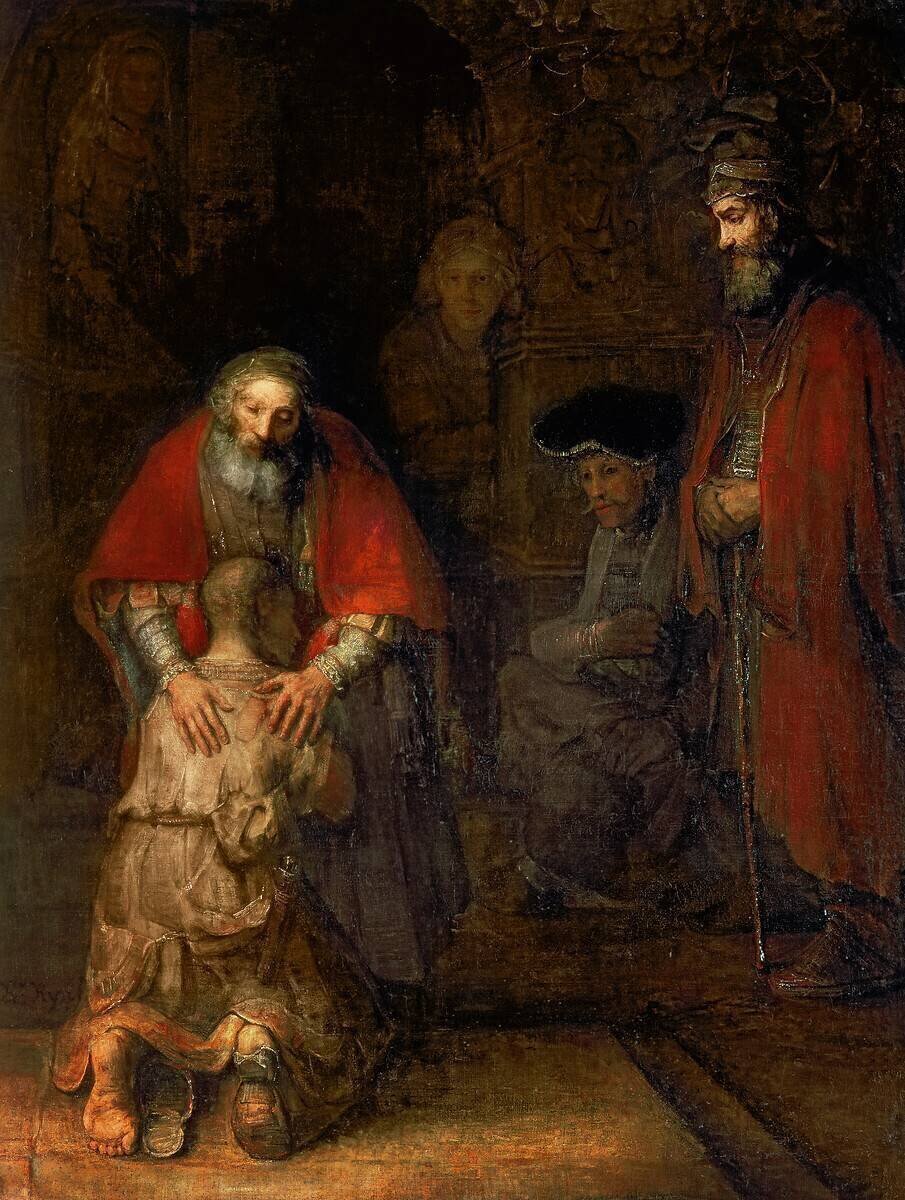
The Return of the Prodigal Son, a monumental oil on canvas measuring 262 cm by 205 cm, painted by Rembrandt van Rijn around 1668, is one of the most moving and spiritual works in the history of Western art. Carefully preserved at the Hermitage Museum in Saint Petersburg, Russia, this painting represents the pinnacle of the Dutch master’s artistic and personal maturity, created in the final years of his life, and probably completed shortly before his death in 1669. It bears witness to a profound reflection on the human condition, mercy and reconciliation, themes dear to the artist throughout his career.
At the origins of an eternal parable: the genesis of Rembrandt’s Return of the Prodigal Son
The inspiration for this poignant work draws directly from the New Testament, more specifically from the parable of the Prodigal Son as recounted in the Gospel according to Luke (15:11-32). This timeless story—of a young man demanding his share of the inheritance only to squander it on a life of debauchery before returning, repentant and destitute, to his father who welcomes him with open arms—had a profound impact on Rembrandt. Indeed, this was not his first foray into this biblical narrative. As early as 1636, he had explored this theme through an etching, demonstrating a consistent interest in the concepts of sin, repentance and unconditional forgiveness. The creation of this large canvas is therefore part of the artist’s long meditation on these universal values, at a time in his life marked by personal trials and growing introspection. Acquired in 1766 by Catherine II, the work found its permanent home within the collections of the Hermitage, where an entire room is dedicated to the master.
The Return of the Prodigal Son: a scene bathed in shadow and divine light
The composition of the Return of the Prodigal Son is striking for its simplicity and emotional power, enhanced by the masterful use of chiaroscuro, a technique emblematic of Rembrandt. The main scene stands out against a dark, almost indistinct background, where a few secondary figures can be glimpsed, silent witnesses to the event. A warm light, almost supernatural, emanates not from an identifiable source but seems to radiate from the central figures themselves, particularly the father and the kneeling son. This light is not merely descriptive; it is eminently symbolic, sculpting the forms, accentuating the tenderness of the father’s gesture and the son’s misery, and creating an atmosphere of intense spiritual intimacy. Rembrandt uses a muted colour palette, dominated by browns, ochres and a deep red for the father’s cloak, which reinforces the solemnity and introspection of the scene. The paint itself, with visible impasto particularly in the lit areas, lends a palpable texture and presence to the figures, making their humanity all the more touching.
The merciful embrace: the beating heart of Rembrandt’s Return of the Prodigal Son
At the centre of this theatrical composition lies the climax of the parable: the reunion of father and son. The son, depicted in a state of extreme destitution, his head shaved, clad in tattered rags that reveal a body scarred by hardship, is kneeling, his face hidden in his father’s embrace. His posture expresses at once shame, exhaustion and total surrender to mercy. One of his bare feet is worn, the other wears a sandal in a pitiful state, highlighting the long and arduous journey home. The father, a majestic yet ageing figure, leans over his long-lost son with infinite tenderness. His face, marked by time and a suggested blindness, radiates compassion and unconditional love, free from all reproach. His large hands, resting gently on his son’s shoulders, are at the heart of the interaction; they welcome, protect and forgive. On the right stands a figure often identified as the elder son, his hands clasped, whose expression and posture suggest judgement or incomprehension in the face of his father’s generosity, introducing a subtle tension.
A universal gesture at the heart of Rembrandt’s The Return of the Prodigal Son
Beyond the biblical narrative, The Return of the Prodigal Son is a work saturated with symbols that enrich its interpretation. The father’s hands, so expressive, have been the subject of numerous interpretations: one, more masculine and firm, could symbolise justice and paternal rigour, whilst the other, gentler and more feminine in its support, evokes maternal tenderness and mercy, thus suggesting the completeness of divine love that embraces both justice and compassion. The father’s red cloak, a colour traditionally associated with charity and nobility, envelops the scene in an aura of dignity and sacrifice. The prodigal son’s destitution, with his torn clothes and injured foot, symbolises the spiritual and physical misery of the sinner estranged from the source of love. The light bathing the central scene, contrasting with the surrounding darkness, represents the divine light of grace and forgiveness that triumphs over the darkness of sin. Even the geometric structure of the composition, in which some see triangles uniting the father and the son, could symbolise the union between God and repentant humanity.
The Return of the Prodigal Son: an artistic and spiritual testament for eternal posterity
Regarded as one of the last great masterpieces by Rembrandt, The Return of the Prodigal Son is far more than a mere biblical illustration. It is the spiritual testament of an artist who had reached the pinnacle of his art and his understanding of human nature. This work had a considerable impact, not only on the perception of Rembrandt’s later career, often marked by financial difficulties, but also through a deepening of his exploration of the human soul. His ability to convey universal emotions with such depth and restraint, and his revolutionary use of light to express spiritual states, have inspired generations of artists after him, from Goya to Van Gogh. The painting remains an absolute benchmark in the depiction of forgiveness, compassion and unconditional love, transcending eras and faiths. It is proof that Rembrandt, at the end of his life, was able to transcend the artistic conventions of his time to convey a message of timeless humanity and spirituality, making this painting one of the greatest depictions of mercy in Western art.
This artwork is a painting from the classical period. It belongs to the baroque style.
« Return of the Prodigal Son » is kept at State Hermitage Museum, St. Petersburg, Russia.
Find the full description of Return of the Prodigal Son by Rembrandt on Wikipedia.
Other artworks by Rembrandt
-
From61.45 €£52.2351.21 €£43.52
-
From43.13 €£36.6635.94 €£30.55
-
From60.73 €£51.6250.61 €£43.02
-
From57.96 €£49.2648.3 €£41.05
-
From60.09 €£51.0750.07 €£42.56
-
From65.76 €£55.954.8 €£46.58
-
From58.29 €£49.5548.58 €£41.29
-
From37.9 €£32.2131.58 €£26.84
-
From69.34 €£58.9457.78 €£49.11
-
From38.15 €£32.4231.79 €£27.02


Other artworks in the same colors
-
From71.91 €£61.1259.92 €£50.94
-
From58.46 €£49.6948.71 €£41.41
-
From59.79 €£50.8249.82 €£42.35
-
From62.61 €£53.2252.17 €£44.35
-
From34.86 €£29.6329.05 €£24.69
-
From62.77 €£53.3652.31 €£44.47


Other similar artworks
-
From63.11 €£53.6452.59 €£44.7
-
From62.35 €£5351.96 €£44.17
-
From64.27 €£54.6353.56 €£45.52
-
From63.94 €£54.3553.28 €£45.29
-
From63.11 €£53.6452.59 €£44.7
-
From43.39 €£36.8836.16 €£30.74
-
From59.27 €£50.3849.39 €£41.98
-
From70.8 €£60.1859 €£50.15