
Customise
Your art print
Where Do We Come From? What Are We? Whe... OF Paul Gauguin
Where Do We Come From? What Are We? Where Are We Going?
Where Do We Come From? What Are We? Where Are We Going? by Paul Gauguin: a pictorial odyssey
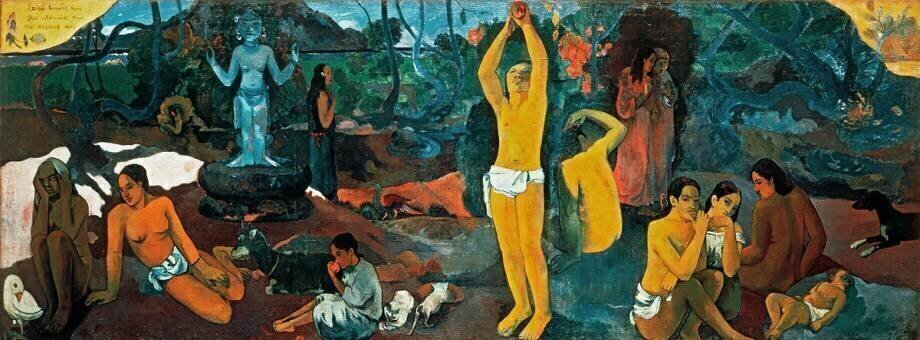
Where Do We Come From? What Are We? Where Are We Going?, a monumental work by Paul Gauguin painted between 1897 and 1898, is much more than a mere canvas; it is a profound philosophical inquiry, an artistic testament and a window into the tormented soul of its creator. Carefully preserved at the Boston Museum of Fine Arts in the United States, this oil on canvas, measuring an impressive 139.1 x 374.6 cm, continues to fascinate and challenge viewers with its rich symbolism and enigmatic beauty.
Where do we come from? What are we? Where are we going? by Paul Gauguin: creative urgency in the face of the abyss
In 1897, Paul Gauguin found himself in Tahiti, during his second stay in what he hoped would be an unspoilt paradise. However, the reality was bitter: the artist was confronted with the deleterious effects of colonisation, the illnesses that plagued him (eczema, syphilis, conjunctivitis), crushing financial difficulties and, the final blow, the news of his daughter Aline’s death. Consumed by despair, Gauguin contemplated suicide. It was in this state of existential crisis, and driven by a desire to leave an indelible mark—a synthesis of his reflections and his art—that he undertook the creation of this major work. He conceived it as his great pictorial testament, working on it day and night with an unprecedented creative fervour for a whole month. This period of profound personal distress imbues the canvas with a palpable gravity and intensity, blending his observations of Tahitian life with a universal spiritual quest, drawing inspiration from sources as diverse as Milton’s Paradise Lost, the Bible, and Jean-Jacques Rousseau’s writings on the state of nature.
Where Do We Come From? What Are We? Where Are We Going? by Paul Gauguin, a Tahitian fresco
Visually, Where Do We Come From? What are we? Where are we going? unfolds like a vast fresco, which, unlike in Western tradition, is read from right to left. Gauguin himself emphasised this directionality, which guides the viewer through the different stages of life and reflection. The landscape is lush, dominated by shades of blue and Veronese green, against which the figures with their ochre-orange bodies stand out. In the background, the sea and the mountains of a neighbouring island anchor the scene in an idealised Tahitian setting, yet transcend the location to attain a universal dimension. The artist inscribed the enigmatic title, without question marks, in capital letters in the top left-hand corner, whilst his signature and the date ‘P. Gauguin / 1897’ appear in the top right-hand corner. The overall appearance, which Gauguin himself described as “terribly crude”, contributes to the raw power of the work, far removed from academic polish, to better serve his philosophical purpose.
Where do we come from? What are we? Where are we going? by Paul Gauguin: a human triptych at the heart of the canvas
The painting is structured into three main groups of figures that illustrate the questions posed by the title, read from right to left. On the right, evoking ‘Where do we come from?’, a sleeping baby and three young women represent the innocence of origins, the beginning of life. In the centre, dominating the composition and answering the question ‘What are we?’, stands an androgynous figure, often interpreted as a young adult, picking a fruit. This highly symbolic gesture may evoke the act of knowledge, existential curiosity, or even a reminiscence of original sin. This central figure immediately captures the attention, embodying man in the prime of life, questioning the meaning of his daily existence. Around him, other figures go about their business, symbolising the various aspects of adult life. Finally, on the left, beneath the question “Where are we going?”, an old woman, inspired by a Peruvian mummy Gauguin had seen, appears crouching, seeming resigned and at peace with the approach of death. She embodies the end of the cycle, the contemplation of the ultimate mystery.
Whispers of Eternity: The Dance of Symbols
Beyond the narrative composition, the canvas is peppered with symbolic elements that enrich its interpretation. The blue idol in the background, which Gauguin described as representing “the afterlife”, is a hieratic figure, a reimagined Hina goddess, possibly influenced by Buddhist sculptures or deities such as Lokesvara. Her raised arms seem to indicate transcendence, a world beyond the tangible. Near the old woman, a strange white bird, holding a lizard in its claw, symbolises, according to Gauguin, the “futility of words” or the vanity of speech in the face of the great questions of existence. The two figures dressed in long purple robes, wandering in the background, could represent the sharing or transmission of secret knowledge. The presence of animals, such as the two cats near a child or the goat, anchors the scene in a sense of everyday life that contrasts with the metaphysical significance of the whole. With this work, Gauguin does not merely depict, but evokes and suggests, in the manner of a symphonic poem where colours and forms resonate to touch the soul.
Where Do We Come From? What Are We? Where Are We Going? by Paul Gauguin: an artist’s testament, a milestone for modern art
Paul Gauguin regarded Where Do We Come From? What Are We? Where Are We Going? not only as his most accomplished work, surpassing all his previous ones, but also as a painting he could never equal. It is now recognised as an absolute masterpiece of Post-Impressionism and a cornerstone of modern art. Its impact was considerable, both on the latter part of Gauguin’s career and on the generations of artists that followed. By blending universal philosophical questions with an aesthetic drawing on the sources of ‘primitive art’ and non-Western cultures, Gauguin paved the way for the artistic revolutions of the 20th century, notably Fauvism and Expressionism. He helped to liberate painting from its purely mimetic function, transforming it into an expressive language of the artist’s inner world. Although his appropriation of indigenous cultures may be the subject of contemporary debate, the visionary power and spiritual depth of this seminal work remain intact, securing its place amongst the most significant and moving creations in the history of art.
This artwork is a painting from the modern period. It belongs to the post-impressionism style.
« Where Do We Come From? What Are We? Where Are We Going? » is kept at Museum of Fine Arts, Boston, Etats-Unis.
Other artworks by Paul Gauguin
-
From42.66 €£36.2635.55 €£30.22
-
From39.98 €£33.9833.32 €£28.32
-
From40.96 €£34.8134.13 €£29.01
-
From42.91 €£36.4735.76 €£30.39
-
From42.66 €£36.2635.55 €£30.22
-
From42.88 €£36.4535.74 €£30.38
-
From43.38 €£36.8836.15 €£30.73
-
From49.24 €£41.8641.04 €£34.88
-
From36.9 €£31.3730.75 €£26.14
-
From43.15 €£36.6835.96 €£30.56


Other artworks in the same colors
-
From57.79 €£49.1248.16 €£40.94
-
From69.25 €£58.8657.71 €£49.05
-
From49.31 €£41.9241.09 €£34.93
-
From64.95 €£55.2154.13 €£46.01
-
From58.84 €£50.0149.03 €£41.68
-
From86.36 €£73.471.96 €£61.17


Other similar artworks
-
From87.69 €£74.5373.07 €£62.11
-
From83.53 €£7169.61 €£59.17
-
From131.03 €£111.38109.19 €£92.81
-
From99.71 €£84.7583.09 €£70.63
-
From85.86 €£72.9871.55 €£60.82
-
From172.88 €£146.95144.07 €£122.46
-
From67.53 €£57.456.27 €£47.83