

Customise
Your art print
Woman with a hat and a feather boa OF Gustav Klimt
Woman with a hat and a feather boa
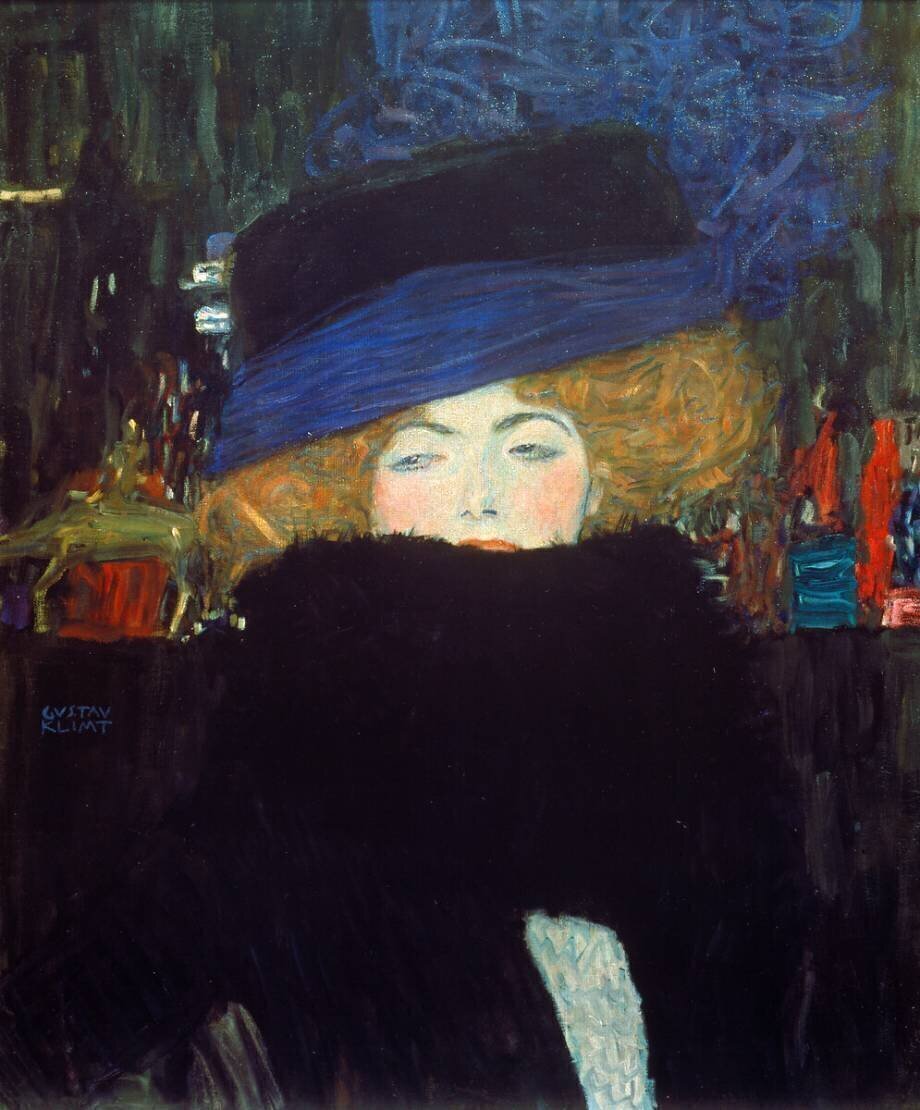
The work Woman with a Hat and Feather Boa, painted by the Austrian artist Gustav Klimt in 1909, is a small oil painting on cardboard measuring 69 cm by 55 cm. Currently held in a private collection, this painting is emblematic of a transitional phase in Klimt’s career, marked by an openness to contemporary European influences whilst retaining the artist’s fascination with the female figure and ornamentation.
Woman with a Hat and Feather Boa by Gustav Klimt: between Paris and Vienna
Painted in 1909, Woman with a Hat and Feather Boa is part of a prolific period for Gustav Klimt and for the Viennese art scene. Klimt, a leading figure of the Vienna Secession movement which he co-founded in 1897, was seeking to break with conservative academicism and promote a total art that integrated various disciplines. The year 1909 is significant, as it follows shortly after the artist’s famous Golden Period, during which he produced major works such as The Kiss (1907–1908). This painting was produced following a journey that Klimt undertook in the autumn of 1909 with his friend Carl Moll, taking them to Prague, Paris and Madrid. His stay in Paris exposed him more directly to French artistic movements, notably Impressionism and Post-Impressionism. Works such as Édouard Manet’s Olympia, which he discovered at the Guimet Museum, and the daring portraits of Henri de Toulouse-Lautrec, seem to have shaped his approach. This context of cultural effervescence and international artistic exchange fuelled the creation of this work, which bears witness to an assimilation of these new influences whilst remaining deeply rooted in Klimt’s own symbolist and ornamental world.
Woman with a Hat and a Feather Boa by Gustav Klimt: a symphony of textures and colours
Woman with a Hat and a Feather Boa stands out for its bold composition and vibrant painting technique. The painting features a close-up of a woman’s bust, whose presence is both assertive and enigmatic. The colour palette, dominated by rich, contrasting tones, plays a crucial role in the visual impact of the work. The background, rendered in relatively neutral tones with touches of blue-green and dark grey, highlights the central figure. The light seems to emanate from the subject herself, accentuating the brilliance of her red hair and the pallor of her skin. Klimt employs a quick, visible brushstroke, particularly in the rendering of the black feather boa and the large mauve hat adorned with flowers, which suggests an influence of Impressionist techniques and a desire to capture an immediate sensation. The composition is structured by masses of colour and sinuous lines: the boa creates a soft yet imposing barrier, whilst the hat, through its volume and intense colour, draws the eye. There is a dynamism created by the contrast between the central area, which is lighter and more detailed and where the face is concentrated, and the darker peripheral areas that are merely suggested. The whole exudes an atmosphere of sophistication and worldly elegance, typical of depictions of the modern woman of the early 20th century.
Woman with a Hat and Feather Boa by Gustav Klimt: the mystery and allure of a modern woman
The central subject of the painting is a young woman, later identified as Hilde Roth, a model of Hungarian origin with flaming red hair. She is depicted facing the viewer, but her gaze, with half-closed eyelids, is evasive, directed to the right of the viewer, creating a sense of distance and mystery. Her face, delicately made up, is partially obscured by the imposing purple hat and the voluminous black feather boa which seems to envelop and protect her. Only part of her face and her fiery hair are clearly visible, the rest of her body being concealed by these opulent fashion accessories. This composition lends the model an aura of unapproachability and veiled seduction. The elegance of her outfit, typical of Parisian fashion of the time, suggests a modern woman, conscious of her appearance and her power of fascination. Her expression is ambiguous, perhaps blending a touch of melancholy, contemplation or restrained defiance. Klimt does not seek photographic realism, but rather to capture an essence, a feminine presence that is both strong and elusive, characteristic of his female portraits. The way in which she is almost absorbed by the textures and colours of her clothes emphasises the importance of ornament and finery in defining her visible identity.
Woman with a Hat and a Feather Boa by Gustav Klimt: beyond appearances
In Woman with a Hat and a Feather Boa, several elements can be interpreted symbolically, enriching the reading of the work beyond its mere appearance. The black feather boa, voluminous and enveloping, may symbolise both elegance, luxury and a form of protection, or even concealment. Feathers, often associated with lightness and grace, can also evoke vanity or the fleeting nature of beauty and fashion. In Klimt’s work, they often accentuate sensuality and feminine mystery. The hat, with its extravagant size and intense purple colour, is a sign of social status and self-assertion, but it also helps to conceal the face, reinforcing the model’s enigmatic aura. It can be seen as an attribute of the modern, emancipated woman, conscious of her image. Hilde Roth’s avoiding gaze, which never meets that of the viewer, suggests a rich inner life, a secret garden, or a form of detachment from the outside world. This lack of visual confrontation is typical of many of Klimt’s female figures, who often appear absorbed in their own thoughts. The red hair, often associated in the collective imagination with passion, sensuality and sometimes the figure of the femme fatale, is here a vibrant focal point. The colours themselves are laden with meaning: the black of the boa may evoke mystery and the unknown, whilst the purple of the hat is traditionally linked to power and luxury. The pale complexion contrasting with these dark colours and the vividness of the hair emphasises a certain fragility but also a vital intensity. All these elements combine to create an image of complex femininity, somewhere between a society figure and an intimate secret.
Lady with a Hat and a Feather Boa by Gustav Klimt: an influential transition
Woman with a Hat and a Feather Boa holds a special place in Gustav Klimt’s career, illustrating a stylistic evolution following his acclaimed Golden Cycle. Whilst ornamentation remains present, here it is less focused on the golden mosaic and more on the pictorial texture and the influence of contemporary French movements, notably Impressionism and Fauvism, in the treatment of colour and brushwork. This portrait demonstrates Klimt’s ability to renew his approach whilst continuing his exploration of the female psyche. The work follows in the tradition of portraits of women from Viennese high society and the modern female figures that feature in his oeuvre, but with a sensibility that is perhaps more direct and less allegorical than some of his earlier paintings. The impact of this painting on Klimt’s career is measured by its contribution to the artist’s image as a portraitist of the modern woman, capable of capturing not only appearance but also a certain psychological atmosphere. More broadly, Woman with a Hat and Feather Boa contributes to art history as an example of how early 20th-century artists navigated between tradition and modernity, incorporating stylistic innovations whilst exploring timeless themes such as identity, seduction and mystery. It reflects the concerns of Art Nouveau and late Symbolism, where the female figure is often idealised, eroticised or rendered enigmatic. This type of portrait influenced the depiction of women in art and continues to serve as a benchmark for its bold elegance and expressive power.
This artwork is a painting from the modern period. It belongs to the art nouveau styles and symbolism styles.
« Woman with a hat and a feather boa » is kept at Osterreichische Galerie Belvedere, Vienna, Austria.
Find the full description of Woman with a hat and a feather boa by Gustav Klimt on Wikipedia.
Other artworks by Gustav Klimt
-
From31.69 €£26.9426.41 €£22.45
-
From31.69 €£26.9426.41 €£22.45
-
From60.21 €£51.1850.18 €£42.65
-
From31.69 €£26.9426.41 €£22.45
-
From39.98 €£33.9833.32 €£28.32
-
From31.94 €£27.1526.61 €£22.62
-
From78.5 €£66.7265.42 €£55.6
-
From33.15 €£28.1827.63 €£23.48
-
From52.66 €£44.7643.88 €£37.3
-
From31.69 €£26.9426.41 €£22.45


Other artworks in the same colors
-
From44.38 €£37.7236.98 €£31.44
-
From41.2 €£35.0234.33 €£29.18
-
From59.76 €£50.7949.8 €£42.33
-
From62.61 €£53.2252.17 €£44.35
-
From49.17 €£41.7940.97 €£34.83
-
From61.45 €£52.2351.21 €£43.52
-
From44.13 €£37.5136.78 €£31.26
![Casino de Paris. Les Amoureux de Venise, ballet en 4 tableaux. : [affiche] ([Variante de format (Alfred Choubrac) - Muzeo.com](https://mz.ykcdn.art/styles/image_oeuvre_slider/public/oeuvres/posters/modern/casino_de_paris_les_amoureux_128917.jpg?v=1773115665)


Other similar artworks
-
From87.52 €£74.3972.94 €£62
-
From58.62 €£49.8348.85 €£41.52
-
From49.73 €£42.2741.44 €£35.23
-
From41.2 €£35.0234.33 €£29.18
-
From31.94 €£27.1526.61 €£22.62
-
From38.76 €£32.9532.3 €£27.46
-
From39.25 €£33.3632.71 €£27.8
-
From42.66 €£36.2635.55 €£30.22
-
From71.19 €£60.5159.32 €£50.42