
Customise
Your art print
Children's games OF Pieter Brueghel the Elder
Children's games
Children's Games by Pieter Brueghel the Elder: a playful and symbolic mosaic
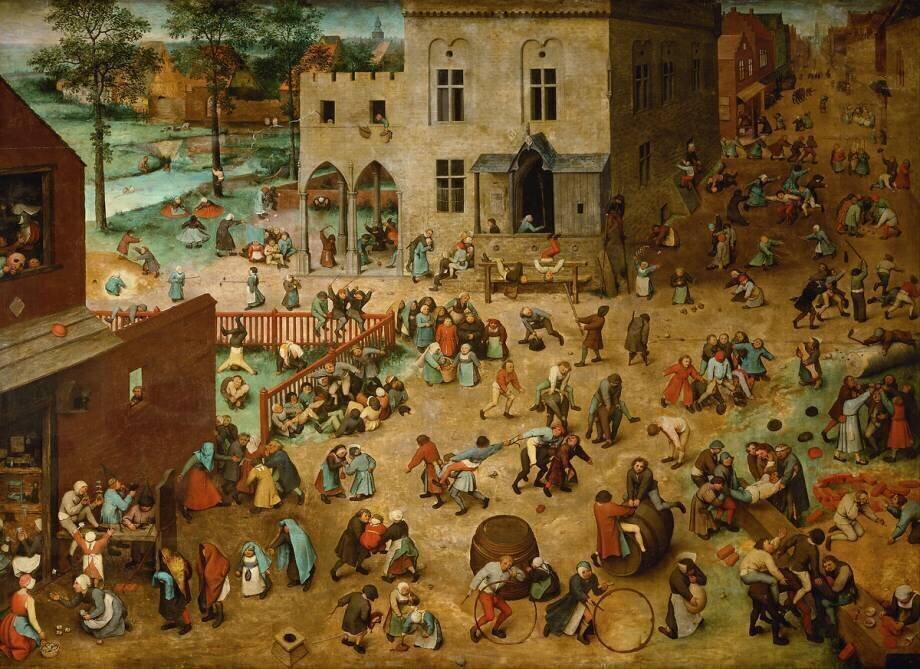
Children’s Games, a rich masterpiece by Pieter Brueghel the Elder, is much more than a simple genre scene. Painted in 1560, this oil on oak panel, measuring 116 centimetres in height and 161 centimetres in width, is a veritable visual encyclopaedia of the children’s pastimes of its time, whilst offering a deeper reflection on human nature and society. Carefully preserved at the Kunsthistorisches Museum in Vienna, Austria, this work continues to fascinate with its richness and complexity, inviting the viewer to a meticulous exploration and a multi-layered interpretation. Brueghel, with his keen sense of observation and talent for composition, offers us a panorama teeming with life that transcends a mere catalogue of games to question the very meaning of existence.
Children’s Games by Pieter Brueghel the Elder: a popular scene
In the mid-16th century, Europe was in the midst of an intellectual and artistic effervescence, marked by the end of the Renaissance and the beginnings of the Reformation. Against this backdrop, interest in everyday life and popular scenes was gaining ground, moving away from exclusively religious or mythological themes. Pieter Brueghel the Elder fitted perfectly into this movement, acting as a chronicler of peasant life and Flemish folk traditions.
Children’s Games thus appears as an illustration of this fascination with the real and the ordinary. However, the work is not without a scholarly dimension. It is part of a humanist tradition that sees childhood as a metaphor for the human condition. The precise origin of the commission is not formally documented, but it is likely that the painting was intended for a learned collector, capable of appreciating its multiple layers of meaning.
Brueghel, who had travelled to Italy and been exposed to the ideals of the Renaissance, combines here the meticulous observation of reality, typical of the Flemish tradition, with an intellectual and moral ambition. The exhaustive depiction of the games—of which more than eighty have been identified—bears witness to considerable research and documentation, making this painting a sort of ethnographic inventory ahead of its time.
Children’s Games by Pieter Brueghel the Elder: a panorama of a bustling square
At first glance, Children’s Games strikes the viewer with its scale and density. Brueghel depicts a vast village square, bordered by typical brick architecture, stretching out to a riverside landscape in the background. The perspective is slightly bird’s-eye, allowing the viewer to take in the entire scene and the multitude of activities taking place simultaneously. The composition is off-centre, with no single focal point, forcing the eye to move constantly across the canvas, mirroring the children’s liveliness.
The colours, though varied, are dominated by warm tones – ochres, browns, reds – which unify the whole and lend the scene an atmosphere that is both familiar and timeless. The light, which is diffuse, does not create sharp contrasts but subtly shapes the volumes and groups of figures. Every corner of the painting is filled with small groups of children absorbed in their games, creating an impression of organised chaos. Despite the apparent absence of a main narrative, a sense of cohesion emerges from this accumulation of vignettes, linked by the shared energy of childhood and the precision of detail with which each game is depicted.
Children’s Games by Pieter Brueghel the Elder: a playful catalogue at the heart of the city
The central subject, as the title explicitly indicates, is an inventory of children’s games played in the 16th century. Brueghel depicts a myriad of young boys and girls, of seemingly varying ages, engaging with seriousness and concentration in an incredible diversity of activities. We can recognise universal and timeless games such as the spinning top, knucklebones, the hoop, dolls, leapfrog, hopscotch, or even ‘church’ (playing at mass).
Other games are more specific to the period or to Flemish culture. What is striking is the almost total absence of adults, with the exception of a few ambiguous figures in the background, leaving the field open to this autonomous world of children. The children are not idealised; they are depicted with a sometimes raw realism, absorbed, sometimes boisterous, but always fully engaged in their activities. Their faces, often indistinct, suggest a universal dimension, as if Brueghel sought less to portray specific children than to depict childhood itself, with its playful seriousness and inexhaustible energy. This accumulation of scenes of play, far from being merely anecdotal, constitutes the true narrative and visual driving force of the painting.
Children’s Games by Pieter Brueghel the Elder: a mirror of human vanities
Whilst Children’s Games may be admired for its documentary value and picturesque charm, a closer reading reveals a symbolic dimension of great complexity. For many art historians, this profusion of children’s games is not merely a celebration of carefree innocence. On the contrary, it could be interpreted as an allegory of the futility of human pursuits.
The children, imitating adult activities (playing at marriage, trade, and religious processions), are said to highlight, through their earnestness, the often vain and derisory nature of the ambitions and concerns of the adult world. This interpretation is in keeping with the moralising trend of the time, which often viewed play as a waste of time and a distraction from religious duties. The popular saying ‘The world is but a child’s play’ might find here a masterful illustration.
Certain elements, such as the presence of a child urinating or others playing with excrement, reinforce this idea of the baseness and fleeting nature of earthly life. Thus, beneath the appearance of a joyful scene, Brueghel might invite us to reflect on the “vanitas vanitatum” – vanity of vanities, all is vanity – a theme dear to 16th-century thought.
Children’s Games by Pieter Brueghel the Elder: the legacy of a visionary gaze
Children’s Games occupies a unique and significant place in the career of Pieter Brueghel the Elder. Created during his mature period, it bears witness to his exceptional technical mastery, his sense of composition and his ability to orchestrate complex and richly detailed scenes. This painting, along with other works such as Flemish Proverbs or The Battle of Carnival and Lent, cemented his reputation as a painter of popular customs, but also as a critical observer of the society of his time.
This work also paved the way for a new genre of popular scenes, in which the observation of everyday life became a subject worthy of artistic interest and imbued with profound meanings. The way in which Brueghel managed to combine descriptive realism and complex allegory influenced many artists who followed him, particularly in Flanders and the Netherlands. Even today, Children’s Games is studied for its iconographic richness, its interpretative complexity and its astonishing modernity in the depiction of childhood and social space. It remains an inexhaustible source of wonder and reflection, affirming the visionary genius of Brueghel the Elder.
This artwork is a painting from the renaissance period. It belongs to the flemish & northern renaissance style.
« Children's games » is kept at Kunsthistorisches Museum, Vienna, Austria.
Find the full description of Children's games by Pieter Brueghel the Elder on Wikipedia.
Other artworks by Pieter Brueghel the Elder
-
From68.52 €£58.2557.1 €£48.54
-
From66.25 €£56.3155.21 €£46.93
-
From66.74 €£56.7355.62 €£47.27
-
From49.73 €£42.2741.44 €£35.23
-
From67.23 €£57.1456.02 €£47.62
-
From44.61 €£37.9237.18 €£31.6
-
From67.55 €£57.4256.29 €£47.85
-
From60.57 €£51.4850.47 €£42.9
-
From58.46 €£49.6948.71 €£41.41
-
From68.75 €£58.4457.29 €£48.7


Other artworks in the same colors
-
From72.24 €£61.460.2 €£51.17
-
From64.95 €£55.2154.13 €£46.01
-
From34.62 €£29.4228.85 €£24.52
-
From36.57 €£31.0830.47 €£25.9
-
From39.98 €£33.9833.32 €£28.32
-
From89.01 €£75.6674.18 €£63.05
-
From38.76 €£32.9532.3 €£27.46


Other similar artworks
-
From67.55 €£57.4256.29 €£47.85
-
From70.58 €£59.9958.82 €£49.99
-
From72.58 €£61.760.49 €£51.41
-
From68.42 €£58.1657.02 €£48.46
-
From71.24 €£60.5659.37 €£50.46
-
From72.9 €£61.9760.75 €£51.64
-
From64.93 €£55.1954.11 €£45.99