

Customise
Your art print
Jeunes filles au piano OF Auguste Renoir
Jeunes filles au piano
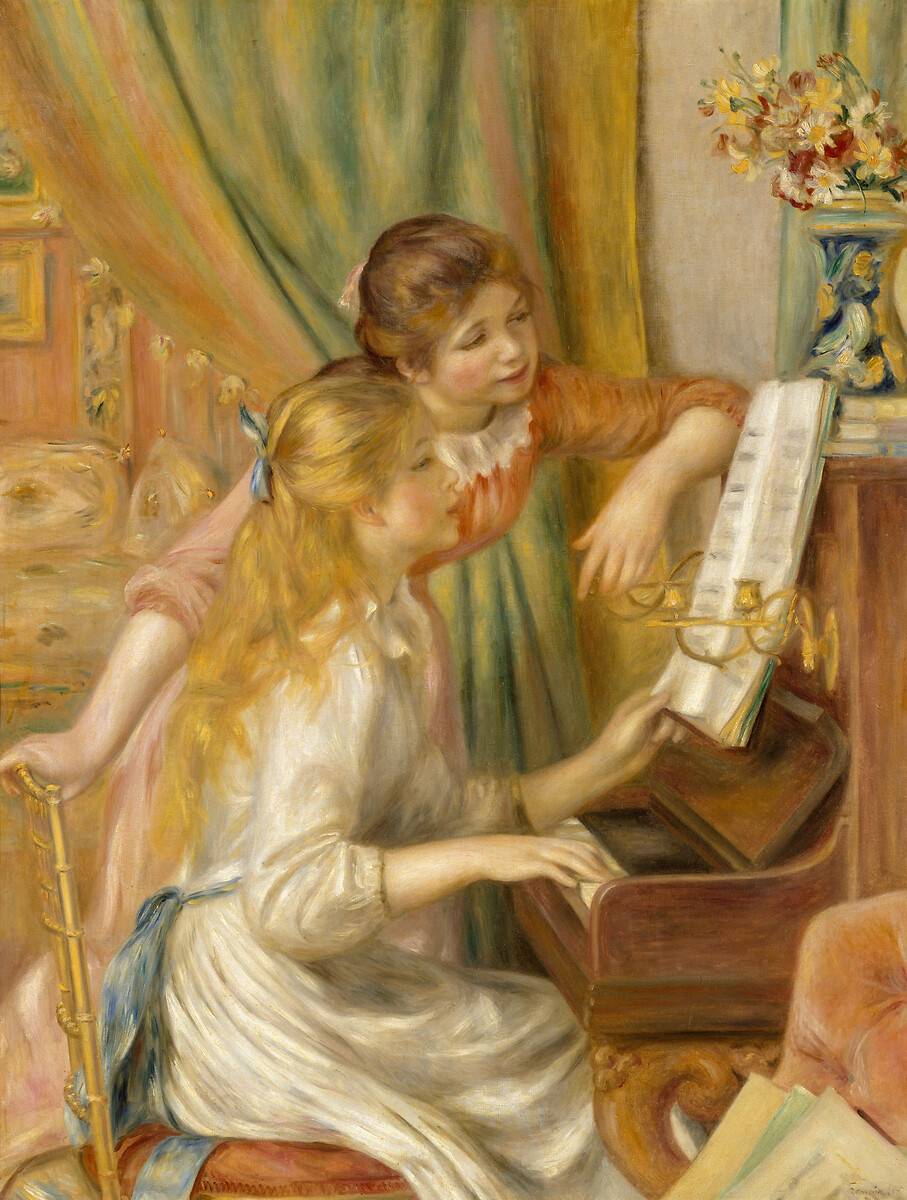
Young Girls at the Piano, an iconic work by Pierre-Auguste Renoir, transcends mere representation to capture the essence of an era and the timeless grace of youth. Painted in several versions, the most famous of which, dating from 1892, is held at the Musée d'Orsay in Paris (dimensions 116 x 90 cm), this canvas illustrates the artist’s mastery at his peak. Other notable versions can be found at the Musée de l’Orangerie, also in Paris, and at the Metropolitan Museum of Art in New York.
Young Girls at the Piano by Pierre-Auguste Renoir: a bourgeois moment commissioned by the State
In 1892, Pierre-Auguste Renoir was going through his ‘pearly period’ (1890–1897), an artistic phase in which his palette softened and his forms became more fluid, moving away from the strict rigour of Impressionism to explore creamier textures and shimmering effects of transparency. It was against this backdrop that the French State, keen to acquire a work by the master for the national collections—in this case the Musée du Luxembourg—expressed its interest. Aware of this major opportunity for his career, Renoir produced no fewer than five or six variations on this intimate and charming theme, seeking the perfect composition that would win over the authorities. The choice fell on the version now at the Musée d'Orsay. This commission marked a decisive turning point, bringing Renoir the acclaim and institutional recognition he had long hoped for, consolidating his position amongst the great painters of his time and opening the doors to a wider legacy. The scene, typical of bourgeois life in the late 19th century, depicts a moment of leisure and privileged education.
Young Girls at the Piano by Pierre-Auguste Renoir: a delicate and warm palette
The composition of Young Girls at the Piano is a masterful example of the balance and harmony that Renoir sought during his ‘pale’ period. The scene is intimate, centred on the two young girls and the instrument, creating an immediate intimacy with the viewer. A large curtain frames the background, defining the space without weighing it down and contributing to the cosy atmosphere of the bourgeois drawing room. The light, soft and enveloping, seems to come from the left, delicately caressing the silky fabrics of the dresses, the curves of the dark wooden piano and the velvety complexions of the young musicians. Renoir deploys a colour palette that is both bold and subtle: luminous whites, soft pinks, vibrant reds and golden yellows blend to create an impression of warmth, gentleness and youthful innocence. His brushwork, consisting of small, elongated strokes and light layers, admirably reconciles the linework—sharp and precise in the figures—with the colour, in a smooth and sensual pictorial texture that unifies the canvas.
Young Girls at the Piano by Pierre-Auguste Renoir: different perspectives on the score
At the heart of this light-drenched scene stand the two protagonists, Yvonne and Christine Lerolle, the daughters of the painter and collector Henri Lerolle, who posed for Renoir. They embody the grace and concentration of youth absorbed in music. The artist subtly plays on contrasts to energise the composition and distinguish his models. The girl seated at the piano, presumably the younger of the two, is depicted in profile, dressed in a white dress, her demeanour suggesting a certain application, or even a slight hesitation as she faces the score. Beside her, leaning affectionately towards her, the second, older girl is seen in a three-quarter view, her dress a pink verging on red adding a touch of more assertive colour. She seems to be guiding or accompanying her younger companion, her expression a blend of encouragement and knowing complicity. Their hair, one blonde and the other brown, frames faces with rosy cheeks, typical of the fleshy and delicate treatment that Renoir reserves for his female figures. Their gazes converge with equal attention on the open score, that focal point which unites their gestures and draws the viewer into their intimate musical world.
Young Girls at the Piano by Pierre-Auguste Renoir: symbols of harmony and bourgeois education
Whilst Young Girls at the Piano immediately captivates with its charm and technical virtuosity, the work also carries a subtle symbolic richness, rooted in the values and aspirations of late 19th-century bourgeois society. Music, and more specifically the playing of the piano, was then regarded as an essential part of the education of young ladies from good families, a sign of cultural refinement and an asset for their future social life. The painting thus depicts an idealised genre scene, a ‘piano lesson’ that evokes learning, the passing on of knowledge and artistic discipline within the home. The shared concentration of the two sisters, their physical closeness and the harmony emanating from their interaction symbolise family ties, camaraderie and the gentle pleasures of life. The piano itself, an imposing and elegant piece of furniture, represents a focal point of cultivated domestic life. The flowers placed on the instrument add a touch of freshness and femininity, reinforcing the atmosphere of grace and innocence that pervades the canvas, a true ode to youth and serene beauty.
Young Girls at the Piano: a pivotal work for Pierre-Auguste Renoir
The acquisition of Young Girls at the Piano by the French State in 1892 was no trivial event in the career of Pierre-Auguste Renoir. It marked an official recognition and a genuine turning point. This institutional recognition, symbolised by the work’s entry into the Musée du Luxembourg, intended for living artists, ensured Renoir greater visibility and prestige, definitively establishing him as one of the masters of his time. The success of the painting and the demand it generated explain why the artist produced several versions, each subtly exploring variations in composition and brushwork, testifying to his deep commitment to this subject. Beyond its immediate impact on his reputation, the work has secured a lasting place in art history as an emblematic representation of Renoir’s “nacre” period, characterised by a search for fuller forms, a lighter palette and a smoother brushwork, which would influence some of his contemporaries and future generations. It remains today one of his most popular paintings, appreciated for its ability to capture a moment of timeless grace and to celebrate feminine beauty with unrivalled tenderness and delicacy.
This artwork is a painting from the modern period. It belongs to the impressionism style.
« Jeunes filles au piano » is kept at Musee d'Orsay, Paris, France.
Find the full description of Jeunes filles au piano by Auguste Renoir on Wikipedia.
You may also like
-
From41.5 €£35.2734.58 €£29.39
-
From42.45 €£36.0835.38 €£30.07
-
From37.68 €£32.0331.4 €£26.69
-
From40.3 €£34.2633.59 €£28.55
-
From37.8 €£32.1331.5 €£26.77
-
From47.49 €£40.3739.58 €£33.64
-
From40.22 €£34.1933.52 €£28.49
-
From40.22 €£34.1933.52 €£28.49
-
From44.34 €£37.6936.95 €£31.41
-
From35.13 €£29.8629.28 €£24.89