
Customise
Your art print
Models OF Georges Seurat
Models
Background and origins of Georges Seurat’s The Three Models
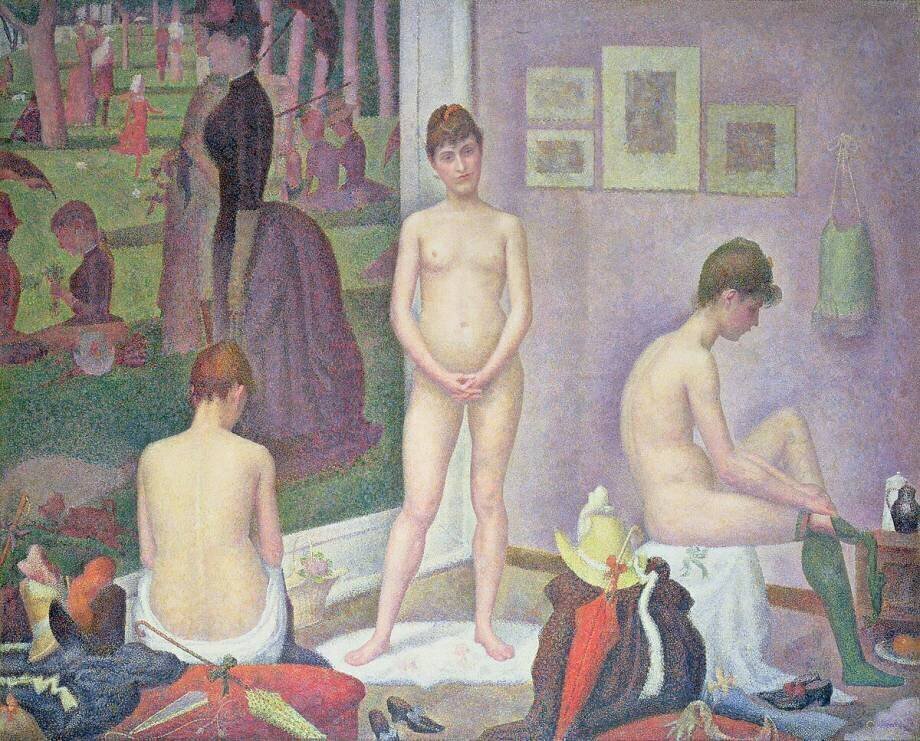
By the mid-1880s, Georges Seurat was already a leading figure in what the critic Félix Fénéon would term Neo-Impressionism. Following the scandal and incomprehension caused by A Sunday Afternoon on the Island of La Grande Jatte (1884–1886), a monumental work executed in a rigorous Pointillist style, Seurat undertook The Models between 1886 and 1888. This painting, measuring 200 x 249.9 cm, is intended as a direct response to critics who deemed his scientific method—known as divisionist or chromo-luminarist—too cold, mechanical and incapable of capturing the vibrancy of life, particularly the sensuality of the female nude. By choosing the classical theme of the model in the studio, Seurat rose to the challenge and sought to prove the versatility and superiority of his approach. The artist prepared his work meticulously, producing several preparatory studies, notably oil paintings on wood for each pose of the model in 1887 (Model Facing Forward, Model in Profile, Model from Behind). The presence in the background of a large section of A Sunday Afternoon on the Island of La Grande Jatte is no coincidence; it anchors The Modelling Women within an artistic and theoretical continuum, as an affirmation of his principles in the face of a quintessentially academic subject. This is the third of his six major works, bearing witness to his ambition and his ceaseless quest for a pictorial harmony founded on scientific principles.
A visual exploration of The Modellers by Georges Seurat
The Models immerses us in the hushed intimacy of theartist’s studio. The composition is structured with great rigour, creating a space that is both orderly and imbued with a contemplative atmosphere. The light, though diffuse, delicately sculpts the bodies and objects, thanks to the meticulous juxtaposition of thousands of tiny dabs of pure colour. This pointillist technique, far from creating the coldness often criticised, aims to produce an optical vibration where colours blend in the viewer’s eye, lending the scene a subtle luminosity and a distinctive chromatic richness. The dominant hues, often variations of purples, ochres and blues, contribute to this serene and almost melancholic atmosphere. The objects scattered around the studio – umbrellas, hats, folded clothes – are treated with the same care as the figures, each element contributing to the overall balance of the canvas. The floor and walls, with their large, punctuated areas of flat colour, stabilise the composition and highlight the volumes of the models. The work, currently held at the Barnes Foundation in Philadelphia, invites prolonged observation to appreciate all its optical subtleties and the complexity of its construction.
Models by Georges Seurat: the models at the heart of the studio
The central subject of The Three Models is the depiction of one (depicted three times), or potentially three, nude female models in the studio. The central figure, standing and facing the viewer, appears to be the focal point of the composition. She is flanked by two other poses of the same model: one in profile to her left, undressing or dressing, and the other with her back to the viewer on her right, seated. This triplication of the model allows Seurat to study the female body from different angles, in the manner of academic studies, but renewed by his Divisionist technique. This is not a narrative or an anecdotal scene, but rather a formal exploration and a meditation on painting itself. The bodies are stylised, their contours softened by the swarm of coloured dots, which gives them a presence that is both tangible and ethereal. Far removed from the garish eroticism of certain contemporary nudes, Seurat offers an internalised and almost modest vision of nudity. The models’ faces are scarcely individualised, the artist focusing more on the harmonies of form and colour than on psychological expression. This depersonalised approach reinforces the idea that the models are, above all, plastic elements serving Seurat’s artistic demonstration, “models” in the literal sense, participating in the construction of a pictorial ideal.
Symbols and interpretations of Georges Seurat’s Models
The Models take on a complex symbolic dimension, going beyond the simple representation of models in the studio. The arrangement of the three nude figures is reminiscent of the classical theme of the Three Graces, mythological figures embodying beauty, grace and creativity. Seurat revisits this traditional motif by transposing it into the modern context of the artist’s studio and filtering it through his revolutionary technique. The presence of A Sunday Afternoon on the Island of La Grande Jatte in the background functions as a ‘mise en abyme’, a painting within a painting, which emphasises the self-reflexive nature of the work. Seurat does not merely paint models; he paints painting itself, his creative process and his theories. In this sense, The Models can be interpreted as an artistic manifesto, a defence and illustration of Neo-Impressionism. The work also questions the status of the model and the relationship between the artist and their subject. Critics have also noted the political implications of the depiction of the naked female body, with Seurat offering an alternative to academic canons that is both modern and classical in style. The serenity and dignity emanating from the figures, despite the pointillist fragmentation, suggest a quest for harmony and order in a changing world.
The legacy of Georges Seurat’s The Models in art
When it was exhibited at the Salon des Indépendants in 1888, The Three Models received a mixed reception, as was often the case with Seurat’s innovative works. Whilst some critics and fellow artists, such as Paul Signac and Félix Fénéon, understood the significance of his approach, many remained perplexed by this rigorous application of colour theory to a subject as classical as the nude. Nevertheless, this work marked a crucial stage in the brief career of Seurat, who died prematurely in 1891. It consolidated his position as a leading figure of Neo-Impressionism and demonstrated the technique’s capacity to tackle ambitious subjects with a new sense of monumentality and depth. The Poseuses is considered one of the seminal works of this movement. Beyond Neo-Impressionism, the influence of Seurat, and by extension of The Poseuses, was considerable on subsequent generations of artists. His analytical approach to form and colour, and his search for pictorial structure and order, paved the way for major movements of the 20th century, such as Fauvism, Cubism (Braque, for example, owned a reproduction of a work by Seurat in his studio), Orphism and Futurism. Although Seurat sold few works during his lifetime, the posthumous recognition of his genius has continued to grow, and The Poseuses is now hailed as a masterpiece of modern art history, whose value on the art market attests to its enduring significance.
This artwork is a painting from the modern period. It belongs to the pointillism style.
Find the full description of Models by Georges Seurat on Wikipedia.
Other artworks by Georges Seurat
-
From62.28 €£52.9351.9 €£44.11
-
From41.93 €£35.6434.94 €£29.7
-
From43.63 €£37.0936.36 €£30.91
-
From47.54 €£40.4139.62 €£33.67
-
From39.98 €£33.9833.32 €£28.32
-
From41.2 €£35.0234.33 €£29.18
-
From52.36 €£44.543.63 €£37.09
-
From50.71 €£43.142.26 €£35.92
-
From51.61 €£43.8743.01 €£36.56
-
From41.39 €£35.1834.49 €£29.32


Other artworks in the same colors
-
From53.36 €£45.3544.46 €£37.79
-
From53.6 €£45.5644.67 €£37.97
-
From44.61 €£37.9237.18 €£31.6
-
From32.88 €£27.9427.4 €£23.29
-
From105.07 €£89.3187.56 €£74.43
-
From46.32 €£39.3738.6 €£32.81
-
From51.61 €£43.8743.01 €£36.56
-
From42.17 €£35.8535.15 €£29.87


Other similar artworks
-
From46.56 €£39.5838.8 €£32.98
-
From51.15 €£43.4842.62 €£36.23
-
From62.9 €£53.4652.41 €£44.55
-
From73.72 €£62.6661.43 €£52.22
-
From43.39 €£36.8836.16 €£30.74