
Customise
Your art print
The Polar Sea OF Caspar David Friedrich
The Polar Sea
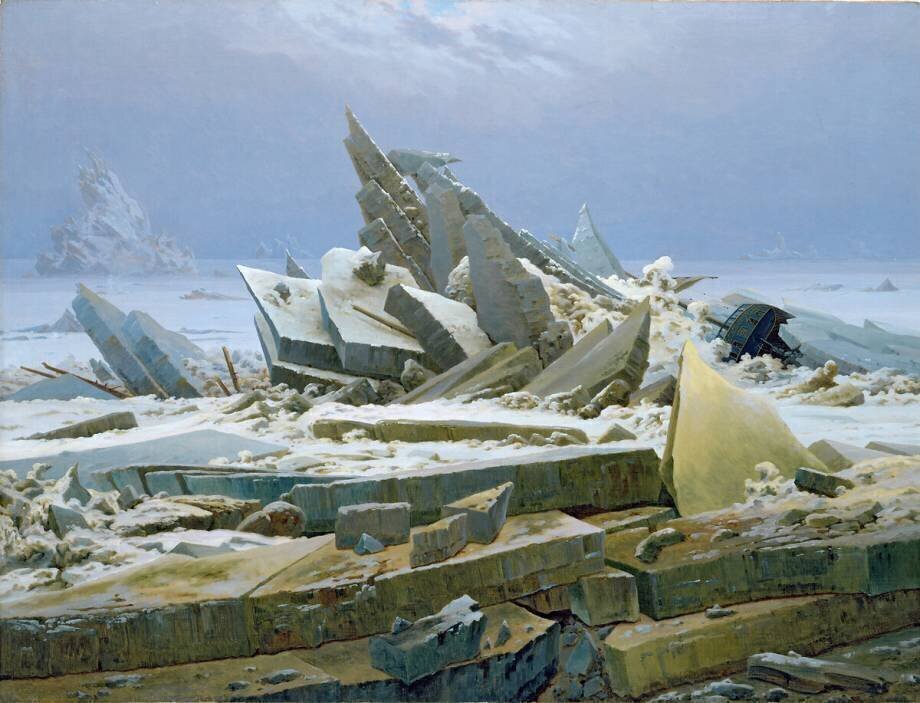
The Sea of Ice (Das Eismeer), painted by the German artist Caspar David Friedrich between 1823 and 1824, remains one of the most iconic and powerful works of European Romanticism. Carefully preserved at the Kunsthalle Hamburg in Germany, this oil on canvas, measuring an imposing 96.7 cm in height by 126.9 cm in width, continues to fascinate and challenge viewers with its evocative power and symbolic complexity. It is far more than a mere depiction of an Arctic landscape; it is a profound meditation on nature, the human condition and the indomitable forces that are beyond our control.
The Sea of Ice by Caspar David Friedrich: the genesis of an ice titan
The creation of The Sea of Ice is rooted in a historical context and a rich personal background. Friedrich, a leading figure of German Romanticism, was particularly fascinated by nature in its wildest and most sublime forms. Although the artist never personally travelled to the polar regions, his inspiration for this painting drew on several sources. On the one hand, he drew on accounts of Arctic expeditions of his time, notably that led by William Edward Parry between 1819 and 1820, which set out in search of the famous Northwest Passage. The ship HMS Griper, one of the vessels on that expedition, is in fact identified as the one depicted, crushed by the ice. Furthermore, Friedrich spent a great deal of time observing and sketching the piles of ice on the frozen Elbe near Dresden during the harsh winters. These meticulous studies of the formation and texture of the ice provided him with the raw material to compose this dramatic scene in his studio. Some art historians also suggest a more intimate dimension, seeing in the violence of the scene a possible echo of the trauma of his brother’s death by drowning, which occurred during his childhood—an event that is said to have profoundly marked the artist and his perception of nature’s destructive forces.
Caspar David Friedrich’s La Mer de glace: frozen chaos
At first glance, The Ice Sea captivates with its bold composition and its oppressive atmosphere. The painting depicts a desolate landscape where the sea, transformed into a chaos of angular, jagged ice blocks, dominates the space. These fragments of sea ice, resembling gigantic shards of crystal, intertwine and rise towards a cold and distant sky, creating an impression of frozen dynamism, as if the cataclysm had only just occurred. The colour palette, dominated by glacial blues, pure whites and menacing greys, accentuates the coldness and inhospitability of the place. A few ochre and brown hues on the wreck introduce a tragically vulnerable earthly note amidst this mineral vastness. The light, diffuse and pallid, seems to emanate from the ice itself, lending the scene an unreal and spectral quality. Here, Friedrich breaks with traditional landscape conventions, favouring a monumental and almost abstract vision of nature, where the pyramidal structure of the piled-up ice inexorably draws the eye towards the centre of the drama.
The Sea of Ice by Caspar David Friedrich: drama at the heart of the ice
The central subject, though partially concealed by the fury of the elements, is the shipwreck. Only the stern of a wooden vessel emerges timidly on the right of the painting, crushed and lifted by the colossal pressure of the ice sheets. This fragment of civilisation, minuscule against the icy immensity, symbolises the fragility of human endeavours when confronted with the overwhelming power of nature. The ship, identified as the HMS Griper, becomes the emblem of human ambition thwarted, of hope shattered against the relentless reality of a hostile environment. The way in which the ice seems to literally devour the wooden structure is of a muted violence, the sharp edges of the icebergs piercing the hull like blades. There is no human presence visible, which reinforces the sense of loneliness and total abandonment. The drama is silent, frozen in an icy eternity, leaving the viewer to contemplate the remnants of a battle lost before it began, an icy tomb for dreams of exploration and conquest.
The Sea of Ice by Caspar David Friedrich: the symbolic echoes of the ice floe
The Ice Sea is a profoundly symbolic work, characteristic of the approach of Caspar David Friedrich, who sought to express emotions and philosophical ideas through the landscape. The frozen sea, with its sharp and menacing forms, can be interpreted as an allegory of the destructive forces at work in the world, but also within the human soul, whilst the piles of ice evoke death, finitude and isolation. The duality between hope and despair is palpable: the failure of the human expedition is evident, but the sublime grandeur of the landscape, though terrifying, invites a contemplation that goes beyond the mere observation of the catastrophe. For Friedrich, nature was a temple, a place of spiritual revelation. Thus, this scene of desolation may also suggest the transcendent power of nature, indifferent to human dramas, and the smallness of man in the face of the infinite. The immaculate white of the ice, contrasting with the dark hues of the wreck, evokes primordial purity and the sacred in the face of the corruption and materiality of human existence.
The resonance of a sea of ice by Caspar David Friedrich
Upon its presentation, The Sea of Ice was deemed too radical and its daring composition remained largely misunderstood by the public and critics of the time. The work remained unsold during Friedrich’s lifetime, reflecting the disconnect between his innovative artistic vision and academic expectations. Towards the end of his career, the artist also experienced financial difficulties and a certain isolation, his style sometimes being perceived as outdated in the face of new trends. It was not until 1905 that the Hamburg Kunsthalle acquired the painting, allowing for its gradual rediscovery. Today, The Sea of Ice is regarded as an absolute masterpiece of German Romanticism and a key work in the history of landscape painting. It illustrates Friedrich’s ability to imbue his canvases with a profound emotional and spiritual charge, revolutionising the genre by elevating it to new heights of subjectivity and symbolism. His influence on subsequent generations of artists is undeniable, his manner of representing the sublime and the ‘tragedy of the landscape’ having paved the way for new explorations of the relationship between man, nature and art.
This artwork is a painting from the classical period. It belongs to the romanticism style.
« The Polar Sea » is kept at Hamburger Kunsthalle, Hamburg, Germany.
Find the full description of The Polar Sea by Caspar David Friedrich on Wikipedia.
Other artworks by Caspar David Friedrich
-
From69.99 €£59.4958.32 €£49.57
-
From62.52 €£53.1452.1 €£44.28
-
From60.08 €£51.0750.07 €£42.56
-
From68.2 €£57.9756.83 €£48.31
-
From77.62 €£65.9764.68 €£54.98
-
From62.11 €£52.7951.76 €£43.99
-
From66.58 €£56.5955.48 €£47.16
-
From68.04 €£57.8356.7 €£48.19
-
From69.17 €£58.857.64 €£49
-
From69.34 €£58.9457.78 €£49.11


Other artworks in the same colors
-
From38.52 €£32.7432.1 €£27.28
-
From47.72 €£40.5639.77 €£33.8
-
From52.66 €£44.7643.88 €£37.3
-
From49.31 €£41.9241.09 €£34.93
-
From42.91 €£36.4735.76 €£30.39
-
From44.61 €£37.9237.18 €£31.6
-
From45.83 €£38.9638.19 €£32.46
-
From82.98 €£70.5369.15 €£58.77
-
From44.37 €£37.7136.97 €£31.43
-
From47.45 €£40.3339.54 €£33.61


Other similar artworks
-
From97.98 €£83.2881.65 €£69.4
-
From75.87 €£64.4963.22 €£53.74
-
From38.01 €£32.3131.68 €£26.93
-
From49.31 €£41.9241.09 €£34.93
-
From57.64 €£4948.04 €£40.83
-
From44.86 €£38.1337.38 €£31.77
-
From61.11 €£51.9550.93 €£43.29
-
From65.11 €£55.3554.26 €£46.12
-
From78.05 €£66.3565.04 €£55.29