

Customise
Your art print
The Tennis Court Oath OF Jacques-Louis David
The Tennis Court Oath
The Tennis Court Oath by Jacques-Louis David: at the origins of the revolution
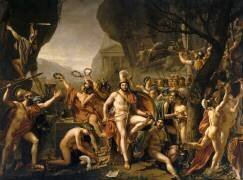
Regarded as one of the most powerful pictorial testimonies of the French Revolution, although it remained unfinished, the painting The Tennis Court Oath by Jacques-Louis David has its direct origins in the historic event of 20 June 1789. On that day, the deputies of the Third Estate, joined by a few members of the clergy and the nobility, having been denied access to the Salle des Menus-Plaisirs where the Estates-General were to be held, withdrew to the Jeu de Paume hall, near the Palace of Versailles. It was in this makeshift venue that they took the solemn oath not to disperse until they had endowed France with a Constitution. This founding act marked a decisive step in the assertion of popular sovereignty against absolute monarchical power. Inspired by the significance of this event, Jacques-Louis David, already a renowned painter and a sympathiser of revolutionary ideas, conceived the project to immortalise it as early as 1790. He then launched a national fundraising campaign, supported by the Club des Jacobins, to finance this colossal undertaking. The Constituent Assembly itself subsequently decided to take charge of funding the work, which was intended to be a glorification of nascent national unity and the beginnings of French democracy. David began work on this large imposing canvas (approximately 304 cm high by 654 cm wide) and ambitious work between 1791 and 1792, with the aim of creating a piece that not only depicted a historical event, but also exalted its symbolic and universal significance.
The Tennis Court Oath by Jacques-Louis David: a canvas pulsating with history
Although the painting is unfinished, the painted study of The Tennis Court Oath bears witness to David’s compositional mastery and expressive power. The scene is dominated by a dense crowd of animated deputies, caught up in a collective surge of enthusiasm and determination. David chose to depict the precise moment when Jean Sylvain Bailly, then President of the Assembly and Mayor of Paris, standing on a makeshift table at the centre of the composition, reads the text of the oath. All eyes and gestures converge upon him, creating a dynamic focal point. Arms are outstretched, hands raised in a gesture of almost unanimous approval, emphasising the fervor of the moment. The artist initially sketched the figures nude, in accordance with academic practice, to perfect the anatomy and movement, before clothing them. The light, streaming in from the high windows of the hall, floods the scene, but a sort of powerful breath, almost divine or popular, seems to rush in, billowing the curtains and papers, symbolising the wind of change sweeping through France. At the windows and on the galleries, the people watch, curious and engaged, as this historic event unfolds, reinforcing the idea of a nation on the move. The grandness of the hall, though simple and unadorned, emphasises the solemnity and the importance of the pledge made.
The Tennis Court Oath by Jacques-Louis David: the protagonists of national unity
The central subject of the painting is theact of the oath itself, a collective commitment that transcends individuals to embody thenational will. In the centre, Jean Sylvain Bailly, a figure of authority and wisdom, administers the oath, his left hand resting on his heart whilst his right hand is raised. Around him, a multitude of identifiable figures, for whom David had produced numerous preparatory portraits, embody the diversity of the deputies present. Among them are major figures of the time such as Mirabeau, Robespierre, Abbé Grégoire, Barnave and Sieyès, the latter depicted seated, lost in thought, perhaps symbolising constitutional reflection. One of the most striking groups in the foreground is that of the three clergymen: the Carthusian monk Dom Gerle, Abbé Grégoire (a Catholic parish priest) and the Protestant pastor Jean-Paul Rabaut Saint-Étienne, embracing fraternally. This trio symbolises the new era of religious tolerance and the union of the different faiths in the service of the nation. In contrast to this general enthusiasm, in the bottom right-hand corner, a single man, Martin-Dauch, refuses to take the oath and crosses his arms in a sign of disapproval, his isolation serving to emphasise the strength of the collective conviction. This single discordant note paradoxically reinforces the impression of unanimity and highlights the courage, or stubbornness, of the opposition.
Allegories and hidden messages in Jacques-Louis David’s The Tennis Court Oath
The Tennis Court Oath is a work rich in symbols, which goes far beyond a mere chronicle of an event. The powerful wind rushing in through the windows, lifting the drapes and carrying away sheets of paper, is a clear metaphor for the revolutionary spirit sweeping away the Ancien Régime. It can also be interpreted as a kind of popular approval or even divine approval. The convergence of all the outstretched arms towards Bailly, who is reading the oath, symbolises the unity of the nation and the birth of a general will. The very act of taking the oath collectively was, at the time, a powerful civic ritual, intended to seal individuals’ commitment to a common ideal. The fraternisation of the three clergymen of different faiths (Dom Gerle, Abbé Grégoire, Rabaut Saint-Étienne) is a powerful allegory of religious tolerance and national reconciliation, themes dear to the early days of the Revolution. Even the austere architecture of the Jeu de Paume hall, far removed from monarchical pomp, can be seen as a symbol of a new era of simplicity and republican virtue. The original nudity of the figures in David’s studies was intended to achieve an anatomical and gestural truth that lends a heroic and timeless dimension to these citizens, builders of a new world.
The Tennis Court Oath by Jacques-Louis David: the fate and legacy of a pictorial ambition
Although Jacques-Louis David never completed The Tennis Court Oath on his final canvas, the work had a considerable impact both on his career and on art in general. The political vicissitudes of the Revolution, notably the growing division between the protagonists of 1789 (some of whom were guillotined or went their separate ways), made continuing the project a delicate matter. Depicting together figures who had become political enemies had become impossible. David therefore abandoned the monumental canvas at the stage of a highly detailed painted sketch. However, this sketch, along with the numerous preparatory drawings, was widely circulated, notably through engravings, and the work quickly acquired iconic status. It became a symbol of revolutionary commitment and national unity. For David, this aborted project nonetheless marked an important milestone, affirming his role as official painter of the Revolution, before he went on to become that of the Empire. The dynamic composition and the energy emanating from The Tennis Court Oath influenced his later works, such as The Distribution of the Eagles. In art history, The Tennis Court Oath is regarded as a major milestone in history painting and committed Neoclassicism, paving the way for a more dramatic and vivid depiction of contemporary events. Housed at the Palace of Versailles, its very unfinished state lends it a special aura, bearing witness to an artistic ambition confronted by the tumult of history. It has been copied, adapted and referenced countless times, becoming a founding image of the French republican imagination.
This artwork is a painting from the classical period. It belongs to the neoclassicism style.
« The Tennis Court Oath » is kept at Musee de la Ville de Paris - Musee Carnavalet, Paris, France.
Find the full description of The Tennis Court Oath by Jacques-Louis David on Wikipedia.
You may also like
-
From57.29 €£48.747.75 €£40.58
-
From58.1 €£49.3948.42 €£41.15
-
From63.86 €£54.2853.21 €£45.23
-
From65.85 €£55.9754.87 €£46.64
-
From67.35 €£57.2556.13 €£47.71
-
From89.74 €£76.2874.78 €£63.56
-
From91.99 €£78.1976.66 €£65.16
-
From66.17 €£56.2455.14 €£46.87
-
From77.31 €£65.7164.42 €£54.76
-
From65.36 €£55.5654.47 €£46.3