
Customise
Your art print
The Raft of the Medusa OF Théodore Géricault
The Raft of the Medusa
Théodore Géricault, an ambitious young painter of his time, made his mark on art history with his monumental and poignant work, The Raft of the Medusa. This oil on canvas, carefully preserved at the Louvre Museum in Paris and impressive for its colossal dimensions of 491 cm in height and 716 cm in width, transcends the simple depiction of a news item to become an icon of French Romanticism and a powerful social and political commentary.
The Raft of the Medusa by Théodore Géricault: a human drama immortalised
The inspiration for The Raft of the Medusa stems from a tragic and scandalous event in French maritime history: the shipwreck of the frigate Medusa in July 1816 off the coast of Africa. Intended to re-establish French rule over the colony of Senegal following the fall of Napoleon and the Restoration of the monarchy, the expedition turned into a disaster. Due to the incompetence of the commander, the frigate ran aground and the lifeboats, which were insufficient in number, were quickly overloaded. Around 150 people were forced to take their places on a makeshift raft, which was subsequently abandoned by the lifeboats. What followed were thirteen days of absolute horror: storms, mutinies, starvation, dehydration, madness and cannibalism. Only about fifteen men survived. Théodore Géricault, then aged 27, was deeply moved by the survivors’ accounts, particularly those of the surgeon Henri Savigny and the engineer-geographer Alexandre Corréard, published in 1817. Aware of the dramatic potential and public resonance of such a subject, he saw it as an opportunity to create a striking work, capable of launching his career and implicitly criticising the negligence of the restored regime. He undertook meticulous research, interviewing survivors and studying corpses and the bodies of the sick to achieve a striking realism.
Géricault’s The Raft of the Medusa: a vision of the apocalypse
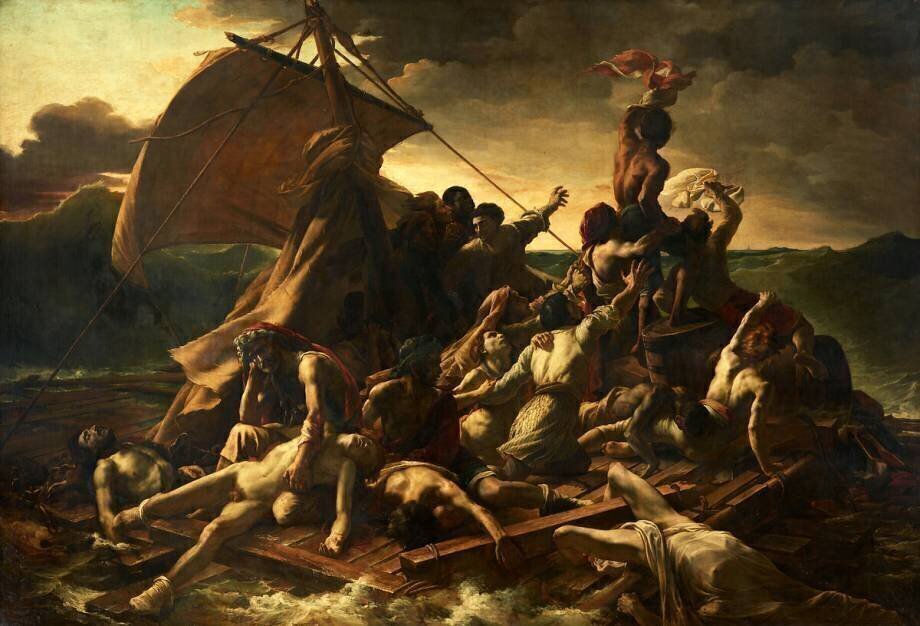
The Raft of the Medusa captivates the viewer with its dynamic pyramidal composition and its dark, oppressive atmosphere. The eye is immediately drawn to a tangle of bodies, oscillating between faint hope and the deepest despair. The scene is constructed along an ascending diagonal, starting with the corpses and the dying in the foreground, sliding across the precarious surface of the raft, and culminating in the group of survivors waving cloths towards a tiny ship, barely visible on the horizon. This main pyramidal structure, symbolising a fragile surge towards salvation, is counterbalanced by another, darker one, formed by the mast and its shrouds, which seems to be dragging the vessel towards the abyss. Géricault uses a deliberately restricted colour palette, dominated by earthy browns, ochres and pale flesh tones, accentuating the tragic dimension and the physical suffering of the shipwrecked. The Caravaggesque light sculpts the bodies with stark contrasts of shadow and light, emerging from a turbulent and threatening sky. The raging sea, a dark green, contributes to this sense of chaos and imminent peril, with the raft appearing at any moment on the verge of sinking.
Géricault’s The Raft of the Medusa
The central theme of the painting is the human condition pushed to its absolute limits, the desperate struggle for survival in the face of abandonment and the cruelty of the elements. On the overloaded raft, Géricault depicts a human pyramid of suffering and fragile hope. In the foreground, naked or scantily clad bodies lie, some dead, others dying, their limbs intertwined in a macabre scene. One can make out a despondent old man, holding the lifeless body of his son, an emblematic figure of pain and loss. Other figures express despair, resignation or madness. At the centre and towards the top of this human pyramid, hope is faintly reborn. Men, still alive, stand up and stretch out their arms towards a distant point on the horizon: the ship Argus, which will eventually come to their rescue. Among them stands out the figure of a black man, Jean-Charles, who, perched on a barrel, waves a cloth to attract attention. This choice to place a man of colour at the summit of the pyramid of hope is not insignificant and bears witness to Géricault’s humanist concerns. The tension is palpable between the desperate energy of this group and the morbid inertia of those who have already succumbed or given up the struggle.
Géricault’s The Raft of the Medusa : the symbolic significance of a drift
Beyond a mere chronicle of a news item, The Raft of the Medusa is imbued with a powerful symbolic significance. The raft itself can be seen as a metaphor for post-revolutionary France, adrift following the upheavals of the Empire, and poorly governed by a restored monarchy deemed incompetent and indifferent to the fate of its people, as evidenced by the officers’ abandonment of the shipwrecked. The emaciated bodies and the scenes of cannibalism, though suggested rather than explicitly shown, evoke dehumanisation and the loss of moral values in the face of the brutal necessity of survival. The raging sea and the threatening sky symbolise the destructive forces, both natural and political, that bear down upon the individuals. The presence of several black figures, notably that of Jean-Charles at the pinnacle of hope, has been interpreted as Géricault taking a stand against slavery and the slave trade, which were still practised despite their official prohibition. The distant ship, the Argus, embodies an almost unattainable hope, highlighting the precariousness of survival and the fine line between life and death. Thus, the work becomes an allegory of the human condition, of the struggle for survival, of social injustice and of the failure of leaders.
The immortal legacy of The Raft of the Medusa by Théodore Géricault
The presentation of The Raft of the Medusa at the Paris Salon in 1819 caused a veritable earthquake. The work, with its raw realism, contemporary subject matter and implicit political charge, baffled as much as it fascinated. Breaking with the academic canons that at the time favoured noble historical or mythological subjects, critics were divided: some praised Géricault’s expressive power and technical mastery, whilst others denounced the ugliness of the subject and its treatment, deemed too realistic and shocking. Despite the controversy, or perhaps because of it, the painting secured Géricault’s fame, although it was not immediately purchased by the French state. Subsequently exhibited in London in 1820, the work enjoyed great success there and helped to establish the young painter’s international reputation. The Raft of the Medusa is today regarded as a seminal work of French Romanticism, paving the way for artists such as Delacroix, who was profoundly influenced by his discovery of it. Its influence extends far beyond, reaching painters such as Turner, Courbet and Manet. Through its emotional power, its commitment and its pictorial innovation, the painting remains an icon of art history, bearing witness to Géricault’s genius and his ability to transform a human tragedy into a universal reflection on suffering, injustice and hope.
This artwork is a painting from the modern period. It belongs to the romanticism style.
« The Raft of the Medusa » is kept at Louvre, Paris, France.
Find the full description of The Raft of the Medusa by Théodore Géricault on Wikipedia.
Other artworks by Théodore Géricault
-
From61.11 €£51.9550.93 €£43.29
-
From70.41 €£59.8558.68 €£49.88
-
From59.79 €£50.8249.82 €£42.35
-
From60.62 €£51.5250.51 €£42.94
-
From61.11 €£51.9550.93 €£43.29
-
From63.27 €£53.7852.73 €£44.82
-
From38.89 €£33.0632.41 €£27.55
-
From59.79 €£50.8249.82 €£42.35
-
From66.1 €£56.1855.08 €£46.82
-
From60.62 €£51.5250.51 €£42.94


Other artworks in the same colors
-
From84.44 €£71.7770.36 €£59.81
-
From63.11 €£53.6452.59 €£44.7
-
From52.48 €£44.6143.73 €£37.17
-
From58.78 €£49.9648.98 €£41.64
-
From62.03 €£52.7251.69 €£43.94
-
From60.57 €£51.4850.47 €£42.9
-
From46.32 €£39.3738.6 €£32.81


Other similar artworks
-
From62.61 €£53.2252.17 €£44.35
-
From83.95 €£71.3669.96 €£59.46
-
From61.78 €£52.5151.48 €£43.76
-
From66.93 €£56.8955.77 €£47.41
-
From66.74 €£56.7355.62 €£47.27
-
From94.66 €£80.4678.88 €£67.05