

Customise
Your art print
Wheatfield with Crows OF Vincent van Gogh
Wheatfield with Crows
Wheatfield with Crows by Vincent van Gogh: the last days in Auvers
Painted in July 1890 in Auvers-sur-Oise, Wheatfield with Crows is one of Vincent van Gogh's most iconic and controversial works. He painted it during the last weeks of his life, a period of intense creative activity but also of profound psychological distress. Recently released from the asylum in Saint-Rémy-de-Provence, Van Gogh moved to Auvers-sur-Oise under the supervision of Dr Gachet. This period was marked by a mixture of fragile hope and persistent anxiety, exacerbated by worrying news about the health and professional situation of his brother Theo, his main source of moral and financial support. A trip to Paris to see Theo, his wife and their newborn son Vincent proved tense and disappointing, adding to the artist's turmoil. It was in this emotionally charged climate that Van Gogh painted this landscape. Contrary to a persistent myth, popularised in particular by cinema, this painting is not his very last work – that honour probably goes to Tree Roots – and it was not painted on the day of his suicide attempt. Nevertheless, it remains a poignant testimony to the torments that troubled the artist at the end of his life. The work is now carefully preserved at the Van Gogh Museum in Amsterdam, the Netherlands.
Van Gogh's Wheatfield with Crows: a panoramic canvas vibrating with tension
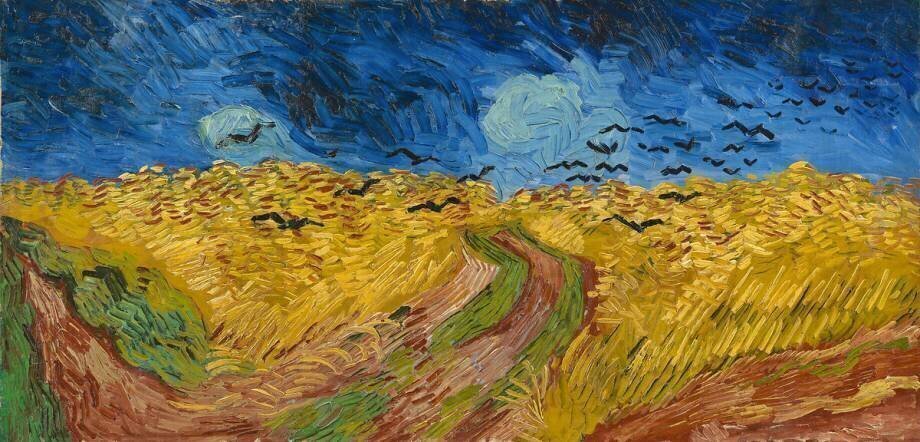
Wheatfield with Crows immediately strikes the viewer with its unusual and daring format: a double square panorama, measuring approximately 50.5 cm high by 103 cm wide. This horizontal dimension accentuates the immensity of the landscape and creates an almost dizzying sense of immersion for the viewer. Van Gogh exploits this format to deploy a dynamic and emotionally charged composition. The painter's touch is visibly energetic, nervous, almost feverish. He applies the oil paint in thick layers, with distinct strokes, sometimes compared to knife strokes, which give the surface a palpable and vibrant texture. There is no single dominant colour, but a striking juxtaposition of pure, contrasting hues: the intense orange-yellow of the ripe wheat contrasts violently with the deep, almost black blue of a heavy, stormy sky. The dirt paths introduce reddish, earthy tones, bordered by the darker green of the grass. This colour palette, applied without prior mixing, creates strong visual breaks and contributes to the overall atmosphere of tension and agitation that emanates from the canvas.
At the heart of van Gogh's Wheat Field with Crows: wheat, paths and crows
The central subject of the work is this vast field of wheat undulating under a threatening sky. The ripe wheat occupies most of the canvas, its golden ears seeming to vibrate under the effect of the wind and the artist's expressive touch. It is a nature that is both generous and disturbing. In the middle of this expanse of grain, three dirt roads cut into the landscape. They do not seem to lead anywhere in particular; the one in the centre stops abruptly or disappears into the indistinct horizon, while the other two diverge towards the edges of the canvas, suggesting uncertain directions, even dead ends. These paths fragment the unity of the field and introduce an element of spatial disorientation. Another crucial and eponymous element of the painting is a flock of black crows flying across the sky and seemingly swooping down on the field. Painted schematically, with simple, quick and energetic black strokes, they barely stand out against the dark blue of the sky, but their presence is massive, dynamic and threatening, adding a sombre and ominous note to the rural scene, which is completely devoid of any direct human presence.
Vincent van Gogh's Wheatfield with Crows: the symbolism of an exposed soul
The Wheatfield with Crows is almost unanimously interpreted as a projection of Van Gogh's tormented state of mind. Each element seems to be imbued with powerful symbolic meaning, reflecting the artist's anguish and distress. The sky, a deep blue turning to black, heavy with purple clouds, is not a serene summer sky but a threatening blanket, heralding a storm or imminent disaster. It weighs heavily on the landscape and expresses intense psychological oppression. The crows, traditionally associated with bad omens or death, reinforce this gloomy atmosphere. Their disorderly flight and black colour contrast with the bright yellow of the wheat, perhaps symbolising the dark thoughts invading the artist's mind. The three diverging paths are often seen as a metaphor for indecision, a lack of clear perspective, or even a feeling of being trapped with no way out. Van Gogh himself wrote about similar paintings that he was seeking to express ‘sadness, extreme loneliness’. The wheat field itself, although a symbol of life and fertility, is here agitated, almost tortured, as if nature were reflecting the painter's inner turmoil.
Wheatfield with Crows by Vincent van Gogh: a cry in art history
Although not the last painting Van Gogh ever painted, Wheatfield with Crows is often seen as an artistic testament, a work encapsulating the artist's final distress and expressive genius. Its impact on the perception of Van Gogh's final days has been considerable, fuelling the romantic myth of the cursed artist painting his own requiem, even if the historical reality is more nuanced. Beyond its biographical dimension, the work occupies a major place in art history. It is a striking example of post-impressionism, taking the subjective use of colour and brushwork to the extreme to express raw emotions. The painting's expressive power, bold composition and intense emotional charge have left a lasting impression and continue to fascinate. Its modernity lies in its ability to translate a complex inner landscape through an outer landscape. The work transcends simple representation to become a powerful visual and emotional experience, foreshadowing 20th-century expressionism and establishing Van Gogh as a pioneer of modern art, whose influence remains perceptible today.
This artwork is a painting from the modern period. It belongs to the post-impressionism style.
« Wheatfield with Crows » is kept at Van Gogh Museum, Amsterdam, The Netherlands.
Find the full description of Wheatfield with Crows by Vincent van Gogh on Wikipedia.
Other artworks by Vincent van Gogh
-
From39.8 €£33.8333.16 €£28.19
-
From41.08 €£34.9234.23 €£29.1
-
From40.53 €£34.4533.78 €£28.71
-
From40.04 €£34.0433.37 €£28.36
-
From40.53 €£34.4533.78 €£28.71
-
From41.27 €£35.0834.39 €£29.23
-
From40.08 €£34.0633.4 €£28.39
-
From39.32 €£33.4332.77 €£27.85
-
From40.78 €£34.6633.98 €£28.88
-
From33.06 €£28.127.55 €£23.42




Other artworks in the same colors
-
From39.06 €£33.232.55 €£27.67
-
From40.04 €£34.0433.37 €£28.36
-
From42.01 €£35.7135.01 €£29.75
-
From34.15 €£29.0228.46 €£24.19
-
From95.55 €£81.2279.63 €£67.68
-
From40.29 €£34.2433.57 €£28.54
-
From34.39 €£29.2328.66 €£24.36
-
From42.18 €£35.8635.15 €£29.88
-
From206.21 €£175.28171.84 €£146.06


Other similar artworks
-
From45.2 €£38.4237.67 €£32.02
-
From40.29 €£34.2433.57 €£28.54
-
From48.17 €£40.9540.14 €£34.12
-
From32.43 €£27.5627.02 €£22.97
-
From49.16 €£41.7940.97 €£34.82
-
From35.37 €£30.0729.48 €£25.06
-
From39.8 €£33.8333.16 €£28.19
-
From38.32 €£32.5731.94 €£27.14
-
From49.16 €£41.7940.97 €£34.82
-
From44.22 €£37.5936.85 €£31.32