
Customise
Your art print
The Apotheosis of Homer OF Jean-Auguste-Dominique Ingres
The Apotheosis of Homer
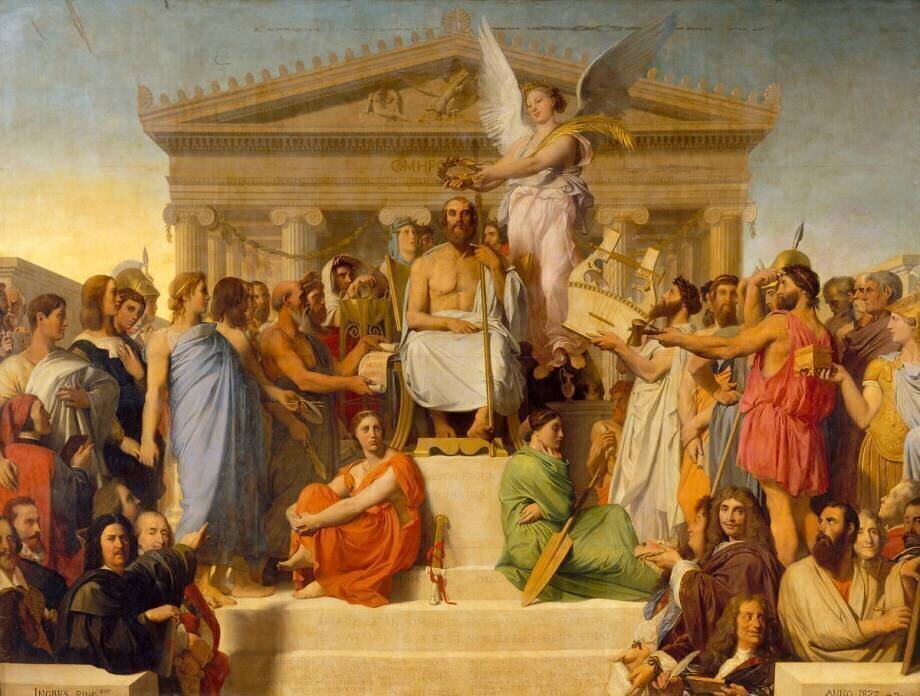
The imposing canvas by Jean-Auguste-Dominique Ingres, The Apotheosis of Homer, painted in 1827, takes pride of place in the Louvre Museum in Paris. With its spectacular dimensions of 386 cm in height and 512 cm in width, this work never fails to impress visitors, both through its size and the richness of its composition and the depth of its message. It remains one of the most eloquent testaments to the Neoclassical movement and to its creator’s ambition to follow in the footsteps of the great masters.
The Apotheosis of Homer by Jean-Auguste-Dominique Ingres: the genesis of a royal commission
The Apotheosis of Homer is the result of a prestigious state commission from King Charles X in 1826. Intended to adorn the ceiling of one of the rooms in the new Charles X Museum at the Louvre, this work forms part of a vast project to revive the tradition of major royal commissions. Jean-Auguste-Dominique Ingres, already awarded the Legion of Honour in 1824 and elected to the Academy of Fine Arts in 1825, was by then a respected figure in the French art world.
Building on his reputation as a portraitist and Neoclassical painter, he undertook this monumental task with palpable ambition, producing over two hundred preparatory studies to achieve the desired formal perfection. The artist, then living in Florence, drew his inspiration from Raphael’s frescoes, notably The School of Athens and The Parnassus in the Vatican, as well as from an engraving by Jean-Baptiste Huet. This Restoration period thus saw a clash between the proponents of Neoclassicism, of whom Ingres saw himself as the paragon, and the young upstarts of Romanticism, embodied by Eugène Delacroix. The creation of The Apotheosis of Homer thus stands as a manifesto of the classical tradition in the face of these new artistic outpourings.
The Apotheosis of Homer: a scene orchestrated with majesty
From the very first glance, The Apotheosis of Homer strikes the viewer with its rigorously balanced composition and its almost architectural symmetry. The scene unfolds around a pyramidal structure of which the poet Homer forms the undisputed summit. Before the façade of a classical Ionic temple, whose pediment bears his name, a multitude of illustrious figures gather, arranged with a mastery that testifies to Ingres’s genius for spatial organisation.
The colour palette, both fresh and light, typical of Neoclassicism, is enhanced by warm tones, dominated by ochres, golds and reds, lending the whole a timeless grandeur. The skilfully directed lighting sculpts the forms with remarkable precision, creating contrasts that accentuate the three-dimensionality of the figures and irresistibly draw the eye towards the central figure. Every detail, from the drapery of the garments to the expressions on the faces, is rendered with meticulous precision, underscoring Ingres’s quest for idealised beauty and absolute narrative clarity, even if a certain rigidity emerges from this impeccable composition.
Homer deified: an immortal icon of poetry
At the heart of this celestial assembly sits Homer, the guardian figure of epic poetry. Depicted as a sage, draped in an immaculate white toga, he embodies dignity and intellectual authority. His blindness, a traditional attribute, far from being a weakness, reinforces his aura as an inspired visionary, capable of perceiving eternal truths.
A winged Victory, the personification of Nike, messenger between the gods and men, leans gently to place a laurel wreath upon his head, a symbol of his literary triumph and immortality. His posture, solemn and noble, evokes that of Jupiter reigning over the Olympus of the arts and letters. At his feet, two allegorical female figures embody his seminal works: the Iliad, dressed in red and holding a sword, evokes the warlike fury of the siege of Troy, whilst the Odyssey, adorned in green and leaning on an oar, symbolises the perilous voyages of Ulysses. Not far away, the historian Herodotus, recognisable by his gesture, burns incense as a sign of veneration, completing this image of deification in progress.
The Apotheosis of Homer by Jean-Auguste-Dominique Ingres: a dialogue across the centuries
The Apotheosis of Homer does not merely celebrate the Greek poet; it weaves a vibrant dialogue across the ages, gathering around him a veritable pantheon of the great minds who have shaped the history of thought and creation. In this work, Ingres forcefully affirms the primacy of the literary and artistic tradition stemming from classical antiquity.
Thus, alongside Homer, stand illustrious figures from ancient Greece such as the tragedian Aeschylus, the painter Apelles, the lyric poet Pindar and the sculptor Phidias. The Roman world is also represented, but it is above all the modern era that pays homage to the father of the epic. We thus recognise Raphael, master of the High Renaissance and Ingres’s absolute model, conversing with Dante Alighieri, author of the Divine Comedy. The great names of 17th-century French classicism are also present: Racine, Boileau (who, as a translator of Longinus, is symbolically positioned as a bridge between the Ancients and the Moderns), Molière, Corneille, La Fontaine and the painter Nicolas Poussin. Each, by their presence, bears witness to Western culture’s inextinguishable debt to the Homeric heritage, within a universalist vision of knowledge and harmony.
Influence and legacy of The Apotheosis of Homer by Jean-Auguste-Dominique Ingres
The presentation of The Apotheosis of Homer in 1827 spectacularly consolidated the position of Jean-Auguste-Dominique Ingres as the leading figure of the Neoclassical school, in direct opposition to the rising Romanticism embodied by Eugène Delacroix, whose The Death of Sardanapalus was exhibited that same year. Whilst The Vow of Louis XIII (1824) had already marked an important milestone in his official recognition, The Apotheosis of Homer became a symbol of his artistic doctrine.
Following this success, Ingres opened an influential studio in Paris, where he trained numerous pupils in the principles of pure drawing and the admiration of the old masters. The work itself became a model of its kind, emblematic of the grand allegorical compositions that adorned cultural institutions in the 19th century, celebrating traditions and knowledge. Although its rigidity and academicism were criticised, with the work sometimes described as a ‘beautiful ceiling that fails to rise’, the influence of the work proved enduring. Paradoxically, certain aspects of Ingres’s style, such as his impeccable illusionism and a certain abstraction of forms, foreshadowed later sensibilities and inspired artists as diverse as the Symbolists and the Surrealists, testifying to the complexity and richness of his artistic legacy.
This artwork is a painting from the classical period. It belongs to the neoclassicism style.
« The Apotheosis of Homer » is kept at Louvre, Paris, France.
Find the full description of The Apotheosis of Homer by Jean-Auguste-Dominique Ingres on Wikipedia.
Other artworks by Jean-Auguste-Dominique Ingres
-
From89.01 €£75.6674.18 €£63.05
-
From67.26 €£57.1756.05 €£47.64
-
From99.97 €£84.9883.31 €£70.82
-
From70.58 €£59.9958.82 €£49.99
-
From80.88 €£68.7467.4 €£57.29
-
From72.58 €£61.760.49 €£51.41
-
From81.21 €£69.0367.67 €£57.52
-
From71.97 €£61.1859.98 €£50.98
-
From57.13 €£48.5647.61 €£40.47
-
From64.6 €£54.9153.83 €£45.76


Other artworks in the same colors
-
From70.41 €£59.8558.68 €£49.88
-
From45.34 €£38.5437.79 €£32.12
-
From70.25 €£59.7158.54 €£49.76
-
From47.54 €£40.4139.62 €£33.68
-
From38.89 €£33.0632.41 €£27.55


Other similar artworks
-
From62.11 €£52.7951.76 €£43.99
-
From68.25 €£58.0256.88 €£48.35
-
From68.75 €£58.4457.29 €£48.7
-
From77.06 €£65.564.21 €£54.58
-
From81.04 €£68.8967.54 €£57.41
-
From69.92 €£59.4358.26 €£49.52
-
From71.91 €£61.1259.92 €£50.94
-
From65.27 €£55.4854.39 €£46.23
-
From86.36 €£73.471.96 €£61.17