


Customise
Your art print
The Valpinçon Bather OF Jean-Auguste-Dominique Ingres
The Valpinçon Bather
The creation of La Baigneuse Valpinçon by Jean-Auguste-Dominique Ingres
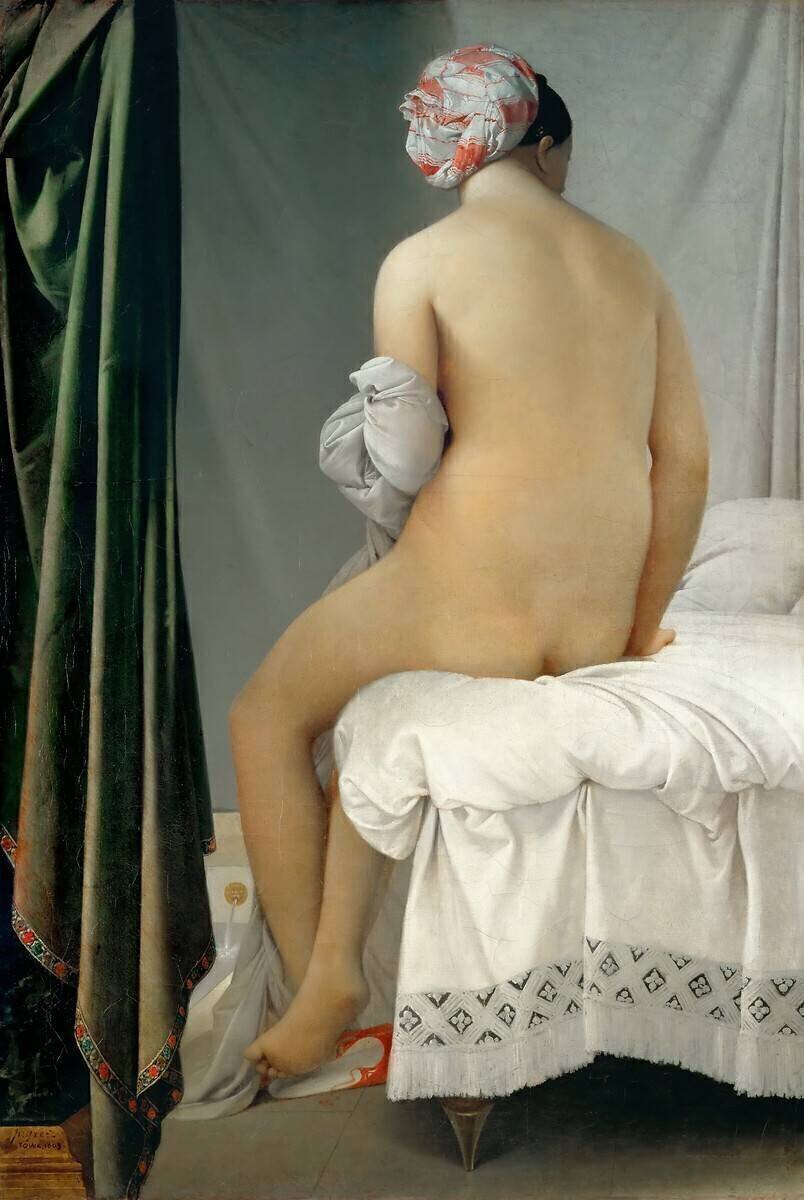
Set against a backdrop of profound artistic and social upheaval, the early 19th century saw the emergence of an artist who would leave a lasting mark on the history of painting: Jean-Auguste-Dominique Ingres. It was against this backdrop, in 1808, whilst he was a resident at the Académie de France in Rome, that La Baigneuse Valpinçon came into being. Ingres, a fervent admirer of Raphael and the Renaissance masters, was part of the Neoclassical movement, advocating a return to the purity of line and the ideal of classical beauty, in reaction to the excesses of the Rococo. However, this early work, originally titled Seated Woman and sent to Paris to demonstrate his progress, already reveals a personal sensibility that transcends strict academic conventions. Far from being a mere study, the painting bears witness to a quest for formal perfection and a unique approach to the female nude. The name La Baigneuse Valpinçon was attributed to it much later, in reference to one of its 19th-century owners, Paul Valpinçon, highlighting the collectors’ attachment to this iconic figure. Carefully preserved at the Louvre Museum in Paris, this oil on canvas, with its imposing dimensions of 146 cm in height and 97.5 cm in width, continues to fascinate with its timeless grace and the technical mastery of its creator, who laid the foundations here for a style that would influence generations of artists.
The Valpinçon Bather: an exploration of Ingres’s composition
The Valpinçon Bather immediately draws us into an atmosphere ofintimacy and tranquillity. The composition, characterised by a deliberate restraint, is dominated by the monumental figure of the bather, who occupies the majority of the pictorial space. Ingres chooses to present her to us from behind, a bold choice that focuses attention on the sinuous, sculptural lines of her body. The artist employs a restricted colour palette yet one rich in nuances: the luminous flesh tones of the skin contrast with the deep greens of the curtain framing the scene on the left and the immaculate white of the bed linen and the turban adorning the young woman’s head. The soft, diffused light gently caresses the bather’s shoulder and back, shaping the forms with exquisite subtlety and creating light shadows that accentuate the sensuality of the figures. The texture of the fabrics is rendered with astonishing virtuosity: the velvety texture of the curtain, the fine drape of the bed, the delicate weave of the turban—all combine to create a tactile sensation. The background, deliberately bare, highlights the clarity of the body and the richness of the textiles, reinforcing this sense of a moment suspended in time, outside of time. Every element is designed to contribute to a visual harmony where the line, so dear to Ingres, reigns supreme.
Ingres’s La Baigneuse Valpinçon: a portrait of captured intimacy
The central subject of the work, this anonymous bather, is an enigma presented to the viewer. By choosing to depict her from behind, Ingres conceals her face, or at least reveals only a tiny part of it, thus preserving her mystery and inviting the viewer to a more introspective contemplation. The emphasis is placed on the architecture of the female body: the delicate nape of the neck, the curve of the shoulders, the arch of the back and the line of the hips are rendered with anatomical precision which, whilst faithful in appearance, does not hesitate to be elongated and idealised to achieve a superior formal beauty. Her left arm bent, with her hand disappearing beneath her body, and the slight turn of her head to the right suggest a peaceful surrender, a serene introspection. The turban encircling her hair, adorned with a delicate pattern, adds a touch of discreet exoticism, an oriental touch that would frequently recur in Ingres’s work. Her skin, of a milky pallor, seems almost to radiate its own light, capturing and reflecting the light sources with infinite softness. More than just a model, under Ingres’s brush this woman becomes an embodiment of grace and linear purity, an ideal of beauty where sensuality is discreet and elegant, far from any provocation.
The Valpinçon Bather by Jean-Auguste-Dominique Ingres: symbols and subtle sensuality
Whilst La Baigneuse Valpinçon does not lend itself to a complex, codified symbolic interpretation like certain allegorical works, it is nonetheless imbued with profound meanings and sensations. Water, although visually absent save for the context of bathing suggested by the title and the towel, is implicitly present, evoking purification, renewal, but also a form of fluid sensuality. The green curtain draped heavily on the left can be interpreted as a boundary between the intimate space of the bather and the outside world, a threshold to a place of secrecy and tranquillity. The immaculate whiteness of the linen and the turban connotes purity and innocence, yet contrasts subtly with the body’s exposed nudity, creating a delicate tension between modesty and abandon. The suggested Orientalism of the turban, though discreet, opens a window onto an imaginary of the elsewhere, a theme then in vogue that allowed for the exploration of forms of sensuality less constrained by Western codes. For Ingres, however, the primary symbolism lies in the quest for ideal beauty through the perfection of line and form. The sensuality of the work is not so much narrative as intrinsically linked to the caress of the brush on the canvas, to the fluidity of the contours and the delicacy of the modelling.
The Valpinçon Bather, a milestone in his oeuvre and a mirror of an era
Upon its creation, La Baigneuse Valpinçon did not immediately receive the acclaim it enjoys today. Judged by some as cold or lacking in narrative expression, it baffled some critics attached to more demonstrative academic canons. Nevertheless, this work proved crucial in Ingres’s artistic trajectory. It marked a fundamental stage in his exploration of the female nude, a theme he would continually revisit and perfect throughout his career, as evidenced by his famous odalisques or the monumental Bain Turc. The Valpinçon Bather established his reputation as a master of line and a meticulous observer of the human form, capable of sublimating reality to achieve a timeless ideal of beauty. Beyond its impact on Ingres’s career, the painting exerted a considerable influence on art in general. Artists such as Edgar Degas and, later, Pablo Picasso admired and drew inspiration from this iconic figure, recognising Ingres as a pioneer in his approach to abstracting and stylising the body. It remains an essential reference in the history of the artistic nude, illustrating a fascinating tension between classical tradition—through its quest for perfection and its smooth rendering—and emerging modernity—through its compositional boldness and the subtle sensuality it exudes. It thus embodies a pivotal moment when formal beauty began to assert itself as a subject in its own right.
This artwork is a painting from the classical period. It belongs to the neoclassicism style.
« The Valpinçon Bather » is kept at Louvre, Paris, France.
Find the full description of The Valpinçon Bather by Jean-Auguste-Dominique Ingres on Wikipedia.
Other artworks by Jean-Auguste-Dominique Ingres
-
From89.01 €£75.6674.18 €£63.05
-
From67.26 €£57.1756.05 €£47.64
-
From99.97 €£84.9883.31 €£70.82
-
From70.58 €£59.9958.82 €£49.99
-
From80.88 €£68.7467.4 €£57.29
-
From81.21 €£69.0367.67 €£57.52
-
From71.97 €£61.1859.98 €£50.98
-
From57.13 €£48.5647.61 €£40.47
-
From64.6 €£54.9153.83 €£45.76
-
From38.4 €£32.6432 €£27.2


Other artworks in the same colors
-
From68.25 €£58.0256.88 €£48.35
-
From61.94 €£52.6551.62 €£43.88
-
From56.8 €£48.2847.33 €£40.23
-
From80.38 €£68.3266.98 €£56.93
-
From49.57 €£42.1341.31 €£35.11
-
From40.22 €£34.1933.52 €£28.49
-
From38.76 €£32.9532.3 €£27.46
-
From40.14 €£34.1233.45 €£28.43
-
From67.09 €£57.0355.91 €£47.52


Other similar artworks
-
From64.6 €£54.9153.83 €£45.76
-
From45.1 €£38.3437.58 €£31.95
-
From68.92 €£58.5857.43 €£48.82
-
From69.82 €£59.3558.19 €£49.46
-
From76.23 €£64.7963.52 €£53.99
-
From89.01 €£75.6674.18 €£63.05